EDM - Electrical discharge machine

Thread Starter

shortbus

Joined Sep 30, 2009
10,050
I understand the learning curve believe me.:) I started this project back in the early 1990s. The head/ram was easy I had the back round for that.

And I disagree with you on motors. Are you also using a lead screw? Mine with a stepper does. And I can move my electrode 0.0005 inches per step. And that's with using a 4mm lead ball screw, so it can be done. The up or down is handled with the output from a voltage/window comparator monitoring the gap voltage. This is then sent to the stepper driver module. Think I paid something like $10 for it off of Ebay, commonly used for DIY CNC machines or 3D printers.
I just know that when you instantly reverse a brush motor without letting it come to a stop there are sparks and those are from the brushes and commutator segments burning.

But to each his own, and you have yours working where I don't. Just trying to understand how other approach doing this.
 

roong

Joined Feb 11, 2017
59
Hi Shortbus, that knowledge concerning "problem when brush motor instantly reverse direction" and that "modern EDM machine using stepper motor" are new to me and everyone should be concern about shorter life of brush itself. I thought that modern EDM were using servo motor.
Actualy, my understanding a servo motor is pretty much a stepper motor with pulse generator locate at the motor shaft to generate feedback pulse signel, am I right?
Voltage comparator is also a kind op-amp. You can drop in a comparator to replace an op-amp in his controller circuit and nothing will be different(once legs are matched).
Edit, ShortBus is right a comparator is faster than an opamp.

Hi, Edmguru I start to like your idea of using relay...the fact that it might be cheaper than using good troggle switch (I wouldn't use a China made one, it perhaps brass ,if you r lucky, and zinc plate instead of copper and silveor or tin plate ).
I have little knowledge with brush motor but your controller circuit should be fine. May be you need some filter to average input voltage or to catch only peak voltage before doing measurment. I am not sure if I understand your problem.
I don't think opto-coupler is a good idea. It only there to solve one problem that is if you want to isolate two side of circuit, I' ve already thrown away from my sensing circuit...and it has not have anything lesser than having had ones. Opto operates at lower frequency(20k ~) and shorter life than transistor.
Now I think, I understand how they define current. It should be at of flat region just after peak during On time(refer to Paco diagram). My transformer is 70Vrms 220W..open circuit DC voltage will be 100V (3.1Amps at 70V) ..... It only give 220W when you set gap voltage to 70V. But you have to subtract loss in resistor. I tried to set gap voltage to 85v, performance was drop drasticly, because 70Vac transformer can not deliver that amount of current at 85V (unless you using 85Vac 220W transformer). Now I start to believe that having a many steps transformer is better than having a single high voltage. And then you just choose RMS value slightly above your required gap voltage then you use resister to limit current. This way you can use less value resistor(s), thus lesser energy waste via the resistor(s).
 
Last edited:

Thread Starter

shortbus

Joined Sep 30, 2009
10,050
Hi Shortbus, that knowledge concerning "problem when brush motor instantly reverse direction" and that "modern EDM machine using stepper motor" are new to me and everyone should be concern about shorter life of brush itself. I thought that modern EDM were using servo motor.
Any brushed motor will do this, the sparking on reversal. Haven't you seen warnings when using brushed motors and Hbridges to make sure the motor has stopped rotating before reversing? The sparking is caused by the current still trying to flow due to the inductance of the motor coils. But it doesn't even have to be reversed to spark. If you have a power tool with brushes look into the cooling slots of the motor and see the sparking even as it runs in one direction.

Your correct that a full size EDM uses a servo motor, but a "hole shooter EDM", a small EDM used to make holes for putting the wire into a part for making inside cuts with WEDM uses a stepper because the power of a servo isn't necessary. This is more like a home built EDM one that will not be using electrodes that wheigh a lot.

Voltage comparator is also a kind op-amp. You can drop in a comparator to replace an op-amp in his controller circuit and nothing will be different(once legs are matched).
I know they, opamps can be used but a comparator chip is much better at it. It will react faster than the opamp. because that is what it is meant to do and is only used for that job, not as an opamp.
 

pmd34

Joined Feb 22, 2014
529
Hi shortbus, i'm rather new to this thread. I'm very interested in EDM and your design sounded appealing. But I wonder if you could just flesh out a bit what your feedback part of the circuit with comparators is doing. What is actually needed to control the EDM machine, what voltages are looked for, when does the electrode move etc. I tired to follow from the beginning but the thread sort of fell apart a bit!
 

Thread Starter

shortbus

Joined Sep 30, 2009
10,050
It's all in here If I find some time I'll try to figure out what post to start reading from. There is a lot of family stuff going on right now so don't get much forum time. I'm not an electrical genius but knew what needs to be done and it took a wile for me to explain to the guys that know electronics so keep reading and it is in here, honest.
 

roong

Joined Feb 11, 2017
59
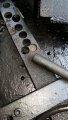
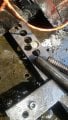
This hole I just spend 57 minute. The big improvements I have had from last time. Last time I use 72Vac(220w) transformer and I adjust set point around 85Vdc. This time I bought a 25Vac (80w)transformer and serie to the 72Vac. So my voltage increase to 97Vrms then I used set piont around 97V(this is the point that electrode is regulate up and down by stepper motor). All other condition just are about the same.
 

Attachments

Thread Starter

shortbus

Joined Sep 30, 2009
10,050
Hi Roong, the new voltage is close to what most of the machines I ran used around 100 volts.

Are you flushing through the electrode? Doing that will or should shorten your burn time and cause less retracting of the electrode during the burn. A small hole through the length of the electrode with dielectric flowing through it is a big help in burning. It keeps the dielectric flushing the debris out of the actual burn point.
 

roong

Joined Feb 11, 2017
59
Are you flushing through the electrode? No, I didnt, just submerged sparked gap under diesel fluid...flush through the side. I forgot to tell that last time I had 220u capacitor at another end of the gap, Mosfet in the middle. This time I reduce it to 22u. Lound bang noise during spark is less. It sounds more like industrial machine.
At the moment, I using simple electrode, dia12mm, Because It is easy to obtain. You just turn its end flat then put it to spark. So I can adjust parameters and compare the result of different settings. I am not really interested in how fast I can drill a file.
 
Last edited:

Thread Starter

shortbus

Joined Sep 30, 2009
10,050
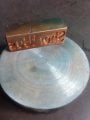
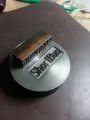
Roong, you have just blown my mind. I have never had anyone make any kind of tribute to my name. Looks like you have overcome your problems with your machine. The burn looks really good.

Would you be willing to explain what changes you made to get to this new point? Again good job!
 

roong

Joined Feb 11, 2017
59
No that not so good it should have been better than that. I will tell you why. I was experiment with graphite until I didnt have to aware the polarity of electrode...with graphite, it will cut at any polarity.
I use straight polarity and spent three hour this moning try to cut this one it only cut like 0.3mm depth.....and electrode erode at the corner. This is bus bar copper should be more durable than EDM copper.....during which time short circuits occur all the time, so frustrated....I spent two more hours try to figure it out... then finally switch to negative polarity.. it cut like charm. I didnt count the time but should be around fifty minute to do this job....
I didnt do much to the circuit. Except my generator now can run upto 80% duty cycle (used to be 45% max). I put an inverter circuit inbetween SG3525 and an emitter follower circuit. That one I used 9k Hz with 60% dutycycle. The surface should be better if it were at 25k am I right.
 

perfo

Joined Aug 15, 2012
10
Any updates ? Please don’t leave it here guys…..

I've read the thirteen pages with avid interest. I was really hoping to get to the end and Shortbus roong or EDMGuru would be posting the final does it all perfect design.
Though I am a hardware / software fellow the idea of getting EMDGurus results with off the shelf bits is awfully tempting.
I want to make an EDM to be able to make bits for trails on a DIY water jet cutter.
I hope you don't mind me asking a really basic question. Why use the caps and not go direct from the transformer? The max energy in the spark is going to be set by the supply only I appreciate you can realise that without caps if you are on 100% on time. Maybe a bigger supply and 80% on time will give the same energy as a smaller supply and charged caps.
Reason I'm interested is due to knowing nothing about EDM at all I hoped to use a standard site transformer (110VAc 32 amps) and just rectify it for my pulse supply. I know I'm missing something here.
 

roong

Joined Feb 11, 2017
59
110vac is about right to begin with. If you use kerosine or EDM oil it might need it to be lower and do so if you also want surface quality.
I dont know much about relaxation EDM, cause mine is pluse EDM. Someone believe that it doesnt need capacitor, but I always put a small cap (0.1u)there, dont know why, but I will try every other when I have time.
For pulse EDM, you cannot use 100 % on time because you need tuberlance of pulse to remove molten metal.
It is quite difficult to make the machine work, because you have to find perfect reason to put any wire here or there.
And if it doesnt work well. You have to find what is the problem....solve it one by one. My two latest problems took me seven months to figure out......and I intend to update this site within next two months.
Now I find out that my cheap graphite rod from ebay doesnt work well. So doesnt graphite rod use in gouging welding seam. It sparks well for shallow hole but not so with deeper well, because when soak it in diesel for a long time, it trend to chip when spark and the small chip trend to drop into the spark hole and conduct the current and ruin the sparking process. It make bright red heat around spark area but no micro-explosion. I need to remake holders to grab copper tube instead of graphite but this will take time. Sometime you went into wrong direction and months was wasted.
...3 May 2020
Edit; I have fixed my problem, It is not my cheap graphite that make "arcing". It was my pulse pattern. It was not square wave, not square enough. This is new knowledge to me. For pulse EDM, It is important that once Mosfets turn on maximum energy must transfer to the spark gap immediately, if not gas explosion does not occur. This explosion creates insulation layer to protect further conduction between electrode and work piece, ie. save electric energy for next explosion. So it is very important that we must create this gas explosion in early stage of spark. Now my circuit (using SG3524) can create square pulse with half a micro second raise time, Not being so satisfy but I dont think I can do better than this. I will have more pictures soon.
 
Last edited:

EdmGuru

Joined Aug 21, 2018
47
Hi perfo,
I’m glad you’re interested in EDM it’s an interesting machining concept which yields various results depending on the transformer output voltage, actual working spark voltage (plasma level), electrode polarity, waveform frequency, electrode and work piece material and probably the most overlooked problem is the debris removal or flush of the working area which effects surface finish and electrode wear etc.
Okay my update so far is that I’ve been trying to redesign my machine, going down the using a stepper motor to drive the head route, with mixed results.
I’ve got the machine to work using a stepper motor and a comparator to measure the output voltage etc but it doesn’t have the same ‘feel’ or ‘reaction speed’ when actually eroding than using a dc motor and controller which has a more of a ‘soft start/ stop’ or ‘acceleration/ deceleration’ effect which seems to perform better as you can raise or lower the electrode at different speeds especially when setting up or clocking up your work piece etc.
Any way I’ve also got hold of a Sieg mini milling machine cheap which I’m going to convert to a spark erosion machine/ milling machine (I’ve already altered the gearbox and motor unit for quick removal to aid quick change over to EDM) and will at some stage rebuild the generator, taking it up to a 30 Amps output unit.
I’ve also been working on the machine schematics and have nearly completed the technical specs for different electrode polarity/ material into different materials complete with wear rates, stock removal rates, surface finishes and spark gaps etc.
To answer your questions the difference between a pulse EDM and an RC type is that with the pulse type you have lower and more control over electrode wear etc than with the RC type however the RC type will remove material faster as it’s output is a ‘mixed’ frequency in the MHz range (basic pulse EDM work between 1 to 150 KHz) but this will give you a high electrode wear rate (also should give a high surface finish if Amps are kept low) which if you just want to erode holes is probably better for you.
I would be careful if you’re going to use a site transformer as when the voltage is rectified it will be about 155 volts dc which is dangerous if touched accidentally.
Hi Roong,
I only use a large value electrolytic capacitor before the pulse stage i.e. before the power transistors or mosfets as any capacitance added after the switching stage will alter your output waveform, changing it to a relaxation waveform (sine wave) which will alter your electrode wear performance and surface finish.
Also it sounds like you’re getting an ‘arc’ (localised overheating) using graphite as an electrode I would use copper tube if it’s only holes your after producing or flush through your graphite electrode (at low pressure). On fast hole spark eroders they use a revolving drill chuck which has a various size internal seal collet type setup for flushing for various diameter electrode tubes (usually brass). It maybe worth while having a look online at their setup.
Cheers.
 
Last edited:

Thread Starter

shortbus

Joined Sep 30, 2009
10,050
Why use the caps and not go direct from the transformer?
The reason is, that to the transformer it would look like a short circuit. Another reason is so each discharge is similar in size.

While Roong has his working, mine is stalled again. I've been at this since dirt was still a mountain, and always get waylaid in the build. The mechanical parts have been done since the 1990's but the electronics is a hard thing for me. I don't quite understand how to figure what resistor values to use. So I went back to some other mechanical projects that have been sitting for a long time.
 

Thread Starter

shortbus

Joined Sep 30, 2009
10,050
Hi Shortbus,
If I can be of help in any way with resistor values or anything let me know.
Cheers.
I'd really appreciate that. I'm kind of in the middle of a couple of projects right now though. Making one good garden tractor out of two so so ones(it's a locally made one that isn't known much outside the area, a Speedex. They were made by 2 brothers that then had a falling out, the Pond brothers. After the falling out one of the brothers then started making a better known brand Wheel Horse).

The other project is one I thought of doing for years, making a garden tractor size crawler/bulldozer. The starting point for it is a 1990's era Cub Cadet. That one has been stalled because of the tracks, then I figured out a way of making them pretty easy.
 
Top