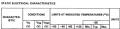
However, if I'm understanding the datasheet correctly, the 40107s would require a pull-up resistor on each output and a diode parallel to each parallel coil set coil in each relay. So, 64 2 additional components. Is that correct?
Just to remove any ambiguity, that means a diode between pin 3 (cathode) and pin 8 (anode) and another between pin 5 (cathode) and pin 8 (anode). Is that correct?
Forgive my noobness. I'm still learning the nomenclature. "V+" in this instance is the same as "VDD."
The turn off is still not instant and so there will be no generation of any spike due to the instant cutoff of coil current, because the current decays slowly as the capacitor charges.
The turn off is still not instant and so there will be no generation of any spike due to the instant cutoff of coil current, because the current decays slowly as the capacitor charges.
That may be true for a single MOSFET, but not necessarily for a CD4000B series device, which has a much higher gain due to having at least two stages from input to output.
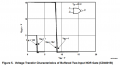
Below is the I/O transfer function for 5V and 15V Vdd from an RCA app report
Note that it takes a only a few hundred mV change on the input for the output to go from Vcc to 0V.
On that basis I think the output could transition fast enough to cause a transient spike from the relay coil inductance, even with the slow input RC fall time.
A couple added diodes is cheap insurance against a possible damaging spike.
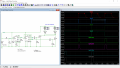
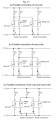
Here is a simulation of Sghioto's circuit.
I added the diodes because they are recommended by the manufacturer because the coils are wound on the same core.
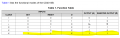
Also, be aware there is a state where both Q and Qbar are high at the same time.
Those diodes do not suppress the inductive transient, which generates a positive spike at the MOSFET's drain.
You need only two diodes, one connected from each MOSFET drain (diode anode) to VDD.

 Facebook
 Google
 GitHub
 Linkedin