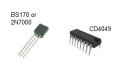
The reason I suggest the CD 4049 is that it requires no additional components, meaning NO additional assembly and no parts standing out/up on the PCB. And, if it does not have quite enough drive, I have seen a second IC stacked directly on top of the socketed one. Soldered on or not.
As mentioned previously, discharge path for the caps. It does work without them but my inexperience suggests that not having them would be unwise. I'd then be relying upon leakage for them to drain, no?
Then I ask where is the sudden cutoff of the coil current as the capacitors charge relatively slowly??In at least one latching relay scheme, the relay coils acted like a transformer, and in this case I am thinking that the diode on one consumes power when the other is being activated.
So the first thing I would try is see how it works without the resistors and the diodes. You might possibly still need the transistor driver, but maybe not.
I have experimented without the resistors (and with various capacitors up to and including 220uF). It didn't work.
With regard to the diodes, my understanding -- which may be incorrect -- is that they're there to protect against potential spikes across the inductors. "Flyback."
This, and the debate regarding their proper usage in this situation with @crutschow, is intriguing. Could I trouble you both for a diagram or illustration of how each of you would wire up one or more 4049s up for this purpose? I've zero experience with them and have none on hand (I do have some 4009s!) but cost/space/performance/complexity are all factors in consideration. Thus the 4049 suggestion is definitely worth trying.
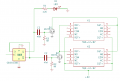
Rather that run the entire relay current through the differentiating capacitor, a better way is to have the R-C differentiator between the ff output and the driver transistor. This will reduce the required ff output current by 90%. It also will drive the relay coils with a more "square" waveform, one with a faster turn-off slope. This will reduce or eliminate contact chatter.
Also, this will reduce the size of the differentiating capacitor.
It's kind-of unrelated but, I bought my first oscilloscope a few weeks ago primarily because I wanted to see exactly what was coming out of those caps. I was expecting (and hoping for) a square-ish pulse but was surprised and sort-of disappointed to see a fast rise followed by a gentle slope back down.
Assuming a 2n3904, could you recommend starting values for the R & C in this configuration?
To be fair to @crutschow I hinted at a "transistor buffer" in the OP but, lacking experience, didn't name it as such. And again, lacking experience, it seemed like the most obvious solution at the time.
If there are better solutions, I'd be SUPER interested in seeing them!
Thanks all. I sincerely appreciate your time here.
Better solution would be post 21.
Don't have time currently to draw up the schematic if you're not able to visualize it.
Was that supposed to be a 470 ohm resistor?
As mentioned previously, discharge path for the caps. It does work without them but my inexperience suggests that not having them would be unwise. I'd then be relying upon leakage for them to drain, no?
I don't understand this question. If it's important, could you rephrase/explain in clearer terms?
I have experimented without the resistors (and with various capacitors up to and including 220uF). It didn't work.
With regard to the diodes, my understanding -- which may be incorrect -- is that they're there to protect against potential spikes across the inductors. "Flyback."
This, and the debate regarding their proper usage in this situation with @crutschow, is intriguing. Could I trouble you both for a diagram or illustration of how each of you would wire up one or more 4049s up for this purpose? I've zero experience with them and have none on hand (I do have some 4009s!) but cost/space/performance/complexity are all factors in consideration. Thus the 4049 suggestion is definitely worth trying.
It's kind-of unrelated but, I bought my first oscilloscope a few weeks ago primarily because I wanted to see exactly what was coming out of those caps. I was expecting (and hoping for) a square-ish pulse but was surprised and sort-of disappointed to see a fast rise followed by a gentle slope back down.
Assuming a 2n3904, could you recommend starting values for the R & C in this configuration?
To be fair to @crutschow I hinted at a "transistor buffer" in the OP but, lacking experience, didn't name it as such. And again, lacking experience, it seemed like the most obvious solution at the time.
If there are better solutions, I'd be SUPER interested in seeing them!
Thanks all. I sincerely appreciate your time here.
That "gentle slope back down is why there is no "spike" that the diodes are supposed to suppress. It is the INSTANT stop of the current when a switch opens the circuit that would produce the spike.
Presumably? That's the weird thing about it. Since I've been playing with this circuit, that resistor has ALWAYS been, in reality, 390 ohm. I've really no idea where "470k" came from. :shrug:
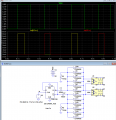
OK, now try it with only three gates driving each relay coil. Also, thanks fro remembering that all CMOS inputs must not be floating, which would happen if R1 and R2 were not present. BUT there might be a problem with that high a resistance. also, consider the RC time constant. I suggest 68K or 100K.
The high resistance is part of a differentiating pulse former, and sets the pulse width that the relay coils see. It is similar to #28, but with approx. twice the time constant. With R1 and R2 equal to 68K, the relay coil pulse would be approx. 7 milliseconds. That's too short for reliable operation.
I can see a possible problem with the schematic in post #30. When an output of the 4013 goes from high to low the right hand side of the capacitor will try to go to about -9 volts. There is a protection zener diode on the input but I can't find the current rating of this diode. It might be worth adding a resistor in series with the capacitor to limit the current through this protection diode or adding an extra protection diode on the inputs of the 4049s.
Les.
When an output of the 4013 goes from high to low the right hand side of the capacitor will try to go to about -9 volts. There is a protection zener diode on the input but I can't find the current rating of this diode.
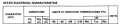
The input current for the CD4049 is 0.1µA max. and 1e-5 µA nominal (below) at or below normal room ambient, so a 1 MΩ pulldown resistor for the 6 inputs should not be a problem:
But 100kΩ and 1µF could be used if concerned about high temperature operation.
@crutschow, thank you for the diagram! It's very much appreciated. I'm going to order some 4049s and give this method a whirl, too.
Earlier in the thread, in reference to the transistor buffer idea, you mentioned that you didn't "necessarily think it's the best solution." I'm curious to learn what you believe the "best" solution is. The mosfets? The 4049s? Something else?
@sghioto appears to leans towards mosfets for performance, size, and layout flexibility. @MisterBill2 appears to lean towards the 4049s for their simplicity, ease of assembly, and the reduced part count.
I have no particular preference, as it mostly is determined by which layout has the advantage.
If it's a hand-wired perf board, than the transistor approach is likely easier, since it has fewer connections.
I have no particular preference, as it mostly is determined by which layout has the advantage.
If it's a hand-wired perf board, than the transistor approach is likely easier, since it has fewer connections.

 Facebook
 Google
 GitHub
 Linkedin