Driving TWO dual-coil latching relays from a D-Type FF?

Thread Starter

Schluppy

Joined Jun 7, 2024
29
Hey all, noob here.

I'm using a TI CD4013BE to toggle a Panasonic TQ2-L2-9V.

Q pulses the "set" coil via a series cap, !Q pulses the "reset" coil via another series cap.

This works great for one relay. For two relays... not so much.

Given the 9V supply, wiring the relays in series appears to be a non-starter. I would require twice the voltage, correct?

So, wiring the relays in parallel is the answer but it doesn't appear that I have enough current coming out of the FF for that.

This is where it gets weird...

When I break the circuit and insert the multimeter (Fluke 107) between Q and R1 it reads nothing. If I run the negative lead to ground instead, it reads 22mA.

I'm not sure what I'm doing wrong or misunderstanding there but I've been operating under the assumption that I actually do have 22mA available. Which, coincidentally, is right around the rated operating current of the relay coils (22.2 mA, +/-10%, at 9V and 20°).

So, what do I have to do to drive a second relay? What would you do to drive a second relay?

More transistors? Maybe another 2n3904 before R2 and another before R3? Probably with a larger series capacitor after each?

Am I on the right track? Or completely off the rails?

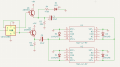
Here's a partial schematic illustrating where things currently stand. Any and all insights would be appreciated.
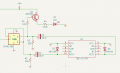
20241121150151.AAC.png
 

crutschow

Joined Mar 14, 2008
38,316
If I run the negative lead to ground instead, it reads 22mA.
That's the short circuit current from the FF (the ammeter looks like a near short).
The FF can't deliver that much current at 9V output.

So you need a buffer.
Connect a transistor configured as you show Q1 from each FF output (you don't need the R1 base resistor as an emitter follower only takes the base current it needs) with the emitter going to the 22k resistors and the capacitors.
If necessary, you may need to increase the capacitor value.

You could use Q1 to do double-duty to drive both the LED resistor plus R3 and C3 (again you don't need R1).
 

Thread Starter

Schluppy

Joined Jun 7, 2024
29
So you need a buffer.
Connect a transistor configured as you show Q1 from each FF output (you don't need the R1 base resistor as an emitter follower only takes the base current it needs) with the emitter going to the 22k resistors and the capacitors.
If necessary, you may need to increase the capacitor value.

You could use Q1 to do double-duty to drive both the LED resistor plus R3 and C3 (again you don't need R1).
Forgive the hastily modified schematic. Have I interpreted your suggestions correctly?

20241121150151.AAC.002.png
 

crutschow

Joined Mar 14, 2008
38,316
Have I interpreted your suggestions correctly?
Yes, appears to.

You LED will be a little dim with only about 20µA through it.
R4 should be closer to 1kΩ or so.

Also the pulse time may be a little short to latch the relays when you add the other relay.
May want to go to at least 100µF.
 
Last edited:

MisterBill2

Joined Jan 23, 2018
27,159
First, what is the purpose of the 22K resistors, R2 and R3? They are reducing the current available to drive the relays. Then I ask where is the sudden cutoff of the coil current as the capacitors charge relatively slowly??In at least one latching relay scheme, the relay coils acted like a transformer, and in this case I am thinking that the diode on one consumes power when the other is being activated.
So the first thing I would try is see how it works without the resistors and the diodes. You might possibly still need the transistor driver, but maybe not.
AND, if you would rather not deal with the transistors, use a CD4049 hex inverter to pull low the negative coil terminal with the positive to V+. Put three inverters in parallel and you will have plenty of drive. The CD4049 can sink much more than it can source. You still need the capacitors but you do not need the diodes.
 

crutschow

Joined Mar 14, 2008
38,316
Put three inverters in parallel and you will have plenty of drive
Not worst-case.
The minimum CD4049 sink current at Vcc=10V is 8mA, and each relay coil takes 22.2mA @ 9V.

You could use two CD4049s with the 6 outputs in parallel for each set of coils, which should then be more than sufficient.
 

MisterBill2

Joined Jan 23, 2018
27,159
Not worst-case.
The minimum CD4049 sink current at Vcc=10V is 8mA, and each relay coil takes 22.2mA @ 9V.

You could use two CD4049s with the 6 outputs in parallel for each set of coils, which should then be more than sufficient.
If each CD4049 output can sink 8mA, then 3 in parallel can sink 24 mA >22.2mA BUT that is the worst part spec., at 0.5 volts typical is 16mA, and at pull down to 1.5 volts it is 40mA. So I suggest giving it a try.
 

AnalogKid

Joined Aug 1, 2013
12,043
Rather that run the entire relay current through the differentiating capacitor, a better way is to have the R-C differentiator between the ff output and the driver transistor. This will reduce the required ff output current by 90%. It also will drive the relay coils with a more "square" waveform, one with a faster turn-off slope. This will reduce or eliminate contact chatter.

Also, this will reduce the size of the differentiating capacitor.

ak
 

sghioto

Joined Dec 31, 2017
8,633
Yes, you said it's more practical to use the transistors.
I'd like to understand why you think that configuration is more "practical".
Less space and simpler pcb layout is one. The transistors have a lot more drive then any 4049 and besides it was your suggestion to use a transistor buffer.
 
Top