driving a transistor from an op amp?

Thread Starter

Fluxor1964

Joined Jun 11, 2015
182
I have the output of my op amp TLO82 pin one feeding into the base of my 2N3904 via a 1K resistor
the output from the op amp is fine on the op amp side of the resistor but is extremely tiny on the transistor side, I
assume I need to pull something somewhere?

basically how do I interface an op amp with a transistor?

Neil.
 

Papabravo

Joined Feb 24, 2006
22,083
The precise meaning of "extremely tiny" is very important in this context. You need to provide us with a schematic and a bill of material so we can see what you're trying to do. With the emitter grounded, the base will never be more than 0.7V with respect to ground. If the Vcc of the opamp was +12VDC and it was a rail-to-rail type you might be able to source about 11.3 mA into the base of the transistor. With a wimpy opamp that might be a stretch.
 

crutschow

Joined Mar 14, 2008
38,526
There's no general rule for connecting a transistor to an op amp output.
It depends on what you want the transistor to do.
What's the application?
 

wayneh

Joined Sep 9, 2010
18,108
a
... but is extremely tiny on the transistor side...
That's about what I'd expect. As has been noted, "extremely tiny" is subjective and needs details.

You can expect the base to be essentially a short to ground for any voltage above o.7V. So you'll only be getting a few mA through your resistor and you will not be raising the base voltage above 0.7V without a damaging current from collector to emitter in the transistor.
 

AnalogKid

Joined Aug 1, 2013
12,143
how do I interface an op amp with a transistor?
Depends on what the other two transistor pins are connected to. If the transistor is NPN and the emitter is grounded, then the base will be 1 Vf above GND and stuck there.

Schematic?

Paraphrasing Rear Admiral Joshua Painter in "The Hunt For Red October", "An Engineer don't take a dump, son, without a schematic."

ak
 

Thread Starter

Fluxor1964

Joined Jun 11, 2015
182
Depends on what the other two transistor pins are connected to. If the transistor is NPN and the emitter is grounded, then the base will be 1 Vf above GND and stuck there.
ok I fitted a 1K resistor between the Emitter and ground instead of having the emitter hard wired direct to ground and all works superb,
technically I don't know what I did but your comment about the base being stuck at 1V above ground gave me the idea that the waveform present at the base needed a bit more room to wiggle so thanks Analogue Kid.

This analogue stuff is really fascinating and after I finish my project I am going to teach myself all about transistors, I am really green when it comes to the technical stuff since my math is crap but I love this hobby soooo much :)

thanks all.

Neil.
 

crutschow

Joined Mar 14, 2008
38,526
ok I fitted a 1K resistor between the Emitter and ground instead of having the emitter hard wired direct to ground and all works superb,
technically I don't know what
Technically, you made an emitter follower (or common-collector) amplifier.
It amplifies current, not voltage, allowing you to drive a lower impedance load than the op amp could.
 

Bordodynov

Joined May 20, 2015
3,431
I recommend to add the diode. For instance 1N4148. This for protection from breakdown. Under it is enough greater on absolute value negative source voltages can occur the breakdown. In effect this will degrade the gain (beta) of the transistor
 

atferrari

Joined Jan 6, 2004
5,012
This comment also applies to those who think it is cute to refer to a transformer as a "trafo". It just makes you sound less than literate.
You could be surprised how common that expression is and how frequently is used by your colleagues who deal with them in actual use. I know a couple of them and they never seemed less than literate to me. On the contrary.

BTW, in few days we are discharging two of them, about 120 metric tons weight, 3MVA IIRC, in a terminal not too far from here.
 

Kjeldgaard

Joined Apr 7, 2016
476
Twenty posts without getting anywhere!

That I can find right now is: Op amp TLO82, Transistor 2N3904 and a 1K Resistor.

I would like to see an sketch of the circuit, supply voltage(s), signal levels into the circuit and what is connected to the transistor?
 

Thread Starter

Fluxor1964

Joined Jun 11, 2015
182
I would like to see an sketch of the circuit, supply voltage(s), signal levels into the circuit and what is connected to the transistor?

My question has been dealt with and hence the problem solved, however if I find the time over the weekend I will draw up the relevant part of the circuit and post.

Thanks to those people who helped me here.

Neil.
 

ian field

Joined Oct 27, 2012
6,536
I have the output of my op amp TLO82 pin one feeding into the base of my 2N3904 via a 1K resistor
the output from the op amp is fine on the op amp side of the resistor but is extremely tiny on the transistor side, I
assume I need to pull something somewhere?

basically how do I interface an op amp with a transistor?

Neil.
The easiest arrangement is an emitter follower. The up side is the emitter signal will be the same phase as the op-amp output. The down side is the emitter voltage will be 0.7V lower than the op-amp.

You need to get all the voltage gain from the op-amp because the emitter follower doesn't give any - all the gain is current gain.

In common emitter with no self-compensating emitter resistor; the B/E junction will clamp the voltage at the end of the resistor to 0.7V.

If you're doing linear - you'd be best off if you do the text book self compensating common emitter stage with its own bias resistor network and AC couple it to the op-amp output.
 

Thread Starter

Fluxor1964

Joined Jun 11, 2015
182
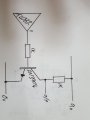
14891865947951064511539.jpg ok here is the circuit for the area I was having a problem with, as shown the square wave from the op amp was good on the op amp output but squashed tiny on the base of the tranny (yes I said it unashamedly) then a post from analogue kid got me thinking and I put a 1k in the emitter lead to ground and hey presto.....my square wave is good on the collector
 

AnalogKid

Joined Aug 1, 2013
12,143
Not much to say. You solved the problem with an emitter resistor. If you know how a diode works (that whole fixed-forward-voltage-that-doesn't-change-much-with-current thing), then you know why your original findings happened.

BTW, with a resistor in the emitter the transistor now might act as a linear amplifier. The gain of the stage is approx. Rc / Re.

ak
 
Top