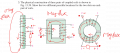
Dot convention - Determine dots

Ian0

Joined Aug 7, 2020
13,132
oh, how to get the true understanding of these case?
It's like those shape puzzles, where you have to rotate the shape in your mind and determine if two are the same.
So, in your mind, slide the winding around the core, until it is on top of the other winding.
Now do they match? (The number of turns doesn't matter, just look whether the turns go in the same direction)
If so, put the dots at the same end. If not, put the dots at opposite ends.
 

Thread Starter

linhvn

Joined Nov 6, 2024
297
It's like those shape puzzles, where you have to rotate the shape in your mind and determine if two are the same.
So, in your mind, slide the winding around the core, until it is on top of the other winding.
Now do they match? (The number of turns doesn't matter, just look whether the turns go in the same direction)
If so, put the dots at the same end. If not, put the dots at opposite ends.
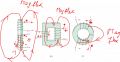
Before I applied Faraday law and Lenz law, suppose current enters 1st terminal, why apply these laws make it wrong?
 

Ian0

Joined Aug 7, 2020
13,132
Before I applied Faraday law and Lenz law, suppose current enters 1st terminal, why apply these laws make it wrong?
Faraday's law V∝dΦ/dt
It's about voltage, not current.
If current enters it must be because there is a voltage across the coil. Flux increase at a constant rate.
An identical coil experiences the same rate of change of flux, and produces a voltage, which must be identical to the voltage in the first coil. If it is a transformer, then that terminal can supply current to a load, so current exits from it.
Far easier to think in terms of the voltages.
If you think in terms of current going in and out, when you try to design a flyback converter you will definitely get in a muddle.
 

Thread Starter

linhvn

Joined Nov 6, 2024
297
Faraday's law V∝dΦ/dt
It's about voltage, not current.
If current enters it must be because there is a voltage across the coil. Flux increase at a constant rate.
An identical coil experiences the same rate of change of flux, and produces a voltage, which must be identical to the voltage in the first coil. If it is a transformer, then that terminal can supply current to a load, so current exits from it.
Far easier to think in terms of the voltages.
If you think in terms of current going in and out, when you try to design a flyback converter you will definitely get in a muddle.
Hard to understand what you say, I am still waiting for a shortly clearer explanation.
 

Jony130

Joined Feb 17, 2009
5,598
In this case, try to use the right-hand rule. And check the flux direction in each winding. And put a dot when the flux is added to each other.
 

Ian0

Joined Aug 7, 2020
13,132
how about this, just Faraday and Lenz law
View attachment 339638
It doesn't help a lot, as a transformer is an AC component, and the flux is in quadrature to the voltage, so half the time the flux is going from + to - and half the time it is going from - to +.

Think about it:
if Φ = ∫V1 dt and V2= dΦ/dt then V1=V2 and it doesn't matter what the flux is doing.
 

Thread Starter

linhvn

Joined Nov 6, 2024
297
It doesn't help a lot, as a transformer is an AC component, and the flux is in quadrature to the voltage, so half the time the flux is going from + to - and half the time it is going from - to +.

Think about it:
if Φ = ∫V1 dt and V2= dΦ/dt then V1=V2 and it doesn't matter what the flux is doing.
Why do you think this does not help, this is basic law, no need equations
 

WBahn

Joined Mar 31, 2012
32,848
I haven't read every response, but it seems like you are (once again) insisting on making this so much harder than it is.

For one of the windings, pick a terminal and put a dot on it.

Now assume that there is a current entering that terminal.

Using the right-hand rule, determine the direction of the magnetic flux in that coil.

Follow that flux through to the other coil.

Using the right hand rule, determine which terminal current has to enter to produce a magnetic flux in that same direction.

Put a dot on that terminal.

Done.
 
Top