Is there any naming convention for small brushed motors? What's just barely larger than N20?

Thread Starter

strantor

Joined Oct 3, 2010
6,875
I need a small, light-weight brushed DC gearmotor with about 150 oz-in torque and 100rpm output. I'm currently using a N20 motor, and I need something just a little bigger than that but I can find it and I don't know what to Google. Everything larger than N20 that I find, is way larger than N20 and too heavy for my use case. There doesn't seem to be any consistent naming convention so I can't just search for "N25" or "N30" (although N30 does seem to maybe be a thing, but rare). I have been searching for some kind of chart or list that shows all the common brushed DC motors from the tiny 1.5V things up to where the NEMA designations begin, and can't find anything like that either. Help? Please! Thanks!
 

Tonyr1084

Joined Sep 24, 2015
9,744
What output voltage do you need? What amperage? Is 100 RPM a hard number?

I have a bunch of brushed motors out of various things like printers and old CD players. IN fact on my work bench there's a CD motor connected to two LED's, one Green and one White. Spin the motor in one direction and the Green LED will light up. Spin it in the opposite direction and the White LED lights up. These LED's are Super Bright 5mm type with a relatively common forward voltage of 2.92 & 2.97Vf. The little CD motor has enough voltage and current to light them up but not burn them out.

I have no experience with the definition of N20 or any other N type motor or generator. Perhaps if your needs are for small voltages and currents a scrapped motor out of a CD player will work. They're not big.

Here's a link to a video I did debunking the idea of "Free Energy" and why it's NOT free. I used the CD motor that slews the laser and pickup back and forth. It has a chain of gears so with the simple push of my thumb I get high rotations and light the LED's. Sorry, I don't know what that gear ratio is off hand. I suppose I could count it, but that's rather tedious.
 

Tonyr1084

Joined Sep 24, 2015
9,744
He did not say he was using it as a generator!
My mistake. Don't know how I got on that track. Nevertheless, I don't know what an N20 motor is. Nor do I know how it relates in size. So it would seem I have nothing more worth contributing on this thread. I'll watch. Maybe learn something along the way.
 

BobTPH

Joined Jun 5, 2013
11,463
I looked up N20 150 RPM motors and most do not specify a torque. The one I found was 18 oz * in. So I would expect one producing 150 would be much larger, probably close to x2 in linear dimensions.

Another way to look at it is output power. 150 RPM at 150 oz*in is roughly 16W. The N20 motors run at 12V 40mA or 0.48W but both cannot be right, because 18 oz*in at 150 RPM is 2W.

I guess you cannot trust their specs.
 
Last edited:

LowQCab

Joined Nov 6, 2012
5,101
A fairly vague set of specifications ............
McMaster-Carr has a variety of Gear-Motors,
I have one picked-out for a future project that may not be far from what You need,
with the possible exception that it is brutally expensive at ~$350.oo each, ( and I need 2 ).
But I was looking for bullet-proof dependability and
roughly ~3-times the actual required Torque for a Turbo-Charger-Waste-Gate application.

If ~$350.oo hasn't made You weak in the knees, I'll gladly post all the links and PDFs.
.
.
.
 

MisterBill2

Joined Jan 23, 2018
27,186
Within industry, the smaller motors are often referenced by size (Diameter), and unfortunately I do not recall if it was millimeters or what. But those will not be seen on a "consumer" website like amazon. But a motor for controlling a turbocharger waste gate may need to be a special high temperature item. So I suggest checking with the turbo-charger distributor or dealer.
 

Thread Starter

strantor

Joined Oct 3, 2010
6,875
I looked up N20 150 RPM motors and most do not specify a torque. The one I found was 18 oz * in. So I would expect one producing 150 would be much larger, probably close to x2 in linear dimensions.


Another way to look at it is output power. 150 RPM at 150 oz*in is roughly 16W. The N20 motors run at 12V 40mA or 0.48W but both cannot be right, because 18 oz*in at 150 RPM is 2W.


I guess you cannot trust their specs.
No you can't trust the data provided for these motors, unless it's a dyno chart that shows actual rpm and torque across a range of speed. And that is almost never provided. I came up with 150 rpm and 100 oz-in based on very non-scientific observations of the performance of a variety of N20s that I have tested, which include the following:


270RPM/17oz-in N20 from ServoCity:
https://www.servocity.com/270-rpm-micro-gear-motor/
- this is geared too high. Unloaded it goes much faster than I need. Under load it stalls and burns up.

170 RPM/45oz-in N20 from ServoCity:
https://www.servocity.com/175-rpm-micro-gear-motor-w-encoder/
- unloaded speed a little higher than needed, bogs down under load but doesn't stall, but I can tell it won't last long as I am running it beyond its capacity.

100 RPM N20 from Amazon:
https://a.co/d/3ARtyR0
-no load speed is just about perfect but under load it is slower than I need. Torque is not quite adequate. Need something just a little bit stronger and faster. Maybe not a little bit, maybe double or triple the power, but that still should be a fairly tiny motor.

The Amazon motor provides zero specs.

The ServoCity motors are grossly overrated. They claim 1600mA stall and provide a bold red letter warning that stalling them may strip out the gears.. but actual stall current is around 450mA and the dramatic warning is a joke. I have not measured RPM or torque output from any of these motors, so I don't know what they're really putting out. I am assuming the 100 RPM Amazon motor follows the trend in torque specs of the ServoCity ones which would put it around 65oz-in. So I said I need roughly double that, with 50% more RPM. But considering how absurdly overrated those motors are, I have built my tower of assumptions and specs on a foundation of sand. What I have measured is the running current at 12V, which is around 350mA (4.5W) when it is approaching the performance I need (and I'm pretty sure that's asking too much of it for continuous operation). A 10 or 15W motor would probably be the ticket.

All I really want to know is "what motor is the next thing up from a N20?" I want to test whatever that motor is, and if it's still not sufficient, I want to test whatever the next bigger motor is. I know there are motors just barely bigger than N20, I just can't figure out what they're called and I don't know what to Google. That's what I'm trying to ask; is there some kind of reference for DC micro motors that I can use to determine what the different "classes" or "families" or "size tiers" of these motors are? Or do such categories even exist? Is there any kind of standardized format they follow? Or is it all just random, whatever any given manufacturer want to make in whatever size/shape they want, and hopefully it matches dimensions someone else needs? Surely not that? There must be some kind of standardized footprint scheme?
 
Last edited:

Thread Starter

strantor

Joined Oct 3, 2010
6,875
A fairly vague set of specifications ............
McMaster-Carr has a variety of Gear-Motors,
I have one picked-out for a future project that may not be far from what You need,
with the possible exception that it is brutally expensive at ~$350.oo each, ( and I need 2 ).
But I was looking for bullet-proof dependability and
roughly ~3-times the actual required Torque for a Turbo-Charger-Waste-Gate application.

If ~$350.oo hasn't made You weak in the knees, I'll gladly post all the links and PDFs.
.
.
.
I'm pretty sure I know which one you're talking about. I just went on McMaster inspired by your post. I thought maybe I would find clues there since McMaster usually has a large selection organized in a logical way, even if they go out of their way to scrub MFG part numbers any other information that could be used to track down the same part from another vendor. But sadly their selection is uncommonly small and they don't have anything close to what I am looking for.
 

Thread Starter

strantor

Joined Oct 3, 2010
6,875
Within industry, the smaller motors are often referenced by size (Diameter), and unfortunately I do not recall if it was millimeters or what. But those will not be seen on a "consumer" website like amazon. But a motor for controlling a turbocharger waste gate may need to be a special high temperature item. So I suggest checking with the turbo-charger distributor or dealer.
I am not trying to control a turbo wastegate, that was lowqcab. I have tried googling things like "10mm DC motor" and the like, I don't stumble upon any kind of pattern. Usually I find DC motors with 10mm shaft or 10mm bolt hole pattern or some other useless reference to 10mm. (10mm just for example, I have tried multiple dimensional references)
 

LowQCab

Joined Nov 6, 2012
5,101
What are the maximum physical dimensions that your project can accommodate ?
And, what Shaft Diameter (range) ?

For reliability, You may need a larger physical-size than You would ideally prefer.
.
.
.
 

Thread Starter

strantor

Joined Oct 3, 2010
6,875
What are the maximum physical dimensions that your project can accommodate ?
And, what Shaft Diameter (range) ?

For reliability, You may need a larger physical-size than You would ideally prefer.
.
.
.
All dimensions are flexible. The only concern is weight. It needs to <100g. Preferably 50g or less
 

LowQCab

Joined Nov 6, 2012
5,101
The weight of the Motor/Gear-Box is almost directly related to it's Torque production capabilities.

You may be looking for a "Unicorn" part made of unobtainium at a maximum of ~4-oz. total weight.

There are some R-C Model Servos that might just be able to pull it off though.
.
.
.
 

MisterBill2

Joined Jan 23, 2018
27,186
Certainly the application requirements will determine what size and shape of a motor will serve best, while cost and availability will affect what gets selected. I spent a bit of time once, looking for a suitable motor for an appliance described in a work of fiction. My conclusion was that there was a great deal of fiction beyond what I had realized.

A better understanding of the application may allow some better suggestions as to what might work.
Certainly the selections in the link provided in post #12 should include at least one suitable candidate.
 

Thread Starter

strantor

Joined Oct 3, 2010
6,875
Certainly the application requirements will determine what size and shape of a motor will serve best, while cost and availability will affect what gets selected. I spent a bit of time once, looking for a suitable motor for an appliance described in a work of fiction. My conclusion was that there was a great deal of fiction beyond what I had realized.

A better understanding of the application may allow some better suggestions as to what might work.
Certainly the selections in the link provided in post #12 should include at least one suitable candidate.
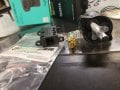
The application is an extruder for a high speed 3D printer. The weight of the toolhead of the 3D printer is one of the limiting factors of how fast it can run. Most (all?) 3D printers use a stepper motor for the extruder. Steppers have a poor power:weight ratio, so I want to use something much lighter. A small, power-dense brushed motor with an encoder that can be controlled in closed loop is the direction I am going right now. I will also test micro BLDC motors but for now I am focused on brushed DC. the N20 motors are almost sufficient, but not quite.
Here is a comparison of the N20 motor to the stepper it replaces:
20240908_172917.jpg
20240908_172841.jpg
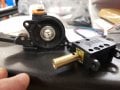
I have installed this already on an extruder and it does work.
20240903_194317.jpg
20240903_195640.jpg
With this N20 motor I am able to extrude at typical printing speeds no problem, and I can extrude at double the typical max printing speed, but only by running the motor beyond its limits. I want to use a motor that will do this without undue stress.

The extruder's original stepper weighs 98g so if the motor I select weighs that much or more, then no improvement has been made. The N20 weighs only about 10g. If I can stay below 50g, cut the weight in half, then I am happy with that.
 

BobTPH

Joined Jun 5, 2013
11,463
Without a stepper, how do you ensure the correct amount of filament is extruded? This control is critical in 3D printing.
 

Thread Starter

strantor

Joined Oct 3, 2010
6,875
Without a stepper, how do you ensure the correct amount of filament is extruded? This control is critical in 3D printing.
With encoder feedback and a PID loop. In theory this can be even more accurate than a stepper because the encoder can be on an idler that measures actual filament passage instead of motor revs. And it can detect a jam and shut down the printer instead of running all night not printing anything. If I want to get real fancy with it, I can incorporate real time filament diameter measurement and compensate the output to be consistent even with deviations in filament diameter.
 
Top