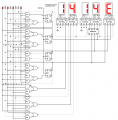
You will need to decode your 4-bit binary-encoded output into two 4-bit BCD-encoded outputs. With just one nibble (4-bits) to worry about, it's not as hard as it might look at first.
Be careful about using multi-input gates and just letting unused pins float. A simulator might be okay with it, but real circuits, particularly CMOS circuits, are not. Even when using something, like TTL, where floating inputs have reasonably well-defined values, they may not be the same values that your simulator happens to use.
You will need to decode your 4-bit binary-encoded output into two 4-bit BCD-encoded outputs. With just one nibble (4-bits) to worry about, it's not as hard as it might look at first.
Be careful about using multi-input gates and just letting unused pins float. A simulator might be okay with it, but real circuits, particularly CMOS circuits, are not. Even when using something, like TTL, where floating inputs have reasonably well-defined values, they may not be the same values that your simulator happens to use.
You will need to decode your 4-bit binary-encoded output into two 4-bit BCD-encoded outputs. With just one nibble (4-bits) to worry about, it's not as hard as it might look at first.
Be careful about using multi-input gates and just letting unused pins float. A simulator might be okay with it, but real circuits, particularly CMOS circuits, are not. Even when using something, like TTL, where floating inputs have reasonably well-defined values, they may not be the same values that your simulator happens to use.
You will need to decode your 4-bit binary-encoded output into two 4-bit BCD-encoded outputs. With just one nibble (4-bits) to worry about, it's not as hard as it might look at first.
Be careful about using multi-input gates and just letting unused pins float. A simulator might be okay with it, but real circuits, particularly CMOS circuits, are not. Even when using something, like TTL, where floating inputs have reasonably well-defined values, they may not be the same values that your simulator happens to use.
That's what i was thinking, using two 4-bit BCD-encoded outputs, but I don't understand how to do a 0001-0000 in a double digit seven segment display without both of them outputting the same number.
That's what i was thinking, using two 4-bit BCD-encoded outputs, but I don't understand how to do a 0001-0000 in a double digit seven segment display without both of them outputting the same number.
Either you use two 7 segment drivers or you use one and do multiplexing. Multiplexing would be more complicated, probably too much so for this assignment.
Glad you were able to complete the assignment on time; and perfectly no less.
If you're going to continue in this field, you should work on learning how to draw more readable schematics:
Style matters in schematics. Mine is a combination of what I decided was good in datasheets from Texas Instruments, RCA/Harris, and Motorola.
The middle display uses a general purpose 4 bit binary to BCD converter using the Double Dabble algorithm that's a common problem for school. Many have posted their problem, but few have completed it (or at least, they never posted their work). That implementation takes 6-8 more gates than the specialized one for your problem.
The simulator I use (Digital Works) makes it easy to troubleshoot logic problems without having to probe each of the nets. You can see from the inputs to the flip flops that the next count will be 7.

 Facebook
 Google
 GitHub
 Linkedin


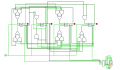


 ). I passed my cw which compost 40% of my grds and got a perfect score. Thank you so much.