Does this quesion have a solution?

wayneh

Joined Sep 9, 2010
18,104
Focusing on integer values based on the hypothesis that the original circuit that the problem writer devised probably used integer value resistors is probably a reasonable hypothesis.
Agreed, but any real resistor is going to be one that fits in the bin for the specs for that nominal value. They can't really be made to integer values except by coincidence. And of course they change with temperature.

I think you might need to look at how you did the analysis, because I don't agree with the numbers you got. I'm guessing the use of intermediate results that are using the nominal resistor values???

Here are the results I get by sweeping R1 from 13 Ω to 1 MΩ, keeping results that resulted in a maximum error in any one of the three voltages not exceeding 10 mV:
Without digging any further into it, I believe any discrepancy is cause by the different procedures. I set R0 to integer values and then forced the other 3 to be integers. You used R1. For me R0 cannot be a source of error versus R1 for you.

Personally, I prefer RMS error as a more meaningful way to express overall error.
I don't disagree, but for finding the minimum values in a list there is no difference.
 

WBahn

Joined Mar 31, 2012
32,840
Agreed, but any real resistor is going to be one that fits in the bin for the specs for that nominal value. They can't really be made to integer values except by coincidence. And of course they change with temperature.
Sure. It's a problem in an ideal world at a level for students that likely haven't been introduced to tolerances and other things -- it's just like beginning students who haven't been introduced to this thing called "friction" yet.

Without digging any further into it, I believe any discrepancy is cause by the different procedures. I set R0 to integer values and then forced the other 3 to be integers. You used R1. For me R0 cannot be a source of error versus R1 for you.
That's shouldn't be able to have any effect at all. It doesn't matter how we came up with those four particular integer values, once we have them, we have the same four integer values and the analysis of the circuit should result in the same voltages on those nodes. If there is any mechanism in your analysis that would be sensitive to which resistor was used as the reference value, then that is likely where the discrepancy lies.
 
Huh? They're given in #1. Whatever is in 56 and 57 is irrelevant.
You said:
"In the range of R0 tested, the minimum error - caused by rounding R1-3 to integers - was given by R0=35, R1=25, R2=26, R3=31. This is the same solution I gave in #30 by just eyeballing the list. Turns out it was indeed the best. The voltages at this solution calculate to 3.2305, 2.4750, and 5.9380. Sum of squared residual errors = 2.92x10^-5"

Where did you get the voltages shown in red? They're not given in post #1; the voltages given in post #1 are 3.23, 2.47, 5.94.
 

Ramussons

Joined May 3, 2013
1,568
There are 2 voltage dividers in parallel. Since tap voltage is known, the ratio of these resistors are also known. R0 : R1 and R2:R3
These 2 divider chains are in parallel and the effective resistance is about 30 Ohms.
You can have an Infinite number of combinations of R0, R1, R2 and R3 to fulfill these conditions.
There cannot be an unique solution to this problem.
 

WBahn

Joined Mar 31, 2012
32,840
There are 2 voltage dividers in parallel. Since tap voltage is known, the ratio of these resistors are also known. R0 : R1 and R2:R3
These 2 divider chains are in parallel and the effective resistance is about 30 Ohms.
You can have an Infinite number of combinations of R0, R1, R2 and R3 to fulfill these conditions.
There cannot be an unique solution to this problem.
Yep. That was established very early on. The discussion now, which everyone understands involves crystal ball reading, is to divine what the most likely circuit was that resulted in those particular voltages. Even then, it's really a basis for discussing various thoughts and ideas about what might have been the intent.
 

MrAl

Joined Jun 17, 2014
13,704
I still don't understand the fascination with integers, but to put this to bed I
1. Calculated precise values for R1, R2, and R3 for a list of integer R0 values ranging from 18 to 260.
2. Each of the calculated R1, R2 and R3 values were then rounded to an integer and
3. The three reference voltages were back-calculated and then
4. Compared (by summing the squared residual errors) to the given values.

In the range of R0 tested, the minimum error - caused by rounding R1-3 to integers - was given by R0=35, R1=25, R2=26, R3=31. This is the same solution I gave in #30 by just eyeballing the list. Turns out it was indeed the best. The voltages at this solution calculate to 3.2305, 2.4750, and 5.9380. Sum of squared residual errors = 2.92x10^-5

The solution proposed by @WBahn was 105, 75, 16, 19, which gives a sum of squares = 1.5x10^-4.

The other lowest-error solutions are:
25, 18, 42, 50 4.65x10^-5
104, 75, 16, 19 1.1x10^-4
Hello,

My reasons for concentrating on integers (positive whole number values for all the resistor in Ohms) is, for one, as WBahn pointed out there could have been an integer solution that the instructor used to create the problem statements, and he might have wanted the student to see if they could notice that there is one.

The second reason, and more important to me, is that if we can prove that there is or is not a positive whole number solution(s) then we put to rest all the long searches for integer solutions.
 

MrAl

Joined Jun 17, 2014
13,704
But the parallel combination result (5940/203) is not (exactly) true unless you round the calculated result to 4 digits.
Is this okay with you that you have to round results to the number of digits shown in post #1? I thought you were not counting a solution as good unless you got exact calculated results.

It's possible to carry your method a little further and get an exact result also for the parallel combination:

View attachment 307852

Hello there and thanks for checking this.

Here's what I did to establish the exact solution to the required total parallel resistance. I am not entirely sure what you did though, where did you get 2926/100 from?

Start with the regular voltage divider equation with Rx the unknown total parallel resistance (and 10v and 20 Ohms):
(10*Rx)/(Rx+20)=5.94

I like what you did with the multiplication of 100, so I use that also:
(1000*Rx)/(Rx+20)=594

Now solve for Rx and I get:
Rx=5940/203

Plugging that back into the equation I get:
594=594

Expressing Rx as a huge floating point number I get:
"29.26108374384236453201970443349753694581280788177339901477832512315270935960591133004926108374384236453201970443349753694581280788177339901477832512315270935960591133004926108374384236453201970443349753694581280788177339901477832512315270935960591133004926"
which as a side note has a repeating decimal every 84 characters (or so), which would imply that we could easily extend this huge number to an even larger one just by tacking on those 84 characters as many times as we want to make the result accurate to 1000's of characters (presumably).

Plugging that huge number back into the equation I get:
594=594

Thus I can not see how this could be 'rounded' or somehow inaccurate.

With these sometimes you never know, so if you can explain that would be good.
Maybe you could order your operations a little more simply so I could go over them too. If I made a mistake somewhere then I have to start all over again (no problem though).
 
Last edited:

MrAl

Joined Jun 17, 2014
13,704
Would someone please close this thread. The correct answer to the question was given in post. #2: Yes, there is a solution. Eventually we got the more informative answer that there are infinitely many solutions. Everything after that has been irrelevant.
The question came up as to if there were any integer solutions. This turned out to be interesting. Check out some of the replies.
 

ericgibbs

Joined Jan 29, 2010
21,442
Hi,
Checking WB post #47.
If you round up the LTSpice Node voltages to the second decimal place, they match the voltages given in the question.
IMO, it is an acceptable answer.
E
 

Attachments

Hello there and thanks for checking this.

Here's what I did to establish the exact solution to the required total parallel resistance. I am not entirely sure what you did though, where did you get 2926/100 from?

Start with the regular voltage divider equation with Rx the unknown total parallel resistance (and 10v and 20 Ohms):
(10*Rx)/(Rx+20)=5.94

I like what you did with the multiplication of 100, so I use that also:
(1000*Rx)/(Rx+20)=594

Now solve for Rx and I get:
Rx=5940/203

Plugging that back into the equation I get:
594=594

Expressing Rx as a huge floating point number I get:
"29.26108374384236453201970443349753694581280788177339901477832512315270935960591133004926108374384236453201970443349753694581280788177339901477832512315270935960591133004926108374384236453201970443349753694581280788177339901477832512315270935960591133004926"
which as a side note has a repeating decimal every 84 characters (or so), which would imply that we could easily extend this huge number to an even larger one just by tacking on those 84 characters as many times as we want to make the result accurate to 1000's of characters (presumably).

Plugging that huge number back into the equation I get:
594=594

Thus I can not see how this could be 'rounded' or somehow inaccurate.

With these sometimes you never know, so if you can explain that would be good.
Maybe you could order your operations a little more simply so I could go over them too. If I made a mistake somewhere then I have to start all over again (no problem though).
Back in post #51 you had tests of your expressions:
"5.94*e1/(e1+R0)=2.48 (true)
5.94*e3/(e3+e2)=3.23 (true)
(e1+R0) in parallel with (e2+e3)=5940/203 (true, and 5940/203 is the required total parallel resistance of the two strings)"

The first two tests give exactly the voltages shown in post #1, but the third test gives 5940/203 which is not the "required total parallel resistance". The required total resistance is given in post #1 as 29.23. 5940/203 is 29.2610837438 and when I saw that I thought that you were aiming for a value of 29.26, which you thought (and I mistakenly thought I remembered) was the required value for the total parallel resistance. I didn't refer back to post #1 to check your assertion that 5940/203 (and its floating point value of 29.2610837438) is the required value (which is actually 29.23).

In post #55, I used your value of 5940/203 = 29.2610837438 rounded to 29.26 to show how to get values for your variables e1, e2, and e3 that would give exactly 29.26 in the test for parallel resistance. But I mistakenly believed I was remembering 29.26 as the required value, when in fact it is 29.23.

Here is the calculation with the mistaken goal of 29.26 changed to 29.23. What you called e1,e2,e3, I just called R1,R2,R3.

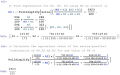
I'm just showing your formulas:
"Here are the solutions I found using R0 as control:
[R1=(124*R0)/173, R2=(2710*R0)/(203*R0-3460), R3=(3230*R0)/(203*R0-3460)]"

But improved so that "(R1+R0) in parallel with (R2+R3)" gives exactly 29.23, rather than 5940/203.

All I'm doing is solving 3 equations in symbolic form, and then testing "(R1+R0) in parallel with (R2+R3)" (using the product over the sum method) to show that the result is exactly 29.23 (shown as 2923/100).

Problem Approx2.png
 

MrAl

Joined Jun 17, 2014
13,704
Back in post #51 you had tests of your expressions:
"5.94*e1/(e1+R0)=2.48 (true)
5.94*e3/(e3+e2)=3.23 (true)
(e1+R0) in parallel with (e2+e3)=5940/203 (true, and 5940/203 is the required total parallel resistance of the two strings)"

The first two tests give exactly the voltages shown in post #1, but the third test gives 5940/203 which is not the "required total parallel resistance". The required total resistance is given in post #1 as 29.23. 5940/203 is 29.2610837438 and when I saw that I thought that you were aiming for a value of 29.26, which you thought (and I mistakenly thought I remembered) was the required value for the total parallel resistance. I didn't refer back to post #1 to check your assertion that 5940/203 (and its floating point value of 29.2610837438) is the required value (which is actually 29.23).

In post #55, I used your value of 5940/203 = 29.2610837438 rounded to 29.26 to show how to get values for your variables e1, e2, and e3 that would give exactly 29.26 in the test for parallel resistance. But I mistakenly believed I was remembering 29.26 as the required value, when in fact it is 29.23.

Here is the calculation with the mistaken goal of 29.26 changed to 29.23. What you called e1,e2,e3, I just called R1,R2,R3.

I'm just showing your formulas:
"Here are the solutions I found using R0 as control:
[R1=(124*R0)/173, R2=(2710*R0)/(203*R0-3460), R3=(3230*R0)/(203*R0-3460)]"

But improved so that "(R1+R0) in parallel with (R2+R3)" gives exactly 29.23, rather than 5940/203.

All I'm doing is solving 3 equations in symbolic form, and then testing "(R1+R0) in parallel with (R2+R3)" (using the product over the sum method) to show that the result is exactly 29.23 (shown as 2923/100).

View attachment 307912
Hello again,

Ok thanks for explaining. I am still a little confused though as to why you would want to use either 29.23 or 29.26 for any calculation because that can't be the right value, can it? If you want to get 5.94 volts exactly from a 10v source with a 20 Ohm and Rx value resistor, the Rx value has to be 5940/203 Ohms. I can't see why anyone would really want to use anything else, although you are certainly welcome to do that.
It seems that if you are using 29.23 Ohms because it was stated in Post #1, that's probably because he calculated the true value incorrectly. That's the only way I can understand it at this point.

Moving to an approximate solution as WBahn was doing, and I believe is reasonable, the best fit I could find within a search space of control R0=18 Ohms through 1GigOhms was:
{105,75,16,19} for R0, R1, R2, R2, and
{5.943396226,2.476415094,3.226415094} for the three voltages,
with the worst voltage error limit being 0.003585 which is actually 0.03585 percent.
The reason I worked in percent error rather than absolute error was because that is the normal way to do these. That's because for a voltage that is much different than another the absolute error shows almost nothing while the percent error shows the relative errors.
For example, if we had two voltages 100v and 1v, if 100v was off by 1v it may not matter, but if 1v was off by 1v that would be terrible.
Likewise, if 100v was off by 0.001v it means almost nothing while 1v being off by 0.001v is a good indicator.
What this means in the solutions is that the 100v can be off by more than the 1v spec and still be a good solution.
For example, 101v and 1.01v would be acceptable because the percent error is the same for both, and so the largest percent error is 1 percent. The absolute error is 1v and 0.01v, hardly comparable, making the 1v error look very bad.
I am assuming I did the search correctly in order to arrive at those results. I'll now compare them to the other solutions from other members.

Oh this is interesting, those were the values Eric found too in post #70.
I also see in post #47 WBahn got those values also.
Thus I guess I did the approximation search correctly.
 
Last edited:

MrAl

Joined Jun 17, 2014
13,704
Hi,
Checking WB post #47.
If you round up the LTSpice Node voltages to the second decimal place, they match the voltages given in the question.
IMO, it is an acceptable answer.
E
Hi Eric,

Yes I have to agree and interestingly those where the same R values I found in my search from R0=18 Ohms to 1GigOhms.
Now how did you arrive at those values?
Those values were the closet within that search space as far as I could tell, and it does not look like it gets any better going higher.
BTW, R0=18 Ohms is the lowest possible positive whole value for R0 as far as I found.
 

ericgibbs

Joined Jan 29, 2010
21,442
hi Al,
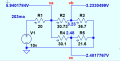
As stated, I used WB post #47 for that last sim. Post #70.

This image is my original Sim circuit.

I calculated the 203mA division into the two resistor branches based on the ratio of the given Vb and Vc Node voltages.
eg: 203mA( 3.23/(3.23+2.48)) ....

Try that, see what you get.

E
EG57_ 1303.png
 

wayneh

Joined Sep 9, 2010
18,104
You said:
"In the range of R0 tested, the minimum error - caused by rounding R1-3 to integers - was given by R0=35, R1=25, R2=26, R3=31. This is the same solution I gave in #30 by just eyeballing the list. Turns out it was indeed the best. The voltages at this solution calculate to 3.2305, 2.4750, and 5.9380. Sum of squared residual errors = 2.92x10^-5"

Where did you get the voltages shown in red? They're not given in post #1; the voltages given in post #1 are 3.23, 2.47, 5.94.
The red values are calculated from the integer resistor values, which contain rounding errors.

1) 1/(R2 + R3) + 1/(R0 + R1) = 1/Rt
2) I = 4.06V/20Ω = 0.203A
3) Rt = 5.94V/0.203A = 29.2610837 , which is at odds with the value given in #1. As noted previously, I ignored anything other than the diagram as being potentially errors introduced by the TS.

4) R3/(R2+R3) = 3.23/5.94 = A
5) R1/(R0+R1) = 2.48/5.94 = B

Rearranging 5:
6) R1 = R0 • B/(1-B )
Combining 1, 4 and 5:
7) A/R3 + B/R1 = 1/Rt
8) R3 = A/(1/Rt - B/R1)
9) R2 = (1-A)/A • R3

To calculate voltages from putative resistance values:
10) R3/(R2+R3)•5.94 =? 3.23
11) R1/(R0+R1)•5.94 =? 2.48
12) 0.203 / (1/(R0+R1) + 1/(R2+R3)) =? 5.94

Squared residual error = ((# 10) - 3.23)^2 + ((# 11) - 2.48)^2 + ((# 12) - 5.94)^2
 

WBahn

Joined Mar 31, 2012
32,840
The red values are calculated from the integer resistor values, which contain rounding errors.

1) 1/(R2 + R3) + 1/(R0 + R1) = 1/Rt
2) I = 4.06V/20Ω = 0.203A
3) Rt = 5.94V/0.203A = 29.2610837 , which is at odds with the value given in #1. As noted previously, I ignored anything other than the diagram as being potentially errors introduced by the TS.

4) R3/(R2+R3) = 3.23/5.94 = A
5) R1/(R0+R1) = 2.48/5.94 = B

Rearranging 5:
6) R1 = R0 • B/(1-B )
Combining 1, 4 and 5:
7) A/R3 + B/R1 = 1/Rt
8) R3 = A/(1/Rt - B/R1)
9) R2 = (1-A)/A • R3

To calculate voltages from putative resistance values:
10) R3/(R2+R3)•5.94 =? 3.23
11) R1/(R0+R1)•5.94 =? 2.48
12) 0.203 / (1/(R0+R1) + 1/(R2+R3)) =? 5.94

Squared residual error = ((# 10) - 3.23)^2 + ((# 11) - 2.48)^2 + ((# 12) - 5.94)^2
Your first error is in Step #2.

You are assuming that the voltage at the right and side of the 20 Ω resistor (what I call V1) is 4.06 V. But this is not the case. That is the voltage that we would LIKE to see at that node, but we are trying to find out what the voltage actually IS.

Think about it this way -- in Step 12, you are calculating V1. But in Step 2, you've already declared that V1 is exactly 5.94 V.

Can't have it both ways.

In calculating the voltages at the midpoints of the branches, you again assume that V1 is somehow exactly 5.94 V. You need to use what it actually is.

To walk through it:

R0=35, R1=25, R2=26, R3=31

Rnet = 1 / [ 1/(R2 + R3) + 1/(R0 + R1) ] = 1 / [ (1/60 Ω) + (1/57 Ω) ] = 29.23077 Ω
Rtot = 20 Ω + Rnet = 49.23077 Ω
Itot = 10 V / Rtot = 203.1250 mA
V1 = 10 V - (Itot · 20 Ω) = 5.937500 V =? 5.94 V (matches diagram)

Now we can use simple voltage dividers to get the other two voltages:

V2 = V1 * R3/(R2+R3) = 5.937500 V * 31 Ω / (26 Ω + 31 Ω) = 3.229167 V => 3.23 V (matches diagram)
V3 = V1 * R1/(R0+R1) = 5.937500 V * 25 Ω / (35 Ω + 25 Ω) = 2.473958 V => 2.47 V (does not quite match diagram)

Sum of squared residual error: (5.94 V - 5.937500 V)^2 + (3.23 V - 3.229167 V)^2 + (2.47 V - 2.473958 V)2 = 4.345E-5 V^2

Comparing this to what my Python script produced:

Code:
  R0   R1   R2   R3   Err_max     V1        V2        V3     sum(err^2)  rms(err)
(  35,  25,  26,  31 ) 0.6042 ( 5.937500, 3.229167, 2.473958 ) 4.345e-05   0.0038
 

wayneh

Joined Sep 9, 2010
18,104
Your first error is in Step #2.

You are assuming that the voltage at the right and side of the 20 Ω resistor (what I call V1) is 4.06 V.
No assumption. The voltage drop across the 20Ω is given. 10V on the LHS, and 5.94 on the RHS. ∆V = 4.06
 

WBahn

Joined Mar 31, 2012
32,840
My reasons for concentrating on integers (positive whole number values for all the resistor in Ohms) is, for one, as WBahn pointed out there could have been an integer solution that the instructor used to create the problem statements, and he might have wanted the student to see if they could notice that there is one.
While I think that there is a very good chance that the instructor (or whomever came up with the problem) used integer values, I'm almost positive that they had no intention of expecting the students to notice this and search for it. The two most likely situations are that the instructor didn't realize that the problem was insufficiently constrained, or the instructor provided an additional constraint that the TS did not provide to us. Another possible, but far less likely, situation is that the instructor is expecting students to recognize that the problem is insufficiently constrained and to either (a) find a solution or (b) parameterize all possible solutions. If this is case, the instructor almost certainly communicated this to the students, either as part of this particular problem, or as part of the overall instruction leading up to this assignment.
 

WBahn

Joined Mar 31, 2012
32,840
No assumption. The voltage drop across the 20Ω is given. 10V on the LHS, and 5.94 on the RHS. ∆V = 4.06
Well, then in that case there is NO error anywhere, because if you can assume that putting four arbitrary resistors to the right of that point has no effect on that voltage, since it is given, then we can just as legitimately assume that the other two voltages are also unaffected by it, since they are also given.

By using your approach, you violate KCL. You have exactly 203 mA entering that node, but have 99.0000 mA + 104.2105 mA = 203.2105 mA leaving it.

Where's that extra 0.21 mA coming from?

That level of error is well beyond what can be allowed when looking for the small residual errors we are examining.
 
Last edited:
Hello again,

Ok thanks for explaining. I am still a little confused though as to why you would want to use either 29.23 or 29.26 for any calculation because that can't be the right value, can it?
It's the value given in post #1 where it says: [R0+R1+R2+R3]= 29.23

In post #9 the question was asked: "Can I assume that the statement “[R0+R1+R2+R3]=29.23Ω” refers to the serial/parallel combination of those resistors and not their simple sum?" and after discussion it's clear that it refers to the series/parallel connection.

The expressions given in the image at the end of post #71 give (for any feasible value of R0) the values of R1, R2, and R3 that will give the exact correct values of 2.48 V, 3.23 V, and 29.23 ohms when these tests are performed:

5.94*R1/(R1+R0)=2.48 V
5.94*R3/(R3+R2)=3.23 V
(R1+R0) in parallel with (R2+R3) = 29.23 ohms
 
Top