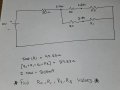
If you know the voltage divider formula this should give you a starting point.
You know the voltage 5.94 so you can use that to find the other resistors by forming an equation for each string.
However, first you have to find the total resistance of the four resistors so you can get that 5.94 volts. That means for the two strings you also have to maintain the same total resistance.
You have 4 unknowns. Can you use your knowledge of electronics to come up with at least 4 equations relating those unknowns? You'll then need some math prowess to actually solve for the 4 unknowns.
Can I assume that the statement “[R0+R1+R2+R3]=29.23Ω” refers to the serial/parallel combination of those resistors and not their simple sum? If that is the case, then imagine that R0 & R1 have values in the hundreds of meg-ohms (essentially making them irrelevant to finding the values of R2 & R3.) That would mean that there are an infinite number of possible solutions to the problem.
The best you can do is pick a (big enough) value for any one of R0, R1, R2 and R4. It has to be big enough so that the resistor in series with it will satisfy the need for the voltage between them and the sum of the two of them to achieve more than the 5.94 on the diagram.
The other series pair in parallel can then be used to adjust back to 5.94V and their ratio is detemined by the mid point voltage.
Yes, there are an infinite number of solutions. My bet is that there is at least one solution where the resistors are whole number values but that's just a guess!
I would assume the drawing is the given problem and ignore what follows, since it adds nothing not already in the diagram.
It's clear that the effective serial/parallel combination ∑R is 49.23Ω (I actually get 49.26Ω). When you subtract the given 20Ω, you're left with the 29.23. So your assumption is apparently correct.
Can I assume that the statement “[R0+R1+R2+R3]=29.23Ω” refers to the serial/parallel combination of those resistors and not their simple sum? If that is the case, then imagine that R0 & R1 have values in the hundreds of meg-ohms (essentially making them irrelevant to finding the values of R2 & R3.) That would mean that there are an infinite number of possible solutions to the problem.
I has to be the series/parallel combination. When I first skimmed the problem, I assumed that it was referring to the simple algebraic sum as a means of providing the additional constraint needed to produce a unique solution.
But a simple inspection shows that (R0+R1)||(R2+R3) must equal the 29.23 Ω. This means that the algebraic sum must be MORE than this since the SMALLER of (R0+R1) or (R2+R3) must be LARGER than 29.23 Ω.
Notice that the voltages at the midpoints of the R0,R1 string and the R2,R3 string are both in the vicinity of 3 volts. 3 volts is about 1/2 of 5.94 volts; this means that the ratios of the R0,R1 combo and the R2,R3 combo are about 1/2 plus or minus a bit. The resistance of the R0,R1 series combo and the R2,R3 series combo in parallel is about 30 ohms, and if all 4 resistors were 30 ohms, the series/parallel combo resistance would be 30 ohms and the ratio of the two voltage dividers would be 1/2. It's possible then that the values of the 4 resistors are all near 30 ohms. Just noticing the preceeding bits is a hint.
It has been pointed out that there are actually an infinite number of solutions, but if the solution is limited to only integer values for the resistors, one might reasonably guess that there is only one solution; consider this a hint.
The notion (hope?) that the expected solution consists of exactly one set of integer values for the resistors runs into problems since solving for integer solutions for such equations is a pretty hard task.
The notion (hope?) that the expected solution consists of exactly one set of integer values for the resistors runs into problems since solving for integer solutions for such equations is a pretty hard task.
If you expect to find a solution to this problem, you need to derive 3 symbolic expressions. First, an expression for the total series/parallel resistance of the R0,R1,R2,R3 combination. That shouldn't be too hard.
Next, the two expressions for the voltage divider ratio of the R0,R1 pair, and for the R2,R3 pair.
Show your derivations. For the forum people to help you, you really must respond to this.
I have to agree that finding integer solutions for all four resistors is probably impossible. I think the three voltages given are too arbitrary for that.
To find out for sure you could solve this ratiometrically for three of the four resistors choosing one, such as R0, arbitrarily (it looks like there are three equations but four variables). You can then use the inverse of the ratio for R1 to force R1 to be a whole number, then see if R2 and R3 comes out to something close to whole. I would bet a little that it would be hard to get close even with a error limit of 0.001 for example for R2 and R3 being whole.
Another interesting part of this is it looks like there is a minimum value for one of the resistors, like R0. For the example of R0 being the arbitrary one, if R0 goes below a certain positive value then either one or more of the others will become negative which would not be a real solution to this. That's interesting in itself, and may be hard to calculate even that. We could give it a shot though.
I was talking about choosing R0 as the arbitrary resistor value simply because it is lowest in number but you could choose any one you prefer.
It's also a little interesting that in the raw problem itself there is some symmetricalness in the network, in that you can swap the two separate series strings and come up with swapped R values. Not too much of a concern I guess though, except that gives rise to even more solutions in principle.
Also a little interesting is that it looks like if one of the resistors is very, very large, then the associated series resistor would also have to be large, and then the other string total resistance will dominate the total parallel resistance, and that would make the close approximation to all this a very simple exercise as it would be a simple voltage divider problem with just one string to worry about maintaining the required total parallel resistance.
This turned out to be a more interesting problem than it originally looked like.
When we chose a resistor to be the control resistor (the other three are controlled by that one value) there is an interesting view to a solution.
Again I chose R0 because it has the lowest enumeration.
We can solve for a 'minimum' value of R0, and this comes about when we understand that R1 has to be decided from that and the 5.94 voltage in order to get the right divider voltage of 2.48 volts. R0+R1 can then assume the entire required total parallel resistance to maintain that 5.94 volts, if we consider that R2 and R3 values are chosen to be highly theoretical values. Those highly theoretical values will add to infinity yet still provide the right divider voltage for that section which is 3.23 volts. That means that R2 might be something like 2.3*inf/5 and R3 might be 2.7*inf/5 just for some quick values. That makes the total R2+R3=infinity, which does not change the required total parallel resistance.
Given that introduction, we would want to choose R2 and R3 to be values that actually total to less than infinity in order to get some practical values. The interesting part here is, if instead of using the absolute minimum value for R0 we add an increment, the increment decides the value of R2 and R3. For an idea what we might get for R2 and R3, if we use a small increment like 0.001 we probably will get some normal values for R2 and R3, but if we use a very tiny increment like 1e-60, we would get values around 2.3e64 and 2.7e64. This is pretty interesting I think. We could easily be able to choose an increment such that we get maybe 2.3e2 and 2.7e2, but these are just partly randomly chosen for now just as an illustration (they should be in the neighborhood though).
Hard enough that there is no general algorithm to determine if a polynomial equation has integer solutions even when the coefficients are integers. It took seventy years, but it's been proven that no such algorithm can exist.

 Facebook
 Google
 GitHub
 Linkedin