Not disturbed, but I totally disagree with the conclusion of the video.
I think it's obvious that the ball which travels into the circumference slow down respect to the ball which travels in straight direction.
If you are convinced that π = 4 for circular motion (no idea of what it means ... ), and you are happy with that, peace & love. You are free to believe what you want.
But I don't like when people try to convince or teach (voluntarily) others with bad informations, non sense explanations, because it's like damaging other people (mainly culturally). The politicians & Co. already do it well, I think it's enough.
ok...don't know how closely you've read this thread. My point was that We........are the only ones that see circular movement. And what We see is an illusion....it is only apparent to Us.
The ball never sees or experiences a circular movement. It only sees a spiral. This is how the ball can turn without losing the average initial velocity. Such as earth does.
If you were riding on the ball........you would decelerate going up the exterior wall due to gravity. And accelerate coming back down on the interior wall due to gravity.
So the first pi of the arc, you are slowing down and going up......and the second pi you are speeding back up while coming back down. Now you are back where you started at the same speed. A helical path can re-direct and conserve and store linear momentum.
Simple mechanics.
"But I don't like when people try to convince or teach others with bad informations, non sense explanations, because it's like damaging other people (mainly culturally)."
pi was just bait. It was analyzing an experiment. Looking for a solution for all to agree and understand. And I was offering changes to test the solution. (with no relevant responses) (but plenty of cat calls)
If I agreed with the fellow in the video or the mathematician who tried to explain it in the pdf,...........I wouldn't need a solution and therefore no need of this thread.
And with nothing but snide emotional remarks and miss-direction in response posts, I see your point. It's just too culturally damaging to discuss.
What the guy was really talking about IMO instead of Pi in his stupid paper was Taxicab geometry.
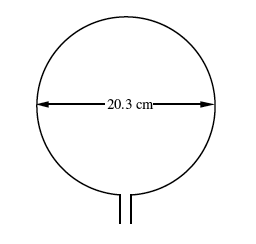
A circle is a set of points with a fixed distance, called the radius, from a point called the center. In taxicab geometry, distance is determined by a different metric than in Euclidean geometry, and the shape of circles changes as well. Taxicab circles are squares with sides oriented at a 45° angle to the coordinate axes. The image to the right shows why this is true, by showing in red the set of all points with a fixed distance from a center, shown in blue. As the size of the city blocks diminishes, the points become more numerous and become a rotated square in a continuous taxicab geometry. While each side would have length √2r using a Euclidean metric, where r is the circle's radius, its length in taxicab geometry is 2r. Thus, a circle's circumference is 8r. Thus, the value of a geometric analog to Pi is 4 in this geometry.
The problem with TaxiG is that it only considers two directions. Now if that ball is not spiraling (it only does one spiral), then my solution is out the window.
That's why I suggested that we replace the tube with a track (like a RR track, bank where needed). This will limit the movement of the ball in only two dimensions at one time. Instead of 3D movement that is possible in tube.
When we rotate a wheel against the ground........we should get pi X d distance. And the wheel and road length start at the time and have the same velocity. Both the wheel and the road move 3.14D length.
In this video...the wheel and road length start at the same time and have the same velocity......but end up with a non pi length.
I looked at the video again......my blinkers aren't too good but I do not see any spiral. And with that size ball and tubing diameter......there's plenty of room. (I would think) And the second test was at the wrong angle to see anything.
Could the pdf mathematician be right? An angled path thru an linear reference will increase the distance traveled. The travel time would increase also. And since we only notice the linear displacement.....it appears to slow down.
So supposedly....21% of the linear length goes into itsy bitsy sideways lengths.....per circle. And length remains absolute.
I like the way this guy talks.
I wish they would have extended the exit tube to see if it appeared to speed back up and keep pace with other ball.
I'm wondering if it gets that 21% returned.
AND so pi, just measures the linear component of the length of a circle? (and not the sideways length component)
So when we put a string around a circle (say a can) ...in actuality, the string is the length of the straight part, not the bent part (21%), of the circumference of the can.
So when we power a wheel on the road........we are only applying 79% (the straight part) of the true length of the wheel?
If all circles and therefore arcs have a 21% sideways component........does that mean that all arcs are constant? And that only with the radius and/or origin change, can cause an asymmetrical arc?
OK...I called it first.....BR-549's Constant Arc Theory.
In a static geometric circle, the circumference is 3.14 times the diameter. And we have assumed that pi is constant and that pi remains 3.14 with motion of rotation.
Could this be wrong? Is linear length equal to angular length? Is linear time equal to angular time? Are we comparing linear momentum to angular momentum in the correct manner? Can we compare linear velocity to angular velocity?
So if we have angular motion we need to add a variable to pi? Pi doesn't change.
Is there really any such thing as an object with no angular motion in the moving universe? There are no straight lines except as it appears to us relatively.
Interesting, but of little value to most of us. I don't need to consider it for anything in my life.
I don't suppose I could convince anyone that earth has a 360 degree bank also. And as earth responds to the angular momentum (which is acceleration), that it spirals as it revolves around the sun.
So the path of earth's orbit is not elliptical.....it's a helix. Think about how many things it explains. It explains perigee and apogee. It explains inclination.
Don't be afraid to explore new ideas. We need them.
What it shows is that angular length is made of two components. These two components are the linear length and the angular length. (which is perpendicular to the linear length). The linear component is 3.14D. But if we take all the angular components and line them up with the linear......the whole total linear length is 4D.
When you bend a line into a circle, the total line length shortens...........because 21% of the length went to lateral (perpendicular) displacement.
We can do the same with velocities.....because in this case the acceleration is due to, two constant perpendicular velocities.
This means that when a linear velocity enters into a circle, the velocity drops 21%. And when a circular velocity changes to linear....it increases 21%.
And if these statements are true........we need to check our linear to angular momentum conversion equations.
Well, if earth was traveling in a straight line.....Then to explain everything we see.......everything in the solar system and everything in the universe would have to revolve around the earth, as earth moves in a straight line.
When they first invented telescopes........most thought that everything revolved around the earth.
If we raise the head, to achieve a velocity for one spiral.......will the ball exit close to pi?
Unlike the non spiral rotation, that uses a sideways vector all thru the arc.........a spiral might need only one kick at the entrance? Just one small turn......not a continuous turn. Does an object feel like it is linear while in a spiral? Or is it just a lower rate of change sideways motion. Could the proper ratio of spiral pitch and spiral diameter........mimic linear velocity?
This might keep most of the velocity close to the linear V. And ball should exit close to pi.
OR will angular V be the same..................no matter what the motion? Or can we adjust the ratio of 3.14/4 ?
Is there any way that one could exit the ball at pi? Impossible?

 Facebook
 Google
 GitHub
 Linkedin



 ), and you are happy with that, peace & love. You are free to believe what you want.