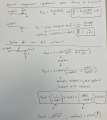
In circuit analysis, everything seems to work out when you set i*cos = sin. But thats not a legitimate equation, so why does that work? Is there a proof that this is a real equation?
We are going in circles.
I really don't understand your strange question.
You said your equation works everywhere and I showed it doesn't.
Resistors are part of everywhere.
lol what? im saying in circuit analysis, you input a sin(wt) signal. If a phase shift happens that gives you a cos(wt) term, replace it with jsin(wt) and continue doing the algebra. resistors do not create any phase shifts so it doesnt even apply
i have a transfer function given by the complex number (A+jB). I multiply my input sin(wt) and i get Asin(wt)+jBsin(wt). Using the equality above, it becomes Asin(wt) + Bcos(wt), which is just standard form of any sinusoid with a magnitude of sqrt(A^2 + B^2). No need to convert into an exponential with eulers formula, then take the "real" part of that exponential.
To show that they are not the same, all that is needed is a single counter example. So set Φ = 0. The cosine of zero is 1, while the sine of zero is zero, and multiplying that by i does not make it equal to 1.
In general, if Φ is real, then both sin(Φ) and cos(Φ) are real. For any value of Φ that yields a non-zero value for sin(Φ), you then have a pure imaginary number when you multiply it by i and that is not going to be equal to the real number that you have cor cos(Φ).
It' hard to tell what you mean when you say "everything works" in circuit analysis.
But here's something to consider.
The use of complex numbers in circuit analysis can be formulated several ways. The two most common are to note that:
sin(Φ) = Im(e^(jΦ))
cos(Φ) = Re(e^(jΦ))
Pick one or the other. Let's pick the first.
Now, when you analyze a circuit (let's start with one that only has DC sources or AC signals/sources operating at a single frequency) you can write all of the sinusoidal signals in terms of the Im(e^(jΦ)). In doing so, you discover that you can "factor out" the step of taking the imaginary part of the equations that result and do that at the very end. So you "transform" the equations into this complex number realm at the beginning, so all the math with straight complex numbers, and then transform it back into the original realm by keeping only the imaginary coefficient of the result.
ya i understand how to do complex circuit analysis, but i just realized that it always works out the same if you replace cos with jsin. I am just wondering why. Perhaps it isnt an equation, but more of a bridge in and out of complex analysis? cos <==>jsin
i have a transfer function given by the complex number (A+jB). I multiply my input sin(wt) and i get Asin(wt)+jBsin(wt). Using the equality above, it becomes Asin(wt) + Bcos(wt), which is just standard form of any sinusoid with a magnitude of sqrt(A^2 + B^2). No need to convert into an exponential with eulers formula, then take the "real" part of that exponential.
You can't transform part of the system and not transform other parts. The (A+jB) had to have come from transforming something from the real world into the complex frequency world. You need to transform your input signal accordingly. The product of a complex frequency domain factor and a time domain factor is meaningless.
I guess im not asking why something giving me the wrong anwer, I am asking why it gives me the CORRECT answer.
Why i simply replace all cos terms with isin, do the algebra, then replace all the isin terms back with cos and somehow magically always get the correct answer.
I guess im not asking why something giving me the wrong anwer, I am asking why it gives me the CORRECT answer.
Why i simply replace all cos terms with isin, do the algebra, then replace all the isin terms back with cos and somehow magically always get the correct answer.
Just because 2*2 = 2+2 does not mean that multiplication and addition are interchangeable.
We can't see what you are doing right or wrong or figure out under what conditions what you are doing might happen to result in a correct answer unless you provide a clear example, worked step by step, so that we can see exactly what you are doing and where you are doing it.
I guess im not asking why something giving me the wrong anwer, I am asking why it gives me the CORRECT answer.
Why i simply replace all cos terms with isin, do the algebra, then replace all the isin terms back with cos and somehow magically always get the correct answer.
Rather hard to justify that claim given all of the design techniques for all kinds of systems, particularly in the realm of signal processing and communication systems, that are based on it.
I may (MAY) have some time tomorrow to go through this, but I can already see some flaws in your approach. At best, I think, you are dealing with a degenerate example (at least effectively). I need to look closely to see if that's really the case, and I need at least a couple hours of sleep.

 Facebook
 Google
 GitHub
 Linkedin