Does a Series Cap Prefer Unipolar or Bipolar Square Waves

sasaudio

Joined Oct 18, 2009
34
I may be incorrect, but I don't think it's similar. In AM radio an AC carrier is modulated by an AC signal. It's not DC modulated by AC. In this question there is no modulation happening at all.
The DC is not shown in the OPs circuit, but the DC is modulated by a rectangular wave signal so
the rectangular signal never passes 0. As such, the DC voltage is the carrier.

Either DC or AC can be a carrier, and thus modulated. General principle.

In response to the op's first post, whether a capacitor is suitable depends upon the application
which includes the frequency involved.

Over and out
pos
 

crutschow

Joined Mar 14, 2008
38,537
I didn't notice anyone say AC only applies to mains. Rather I thought some of us feel there must be alternating forward and reverse current to be called AC.
And some of us don't.
That Alternating Current definition was stated in the Wikipedia article that was referenced by Max in Post #27, and that only discusses AC power.
It makes no mention of AC signals, which are a somewhat different animal.

My view is that, if you remove the DC, than anything that is left is AC.
That way there's no concern about whether the current actually "reverses" since any voltage/current variations left after the DC is removed will, of necessity, be periodically reversing.
 
Last edited:

Werecow

Joined Aug 4, 2025
37
I've always seen and referred to this with a circuit's intent in mind. If the measurement of interest is the output of a DC power supply, it's DC with AC ripple component, but those same voltage levels in a circuit processing AC signals, e.g. filter, amplifier, etc., are AC with DC bias.

You say po-TAY-to, I say po-TAH-to, let's call the whole thing semantics... ;)
But my answer to the TS's question remains the same: IF the ceramic capacitor selected is appropriate for an application, it "prefers" neither unipolar nor bipolar waveforms, because the waveform is taken into account in the selection process.
 

Thread Starter

johnyradio

Joined Oct 26, 2012
615
But my answer to the TS's question remains the same: IF the ceramic capacitor selected is appropriate for an application, it "prefers" neither unipolar nor bipolar waveforms, because the waveform is taken into account in the selection process.
To me that sounds circular. "If it works, it works, and that's good enough."

Let's assume the "application" is the circuit in the original question.

Let's assume the circuit performs with acceptable behavior, thermal characteristics, and losses at a given frequency, with a bipolar square wave, and a given ceramic capacitor.

Now change the bipolar square wave input to a unipolar square wave, but change nothing else. Will behavior of the circuit, losses, and thermal characteristics remain unchanged?
 

drjohsmith

Joined Dec 13, 2021
1,615
To me that sounds circular. "If it works, it works, and that's good enough."

Let's assume the "application" is the circuit in the original question.

Let's assume the circuit performs with acceptable behavior, thermal characteristics, and losses at a given frequency, with a bipolar square wave, and a given ceramic capacitor.

Now change the bipolar square wave input to a unipolar square wave, but change nothing else. Will behavior of the circuit, losses, and thermal characteristics remain unchanged?
either build the circuit and meassure , or simulate and meassure
 

Werecow

Joined Aug 4, 2025
37
To me that sounds circular. "If it works, it works, and that's good enough."
I don't see my explanation as circular. With operating conditions specified in the design stage, components are selected based on those specifications. Seems pretty straightforward.
Now change the bipolar square wave input to a unipolar square wave, but change nothing else. Will behavior of the circuit, losses, and thermal characteristics remain unchanged?
It depends. If initial specifications stated that unipolar waveforms are possible, you would have selected a capacitor tolerant of DC bias, with minimal effect on other parameters, so behavior of your circuit would be affected as little as possible. The chance of being completely unchanged is non-zero but, as with many design choices, compromise of some sort is often required.
 

drjohsmith

Joined Dec 13, 2021
1,615
assuming perfect components.
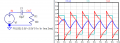
can you draw what waveform you would expect to see across the resistor in steady state with the signal from the generator going +- 2.5 v a d then for the generator going 0 to +5v

a clue , look at what happens across a perfect capacitor when one side changes volts suddenly then stay at that voltage ., what does the other side of the capacitor do.
 

drjohsmith

Joined Dec 13, 2021
1,615
That sounds like "We don't answer questions here'", which sounds like "I have no idea."
the forums have explained what happens in this very simple rc circuit.
you seem not to get the answer, so we're suggesting two ways forward to enable you to get a better understanding,
first is practical , if your luck enough to have the test equipment, or if not there are free simulators to alow you to build the circuit and experiment.
second we suggest you look at the basic theory of a capacitor, and see what happens when you apply a sudden change of voltage. we have suggested that you draw graph of the expected waveform across the capacitor and share ,
what do you understand about the perfect capacitor ?
the easy answer is the perfect capacitor does not care if waveform is square 0 to 5v ,,or -2.5 to +2.5 v,
I await your graph of volts v time across the capacitor

BTW. which institution is this homework for ?
 

Danko

Joined Nov 22, 2017
2,173
can you draw what waveform you would expect to see across the resistor in steady state with the signal from the generator going +- 2.5 v a d then for the generator going 0 to +5v
a clue , look at what happens across a perfect capacitor when one side changes volts suddenly then stay at that voltage ., what does the other side of the capacitor do.
That sounds like "We don't answer questions here'", which sounds like "I have no idea."
Look:
1755668007140.png

1755668237932.png
 
Last edited:

Thread Starter

johnyradio

Joined Oct 26, 2012
615
<MOD - Personal exchanges snipped>

I may have this wrong, but i believe electricity can only do work (power a load) when it's moving -- there must be current. With a series capacitor , current only flows when the cap is charging or discharging. That can only happen with a changing input-voltage (with some caveats).

When it charges, electrons accumulate on the plate connected to the forward electron supply. That accumulation repels electrons on the opposite side of the plate, attracting positively charged particles to the opposite side (protons?). Once the cap is fully charged, current stops flowing. It cain't hold no mo.
1755891823232.png

When it discharges, the accumulated electrons flow in the reverse direction as current, leaving behind protons on the forward plate, and attracting electrons to the opposite plate. Electrons on the opposite plate are be supplied by whatever is attached to the opposite plate. Once all the accumulated electrons have been discharged, and the opposite plate is fully charged, current stops. You've reached the "capacity" of the capacitor. See what i did there?
1755892007775.png

The smaller the capacity, the less time it takes to charge fully. A capacitor is therefore frequency sensitive. A series cap, as in my circuit, is a high-pass filter, because a lower frequency square wave spends more time in the fully charged and discharged states, ie more time in the no-current-moving condition. It just sits there. So the slower the input, that is the closer it is to DC, the less current flows.

My mind's eye is telling me that a unipolar square is only using half the capacity of the capacitor. The amplitude of the forward-current voltage input might be insufficient to fully charge the cap. Or the reverse-current voltage might be insufficient to fully discharge the cap. If there's any DC offset, then the cap might charge more than it discharges or vice-versa.

Furthermore, if the input is unipolar, then it seems the forward plate will charge and discharge the same amounts as the reverse plate. Ie, the voltage on the reverse-current plate will be unipolar too.

Which goes against my understanding that caps block DC. So i'm missing something here.
1755892140904.png

what do you understand about the perfect capacitor ?
My understanding of "perfection" in electronic components, which i think is usually termed "ideal", is about losses -- an ideal component has none. But i think you mean something different.

the easy answer is the perfect capacitor does not care if waveform is square 0 to 5v ,,or -2.5 to +2.5 v
That goes against my understanding that caps block DC.
 
Last edited by a moderator:

MrChips

Joined Oct 2, 2009
34,875
When it charges, electrons accumulate on the plate connected to the forward electron supply. That accumulation repels electrons on the opposite side of the plate, attracting positively charged particles to the opposite side (protons?). Once the cap is fully charged, current stops flowing. It cain't hold no mo.
What do you mean by Once the cap is fully charged, current stops flowing. ?

When does a capacitor become fully charged?
A capacitor is not like a water tank. It doesn't have a "full" capacity.
If you keep putting charge into the capacitor, it will continue to charge.
 

WBahn

Joined Mar 31, 2012
32,925
<MOD - Personal exchanges snipped>

I may have this wrong, but i believe electricity can only do work (power a load) when it's moving -- there must be current. With a series capacitor , current only flows when the cap is charging or discharging. That can only happen with a changing input-voltage (with some caveats).

When it charges, electrons accumulate on the plate connected to the forward electron supply. That accumulation repels electrons on the opposite side of the plate, attracting positively charged particles to the opposite side (protons?). Once the cap is fully charged, current stops flowing. It cain't hold no mo.
View attachment 354617

When it discharges, the accumulated electrons flow in the reverse direction as current, leaving behind protons on the forward plate, and attracting electrons to the opposite plate. Electrons on the opposite plate are be supplied by whatever is attached to the opposite plate. Once all the accumulated electrons have been discharged, and the opposite plate is fully charged, current stops. You've reached the "capacity" of the capacitor. See what i did there?
View attachment 354618

</QUOTE>

Your description isn't self-consistent. Your description of the charging process explicitly describes charge being added to one plate being accompanied by charge being removed from the other plate. But then your description of the discharging process only makes sense if the other plate is starting out uncharged.

As I've stated before, the capacitor as a whole has zero net charge. Whatever charge is on one plate, be it positive, negative, or zero, the charge on the other plate is the opposite of that. So, as one plate is discharged, so is the other. Like a battery, you need to have both sides connected to the circuit for any current to flow and what ever current flows into/out-of one side will flow out-of/into the other.

<QUOTE>
The smaller the capacity, the less time it takes to charge fully. A capacitor is therefore frequency sensitive. A series cap, as in my circuit, is a high-pass filter, because a lower frequency square wave spends more time in the fully charged and discharged states, ie more time in the no-current-moving condition. It just sits there. So the slower the input, that is the closer it is to DC, the less current flows.
</QUOTE>

What does it mean "to charge fully"? The capacitance is merely the relationship between the amount of charge separation and the corresponding voltage across the plates.

<QUOTE>
My mind's eye is telling me that a unipolar square is only using half the capacity of the capacitor. The amplitude of the forward-current voltage input might be insufficient to fully charge the cap. Or the reverse-current voltage might be insufficient to fully discharge the cap. If there's any DC offset, then the cap might charge more than it discharges or vice-versa.

Furthermore, if the input is unipolar, then it seems the forward plate will charge and discharge the same amounts as the reverse plate. Ie, the voltage on the reverse-current plate will be unipolar too.
</QUOTE>

Your mind's eye is leading you down a road of half-truths. Each plate will always charge and discharge the same amount as the other plate. Doesn't matter if it's AC, DC, or some combination of the two. Over their designed operating range, most capacitors are quite linear devices, meaning that the total response to a combined signals is just the sum of the individual responses to the individual signals.

<QUOTE>
Which goes against my understanding that caps block DC. So i'm missing something here.
View attachment 354619
</QUOTE>

The notion of "blocking DC" applies to the steady state response, which will be zero for the DC component of the input.

It does not mean that there won't be a transient response (which, pretty much by definition, is not DC). But there is some fine print involved, namely that the circuit must allow the transient response to die out. Virtually every real circuit does, even if all of the components are ideal. But we can construct circuits for this this is not the case. On paper, these have an indefinite DC response even if DC is nominally blocked. In the real world, they usually exhibit sufficiently long times for the initial transient to die down that they can't be ignored in steady state (because truly reaching steady state would take too long).

A simple example is two capacitors in series. Start out with them initially discharged and then apply a DC voltage across the combination. There will appear a DC voltage across each capacitor which will remain indefinitely. In practice, there is almost always something that will eventually discharge the output capacitor resulting in zero output for a DC input (in steady state).

<QUOTE>
My understanding of "perfection" in electronic components, which i think is usually termed "ideal", is about losses -- an ideal component has none. But i think you mean something different.
That's not what "ideal" means. If it did, then how could we ever treat a resistor as being ideal? Or a transistor?

An ideal component is merely one that strictly adheres to the basic constitutive equations for that kind of device.
 

Thread Starter

johnyradio

Joined Oct 26, 2012
615
A capacitor is not like a water tank. It doesn't have a "full" capacity.
If you keep putting charge into the capacitor, it will continue to charge.
Wow, I had no idea! I thought it's capacitance refers to how much charge it can hold. Like a battery.

My understanding from the video above is that the way to force more electrons into the capacitor is by increasing the input voltage. Capacitors have a voltage rating. Therefore, I would think that the charge limit of a capacitor is based on its voltage rating, no?
 
Last edited:

MrChips

Joined Oct 2, 2009
34,875
The voltage V across a capacitor with capacitance C is given as,

V = Q / C

where,
V is in volts,
Q is coulombs
C is farads

Charge Q = I x t
where,
I is current in amps
t is time in seconds

Thus,

V = I x t / C

You charge a capacitor by injecting current, not by applying voltage. Semantics, yes.
If you apply a voltage, the capacitor cannot charge instantly. You need to know the series resistance in order to determine the charging current.

If you charge a capacitor with a constant current I, the voltage V across the capacitor will increase linearly with time. Theoretically, there is no limit. Eventually, the electric field across the capacitor will cause arcing and breakdown of the dielectric. An air-gapped tuning capacitor can withstand thousands of volts across the plates.
 
Top