Does a Series Cap Prefer Unipolar or Bipolar Square Waves

Thread Starter

johnyradio

Joined Oct 26, 2012
615
Thank you everyone for your continued participation in this thread, for the sake of my understanding, as well as drama and giggles.
IMHO this kind of thinking is the direct result of lazy-sloppy academics neglecting to teach the difference between "voltage" and "emf".
I'm not a university trained EE. My mistake is all me. No offense taken!
To "charge" a capacitor you must "force" electrons onto one plate and off of the other plate, the result is a development of "voltage".

EMF is the driving force ina circuit, whereas the potential difference is the result of the EMF
So the force is the chicken.
You need voltage to push current. But it is current (charge flow) that charges the capacitor.
That seems to contradict Mr Spidey. You say the voltage is the chicken. That was my understanding too.
Maybe he meant derivative, dv/dt.
Shamefully, I misspoke. Where as in a load, my understanding is the voltage difference between supply and ground is what creates current flow through the load. But, apparently charging a capacitor is different. That requires force. If I understand correctly.
Precision high-Q resonators and other RF circuits are the one that come to mind.
Thanks for that. Can you explain why they like a DC biased oscillation that never reverses direction?
 
Last edited:

MrChips

Joined Oct 2, 2009
34,887
So the force is the chicken.

That seems to contradict Mr Spidey. You say the voltage is the chicken. That was my understanding too.

Shamefully, I misspoke. Where as in a load, my understanding is the voltage difference between supply and ground is what creates current flow through the load. But, apparently charging a capacitor is different. That requires force. If I understand correctly.
I said it’s a chicken and egg problem. Which comes first? There is no answer to that question.

Why is ground necessary? Voltage is by definition a difference. It is the measure of potential between point A and point B.

How can charging a capacitor be any different? They are both subjected to the same laws of physics.
 

Thread Starter

johnyradio

Joined Oct 26, 2012
615
Voltage is by definition a difference. It is the measure of potential between point A and point B. How can charging a capacitor be any different?
If you connect a capacitor to a battery, What starts the electrons flowing? My understanding is that the initial action is a pile up of electrons on one plate pushed there by the battery's negative terminal, and not due to any voltage difference. Soon, those electrons repel electrons from the opposite plate. I'm not sure if that repulsion is due to a voltage "difference" between the plates.
 

MrChips

Joined Oct 2, 2009
34,887
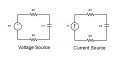
Charging a capacitor from a voltage source and current source
Capacitor charging.jpg

We can charge a capacitor from a voltage source or current source. The physics is the same.
In both circuits, we integrate (sum) the charge accumulation on the capacitor.

When charging from a voltage source, we integrate the current. Since the current is changing, the mathematical solution is a non-linear equation. It is represented by a differential equation since dQ/dt is not constant. You need to use calculus to solve this equation.

When charging from a current source, we again integrate the current. If the current stays the same, dQ/dt is constant and the voltage across the capacitor increases linearly with time.

I have shown two resistors in each circuit in order to visualize four concepts.

1) The circuit is a closed loop. The current flowing into the capacitor is the same as the current flowing out of the capacitor.
Now replace the capacitor with a battery. The same thing applies.

2) Direct current flows in the circuit, contrary to what we think about a DC blocking capacitor.

3) A ground in the circuit is not required. You can measure the voltage difference between any two points in the circuit with a voltmeter.

4) You cannot measure voltage in the circuit using only one lead of a voltmeter or just the probe of an oscilloscope. You need to establish a reference point in the circuit.
 

joeyd999

Joined Jun 6, 2011
6,337
If you connect a capacitor to a battery, What starts the electrons flowing? My understanding is that the initial action is a pile up of electrons on one plate pushed there by the battery's negative terminal, and not due to any voltage difference. Soon, those electrons repel electrons from the opposite plate. I'm not sure if that repulsion is due to a voltage "difference" between the plates.

Assume a completely discharged cap. There is a resistor in series with the battery and the cap (no matter how small, and even if it is apparently non-existant). Call this resistance R.

At T+0, the differential voltage across R causes a current to flow through R with a magnitude of V/R. It is this current that forces charge into the cap which subsequently causes its differential voltage to rise.

There is no catch-22.
 

MrChips

Joined Oct 2, 2009
34,887
If you connect a capacitor to a battery, What starts the electrons flowing? My understanding is that the initial action is a pile up of electrons on one plate pushed there by the battery's negative terminal, and not due to any voltage difference. Soon, those electrons repel electrons from the opposite plate. I'm not sure if that repulsion is due to a voltage "difference" between the plates.
I will answer your question later to prevent cross posting.

Edit: joey answered your question.
 

joeyd999

Joined Jun 6, 2011
6,337
I should point out that it is physically impossible to apply a V across a C. You can not change a cap's voltage instantaneously.

There will always be an R or an L (more likely, both) in series with a V and a C, even if only parasitic, which will govern the charging current into C.
 

drjohsmith

Joined Dec 13, 2021
1,615
its amazingly how deep this could go @johnyradio
and the posts so far dont seem to take into account quantum mechanics, induced currents , interaction of them with external electro magnetic fields, etc

@johnyradio
is the post so far going where you want it ? are you anywhere nearer an answer to your post ?
 

joeyd999

Joined Jun 6, 2011
6,337
its amazingly how deep this could go @johnyradio
and the posts so far dont seem to take into account quantum mechanics, induced currents , interaction of them with external electro magnetic fields, etc

@johnyradio
is the post so far going where you want it ? are you anywhere nearer an answer to your post ?
Has anyone mentioned dielectric saturation, dielectric breakdown, or mechanical stress? Not sure, I haven't read all the posts.
 

MrChips

Joined Oct 2, 2009
34,887
The problem is that thinking of current flow as a bunch of marbles being pushed is too simplistic and is going to lead you astray.
And the same goes for the water analogy. We do not use either of those when teaching the physics of electricity flow.

Mathematics is the language of physics. We teach electric current flow by using mathematics, the most fundamental being Ohm's Law which is expressed as,

I = V / R

Notice that it is not,

V = I x R

I is the dependent variable.
V is the independent variable.
 

drjohsmith

Joined Dec 13, 2021
1,615
The problem is that thinking of current flow as a bunch of marbles being pushed is too simplistic and is going to lead you astray.
And the same goes for the water analogy. We do not use either of those when teaching the physics of electricity flow.

Mathematics is the language of physics. We teach electric current flow by using mathematics, the most fundamental being Ohm's Law which is expressed as,

I = V / R
its all about using the right analogy for the right audience,
I assume your w would not talk to a quantum physicist, or a kinder garden kid about electricity flow the same .

ohms law is obviously a fundamental, but its for dc , even the simple change to AC and ohms law is superseded by impedance ,
 

MrChips

Joined Oct 2, 2009
34,887
its all about using the right analogy for the right audience,
I assume your w would not talk to a quantum physicist, or a kinder garden kid about electricity flow the same .

ohms law is obviously a fundamental, but its for dc , even the simple change to AC and ohms law is superseded by impedance ,
If you attempt to explain electricity as a flow of marbles to a kindergarten kid, they will liked try to break open a power outlet to extract the marbles!!!
 

MrChips

Joined Oct 2, 2009
34,887
ohms law is obviously a fundamental, but its for dc , even the simple change to AC and ohms law is superseded by impedance ,
Impedance comes in the next lesson on AC after DC.
Then we move on to complex numbers.
Maxwell's Equations are covered in a more advanced course on E & M Theory, followed by QM.
 

drjohsmith

Joined Dec 13, 2021
1,615
If you attempt to explain electricity as a flow of marbles to a kindergarten kid, they will liked try to break open a power outlet to extract the marbles!!!
your knowledge of kindergarten kids is obviously second to none , and I agree one has to teach at the required level using concepts the audience can follow.

its more difficult if you also have to get past people's prejudice, but thats the fun of teaching to humans.
 

MrChips

Joined Oct 2, 2009
34,887
your knowledge of kindergarten kids is obviously second to none , and I agree one has to teach at the required level using concepts the audience can follow.

its more difficult if you also have to get past people's prejudice, but thats the fun of teaching to humans.
In the academic environment it is always safest in the long run to teach a subject as it is rather than trying to use analogs.
Otherwise you end up having to unlearn what you were told before.
 

ElectricSpidey

Joined Dec 2, 2017
3,337
If you connect a capacitor to a battery, What starts the electrons flowing? My understanding is that the initial action is a pile up of electrons on one plate pushed there by the battery's negative terminal, and not due to any voltage difference. Soon, those electrons repel electrons from the opposite plate. I'm not sure if that repulsion is due to a voltage "difference" between the plates.
Yes, but remember electricity works with "2" forces...attraction and repulsion.

(a fact many people using analogies seem to overlook especially the gravity analogy)
 
Top