Does a Series Cap Prefer Unipolar or Bipolar Square Waves

crutschow

Joined Mar 14, 2008
38,534
If you fed a unipolar square wave into the AC input with its high pass filter, then the scope will not display a unipolar square wave; it will display a bipolar square wave, which is not what the source actually is.
Obviously, as it is displaying only the AC portion of the signal, since it removes the signals DC average value.
What's your point?
 

crutschow

Joined Mar 14, 2008
38,534
"Alternating" meaning forward current, then reverse current, then forward current, etc.
The common usage is that "alternating" means a change in voltage/current, even if it doesn't technically reverse.
Basically it's just the changing part of the waveform, ignoring any DC component.
Thus an AC signal can go through an amplifier, experiencing various DC bias shifts, and it is always still an AC signal.
 
Last edited:

MisterBill2

Joined Jan 23, 2018
27,652
The first one is an AC signal, the second one is a 50% PWM DC signal.
While OFF is the opposite of ON, it is not a reversal. So we have an alternating polarity signal and an ON/OFF signal.
 

MisterBill2

Joined Jan 23, 2018
27,652
OK, possibly, although it would probably be DC before it is switched on and off, just like the voltage on the plate of a typical audio amplifier is DC, although the voltage is changing. Certainly the output of a noisy switcher power supply is DC, along with a bunch of noise. So it may not be PURE DC, but rather pulsed DC, but yes, it is DC. The polarity never changes.
 

WBahn

Joined Mar 31, 2012
32,925
That has never been my understanding. If a voltage crosses zero and changes polarity, it is AC, otherwise, it is pulsating DC, both current & voltage. my understanding anyway?

Wiki
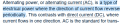
View attachment 354286
As I noted in an earlier post, context is very important when it comes to what AC and DC means. When talking about electrical power, it is generally taken to imply current reversal. In electrical signals, it is generally taken to refer to spectral content at or sufficiently near zero hertz.
 

MisterBill2

Joined Jan 23, 2018
27,652
As I noted in an earlier post, context is very important when it comes to what AC and DC means. When talking about electrical power, it is generally taken to imply current reversal. In electrical signals, it is generally taken to refer to spectral content at or sufficiently near zero hertz.
A handy way of reference is to call it "audio" or "RF", or even "VIDEO". Those terms are clear and descriptive.
 

drjohsmith

Joined Dec 13, 2021
1,615
I think what we have identified is the limits of the English language, and the multiple interpretations of.

example . mains of say 100 v pk to pk,
typically called AC, as in alternating current.
if its transformers to say 5v pk to pk , is it still AC ,
if it has a 2.5v dc common mode , is it still ac ?
if it has a 10 kv dc offset, is it now dc with a ripple?
 

MrChips

Joined Oct 2, 2009
34,871
A signal such as 6 VAC without context implies the RMS value of a sinusoid with zero DC content.

If it is added to 10 kVDC, you would state it as such,
10 kVDC with 6 VAC rippple.

10 kVDC with 6 V ripple would imply 6 V pk-pk.
 

drjohsmith

Joined Dec 13, 2021
1,615
A signal such as 6 VAC without context implies the RMS value of a sinusoid with zero DC content.

If it is added to 10 kVDC, you would state it as such,
10 kVDC with 6 VAC rippple.

10 kVDC with 6 V ripple would imply 6 V pk-pk.
precisely, @MrChips
the same sine wave depending on context has different english.
 

drjohsmith

Joined Dec 13, 2021
1,615
To rephrase,
If you say, 6 VAC, it is RMS voltage.
If you say, 6 V ripple, it is peak-to-peak voltage.
Totally ,
A 10v peak to peak sine wave can have many names , and definitions.
E.g. in the 10 kv line , one could be looking at removing the sine wave , so it could be called noise
Or it could be a control signal , so it's called modulation
English is wonderful , I only realised when I started working around world , and one has to be very aware of context

Lovely one , one company called a rack what the client called a shelf .
 

Thread Starter

johnyradio

Joined Oct 26, 2012
615
How about a mains AC to DC converter, labeled as such, which due to poor filtering has ripple in its DC output. Would that ripple mean that this converter is outputting AC?
 
Top