DIY power transformer help

Hymie

Joined Mar 30, 2018
1,347
It was I that advised you that you needed a capacitor of the order of a Farad+ to smooth out your rectified dc at the current being drawn – and I see that you have several 3.6V, 1F super capacitors (no doubt for this purpose).

Given that your fully charged battery will be above the capacitor voltage rating 3.6V, you will need to place two in series to produce a capacitor with a 7.2V rating. But placing two 1F capacitors in series (to get a 7.2V rating) will half the effective capacitance. Therefore to bring the capacitance value back to 1F you will need to add a second set of two 1F capacitors in series, placed in parallel with the first set.

Now the bad news – these super capacitors are in general used as a voltage back-up source much like a 3V lithium cell, where the current draw is very low. The reason for this is that these super capacitors have a relatively high internal intrinsic impedance. Imagine that the super capacitors you have, have a 1Ω internal resistance. Fully charged at 3.6V, the capacitor could deliver a maximum current of 3.6A – which is not going to do much good for your 100A charge current.

To get capacitors capable of large ripple (charge/discharge) currents, you need to consider electrolytic types – which as you will discover, even at the relatively low voltage required, the large capacitance values will make them expensive.

That said – I don’t believe that charging the battery with a full wave rectified voltage will be an issue.
 
Last edited:

Thread Starter

quitenoob

Joined Mar 27, 2022
262
Given that your fully charged battery will be above the capacitor voltage rating 3.6V
I intend to use my full power setup to charge the battieries up until 3.6v.

And then pull out my CV/CC that can go to 10 amps to top things off as to make sure the batteries do get the love they need while also making sure I can give them a good ass kicking as to make sure they are up to specs.

yes there is no photo of my lab power supply yet. I am also not sure there will ever be one. Just believe me. I seldomly lie. Even less in this context.
 

Thread Starter

quitenoob

Joined Mar 27, 2022
262
I intend to use my full power setup to charge the battieries up until 3.6v.

And then pull out my CV/CC that can go to 10 amps to top things off as to make sure the batteries do get the love they need while also making sure I can give them a good ass kicking as to make sure they are up to specs.

yes there is no photo of my lab power supply yet. I am also not sure there will ever be one. Just believe me. I seldomly lie. Even less in this context.
And let's remember that the charge goal is 3.65 volts rather than anything lower. This is in context of top balancing.

Certainly later down the line in where we want to have our battery bank go even further than the 6000+ cyle rating then we need to stop discharge before 20% and stop charge before 80%.

But this whole eneavour is about how to get many cells tested in a short amount of time.
 

Thread Starter

quitenoob

Joined Mar 27, 2022
262
And let's remember that the charge goal is 3.65 volts rather than anything lower. This is in context of top balancing.

Certainly later down the line in where we want to have our battery bank go even further than the 6000+ cyle rating then we need to stop discharge before 20% and stop charge before 80%.

But this whole eneavour is about how to get many cells tested in a short amount of time.
So that is why I intend to go full force to 3.6v and then use my lab power supply to level out to 3.65 in a controlled manner
 

Hymie

Joined Mar 30, 2018
1,347
Don’t exceed that 3.6V rating, otherwise you are likely to have a mini explosion of the capacitors, with the resultant debris spread over the local vicinity. Also check out their specs – you might find that charging/discharging at 100 times/second is not recommended.
 

Thread Starter

quitenoob

Joined Mar 27, 2022
262
Given that your fully charged battery will be above the capacitor voltage rating 3.6V, you will need to place two in series to produce a capacitor with a 7.2V rating. But placing two 1F capacitors in series (to get a 7.2V rating) will half the effective capacitance. Therefore to bring the capacitance value back to 1F you will need to add a second set of two 1F capacitors in series, placed in parallel with the first set.
I've got 4 of those bad *sses and given their pricing You give me a number and I will get it.
 

Hymie

Joined Mar 30, 2018
1,347
Given that these capacitors are normally used in battery back-up type applications, rapid charge/discharge may be outside their operating specs. As an example, if they were to have a 1Ω internal resistance, the power dissipated by this internal resistance (due to the current flow) may result in the capacitor over-heating and failing.
 

Hymie

Joined Mar 30, 2018
1,347
If these super capacitor can withstand charge/discharge at 100 times/second, you need to know what the effective internal series resistance is to work out how many you would need (in parallel) to sustain a 100A discharge current.

You could consider buying something like this to measure the ESR of the capacitor – but others may be able to advise of a technique to measure this using a multimeter.

https://www.ebay.co.uk/itm/303744883244?hash=item46b89b1a2c:g:Ac4AAOSwCxtfmn5U
(the ebay device may not be able to handle a 1F capacitor, being outside its measurement range)

Even so, it might be that the number of capacitors required is more than 100.
 

Thread Starter

quitenoob

Joined Mar 27, 2022
262

Thread Starter

quitenoob

Joined Mar 27, 2022
262
It has come to my attention during my closed rectifier thread that this platform also has a compent search feature. shall we try that one?
 

Thread Starter

quitenoob

Joined Mar 27, 2022
262
that can happen to all f us. it will certainly happen to me all the time.

Anyway. is not 3.6 volts what we are looking for. and we deal with the farad rating later?
It has come to my attention during my closed rectifier thread that this platform also has a compent search feature. shall we try that one?
 

Thread Starter

quitenoob

Joined Mar 27, 2022
262
The scientific method.
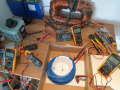
In an earlier step I made a small magnetic flux meter as I had no other means to measure magnetic fields that shift poles as fast as 50Hz.

in step 2 I am now using it to see where the fields lines are stongest and where we should focus attention on.
1652181387727.png

I am drawing the tentative conclusion there is no point in having a large core.
My custom field meter reads .6 milivolts when held next to the wire and .3 when at the center.

My readings could be way different if I beef up this experiment with a voltage that actually scares a bit. So that is obviously what I am going to do next.

For those not recognizing that black component attached in between variac out and coil in. That is an inrush limiter.
I am getting the feeling I just might have been extremly luck again just randomly selecting something and having it seemingly work out.
 

Thread Starter

quitenoob

Joined Mar 27, 2022
262
Update # I forgot ;)

So I could really use some suggestions on how to interpret my recent findings.
1652268027774.png
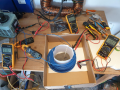
Seen here can be an additional custom field meter.
Also the coil is now directly hooked up to the variac.

I failed miserably to actually apply the scientific method because although both custom field meters have 20 winds and use the same enameld copper wire (.4mm diam) I never checked if they are reading the same values at the same locations :(

What makes me no longer certain I am qualified to draw any conclusions regarding core size is.
1652268266278.png
Look how adding a little powder decreases the field strength near the coil a bit yet increases it dramatically near the center of the coil.
This is why I prefer practical experiments over theoretical number crunching. I could feel the 50Hz vibration in the cup that held the powder while I was pouring it is. Really cool experience.
I think the lowering of the value on the field meter closes to core (FM1) is because it's alignment with the field got knocked a bit when the avalange of powder came ;)

But I was not done yet.
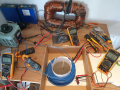
1652268582484.png

Adding more powder seems to keep increasing the field strength. As well as reducing current draw in the coil.

So now I am not certain anymore what size of coil I should go for.

Any suggestions on how to determine this by practical field experiments are much welcomed.
 

Thread Starter

quitenoob

Joined Mar 27, 2022
262
Although I am not entirely sure what inductance is yet, and how it is related to this project, I have learned in the meantime of some calculations;
Measure the primary current with the secondary open circuit.
Z=V/I will give you the impedance.
X = √(Z^2 - R^2) gives you the reactance
(the resistance should be insignificant), and from that,
L= X/(2πf) gives you the inductance

Would it make sense to measure inductance now on the current transformer or do we wait until the all new and improved (I have such a good feeling about what's coming!!!) version sees the light of day?
 
Top