DIY power transformer help

Thread Starter

quitenoob

Joined Mar 27, 2022
262
I just lost 1 unit of internet fame on my misplaced bet.

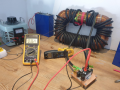
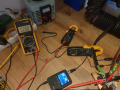
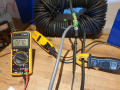
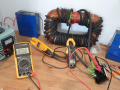
With 90 winds (100% increase as earlier there were 45) in the secondary coil

When the amps in primary reach 6.7 I am no where near 3.65 VAC in secondary (with the good old 5m 2.5mm2 resistor attached)

Also the amps in secondary are pathetic (in relation to this project's expectations) at 58 ;(
1650035321260.png

I will try now with 23 winds (50% of the original and 25% of current wind count)

I am placing no more bets ;(

Moderator's note: Please don't post huge images (3MB) 800 x 600 is enough and is more convenient for people without very fast internet connections.
 
Last edited by a moderator:
Thread Starter

quitenoob

Joined Mar 27, 2022
262
ugg, i've lost more than only 1 bet. Also lost my self confidence.

I thought I was slowly learning and understanding more about the matter at hand yet my findings with 23 winds are similar to those with 90 winds.

I am soo confused atm. I am just not smart enough to make any predictions and so I am back to the good old trail and error.

Winding back to 45 winds now and taking it from there. I have failed to improve the efficiency but 36% is better than nothing and I will take it for the time being. Certainly not a long term solution.

it is however a more than good solution in a crisis situation. after all that is what I am prepping towards in broader terms anyway
 
Last edited:

Thread Starter

quitenoob

Joined Mar 27, 2022
262
it's good to be back with +- 45 winds.

I have confirmed that the recitifer is no good for this scenario.

I can only get to about 2.4VDC while reaching the 100amps rating of the rectifier. It gets really (too) hot and fast at that.

I will be DIYing a rectfier for the grownups then ;(

1649937455312.png

I realize I took the picture after the experiment but this is just to let you guys see they way I hooked it up in case there might be something done wrong.
 

strantor

Joined Oct 3, 2010
6,875
ugg, i've lost more than only 1 bet. Also lost my self confidence.

I thought I was slowly learning and understanding more about the matter at hand yet my findings with 23 winds are similar to those with 90 winds.

I am soo confused atm. I am just not smart enough to make any predictions and so I am back to the good old trail and error.

Winding back to 45 winds now and taking it from there. I have failed to improve the efficiency but 36% is better than nothing and I will take it for the time being. Certainly not a long term solution.
Don't lose heart, you are learning! You have crested mount stupid and are looking down into the valley of despair.
Screenshot_20220414-072745_Google.jpg
You may or may not (probably do, unfortunately) have further to descend, but as you can see in the above graph, it does trend back upwards at some point. Things will get better. You are doing yourself a favor in my opinion, learning these things first hand at the start, before going to books. When you start with books, you have nothing tangible to relate the information to.

Now you have a taste of the reasons why:
-I am so impressed your transformer worked at all
-I refused to place any bets

I think you got pretty lucky with selecting a number of turns that worked early in the process. There is much math that goes into this usually. And usually that math is based on mathematical models of known characteristics of transformer laminations published by the manufacturer of the laminations. This thing doesn't even have laminations, so the math is pretty much hopeless and the only way I know to optimize it would be to do dozens of experiments with different numbers turns in primary and secondary.

If this PVC transformer doesn't do what you want easily enough, you can try what everyone does: rewind a microwave oven transformer. Those at least are made of legitimate laminations and the primary winding is already done for you, in the proper number of turns for the given laminations. All you need to do is find the right number of turns in the secondary to get the voltage you want.
 
Last edited:

Hymie

Joined Mar 30, 2018
1,347
Those wires attached to the lithium battery in your photos look like they could withstand passing 10A (at most) – are you sure the battery is rated for a 140A charge (and not 14A)?
 

Hymie

Joined Mar 30, 2018
1,347
The bridge rectifier needs to be attached to a large heatsink to pass 100A.

The diodes will drop 1.4V in forward bias, and at 100A will dissipate 140W, even at 50A it will dissipate 70W – you might get away with a smaller heatsink combined with a fan blowing directly at the bridge rectifier.
 

Thread Starter

quitenoob

Joined Mar 27, 2022
262
Those wires attached to the lithium battery in your photos look like they could withstand passing 10A (at most) – are you sure the battery is rated for a 140A charge (and not 14A)?
Weird yes? But those 10mm2 wires have passed to test and can easily handle a load of 60 amps. I have used a cc/cv earlier to confirm this.

I am certain that the cells are rated at 280A discharge and 140A charge.

what I am not certain about is if they really are

hence this whole endeavor

Point being, even if we buy reputable branded products. how can we know if things are up to specs we we blindly trust the on paper specs?

NO!!

We should be enabled to make sure specs are as advertised.

In a completly different domain. In where it was about ECC memory (computer related stuff) my sheer determination has uncovered some nasty facts that when blindly trusting the on paper specs will get one into a world of hurt

sometimes its good to be a little weird like I am ;)
 

strantor

Joined Oct 3, 2010
6,875
my thoughts exactly.
I must have crossed some kind of arbitary boundry had have not been given a mechanism to redeem my self.
I asked here because every time I've had a thread closed, there was a little 5-word explanation that (I think) only I could see.

I suspect a mod felt the project was unsafe, but if that's the case they closed the wrong thread. That one was pretty harmless, just a rectifier. If anything here is dangerous it's the transformer.
 

strantor

Joined Oct 3, 2010
6,875
Also sometimes if a discussion gets nasty (personal insults back and forth, usually political) a thread will get closed and the offending posts deleted, leaving little clue as to why. The only people who know what happened are those who saw the exchange before the hammer came down. I wondered if maybe someone saw something.
 

Thread Starter

quitenoob

Joined Mar 27, 2022
262
Ladies and gentlemen!!


I have now a different rectifier setup. The module it self is 150A rated and I have gone and gave it some help in terms of heat dissipation.
As an IT guy myself I found myself some thermal paste and an old heat sink that I forgot about so I applied those.

Although reading up on the theory, which I really do not like, I am not sure I am getting any closer to understanding what I am doing.

Please take this for example.
1650808376873.png

If my interpretations are correct I am now outputting around 3.65VDC at an amperage that is not at all we are looking for ;(

If the image is not of high enough resolution to make out the amps in the secnd. coil than please let me know so I can ask the community to reevaluate their stance on high resultion images.

Anyway it is soo low that I am still confused ;)

Should I put an actual load there like the one we had earlier? the 5m 2.5mm2 wire that is?
 
Last edited by a moderator:

strantor

Joined Oct 3, 2010
6,875
After a short while of absence [...]

If my interpretations are correct I am now outputting around 3.65VDC at an amperage that is not at all we are looking for [...] it is soo low that I am still confused ;)

Should I put an actual load there like the one we had earlier? the 5m 2.5mm2 wire that is?
Glad to see you back! I was afraid we'd lost you.

Yes, you need to connect a load to it, in order to see any amps. The wire load from previous experiments should work fine.
 

Hymie

Joined Mar 30, 2018
1,347
With the secondary of the transformer connected to the bridge rectifier AC (~) terminals, you need a load (low resistance) connected between the + and – terminals of the bridge rectifier.
Even with the heatsink in the photo, keep a careful eye on the rectifier’s temperature, otherwise one or more of the diodes may fail open or short circuit due to an excessive temperature.

I still think you are going to need more than 3.65Vdc to charge the lithium battery, but first see if you can get the required current through the rectifier – then think about connecting a battery as the bridge rectifier load.
 

Thread Starter

quitenoob

Joined Mar 27, 2022
262
Ok, so I am not quite ready to rock yet.

Yes I've posted here an excerpt regarding that lifepo4 will not degrade when pulse charging.

But my intuition tells me that having this ripple is no good eather ;(

1650995873086.png

Funny enough the resistor and the rectifier keep their cool so to speak. does not really matter if the system is running for 30 seconds or 2 minutes as I have tried both durations and smooth sailing all along.

I will be thinging about capacitators and bleed resistors next to smoothen out the ripple.

Given the AC input is at around 110. can one run a quick efficiency calculation please? I am hoping that earlier values were a little off.
 

Thread Starter

quitenoob

Joined Mar 27, 2022
262
ok,i'll go and give it a try.

in: 110vac * 8 A = 880 Watt
2 VDC after rectification = 1.38VAC before rectification
out: 1.38vac * 58.7 A = crap
efficiency = total crap

I'll try again tomorrow. these numbers can't be correct ;(
 

Hymie

Joined Mar 30, 2018
1,347
The battery charging waveform out of the rectifier will be a full wave rectified voltage – by adding a capacitor across the output of the rectifier will reduce the voltage ripple.
However given the current draw, to significantly reduce the voltage ripple will require a very large capacitor.

The formula for the peak to peak ripple voltage is given by:-

V = (I x t)/C

Where V = the p-p ripple voltage, I = the current (in amps), t = time between charging pulses (in seconds), C = the capacitor value (in Farads).

Using the formula, if we consider the current to be 100A, and the allowable voltage ripple to be 1V, the time between charging pulses is 0.01s for 50Hz mains – putting these numbers in the formula, we get:-

1 = (100 x 0.01)/C; so even limiting the ripple voltage to 1Vp-p will require a 1 farad capacitor.
 

LowQCab

Joined Nov 6, 2012
5,101
Most Standard Diodes are going to drop anywhere from ~.5-Volts to ~1.5-Volts,
some even go as high as ~2-Volts of "Forward-Voltage-Drop".

Multiply the particular Voltage-Drop of your Diodes by the Current being pushed through through them,
and You will then have the number of Watts that each Diode will waste, and which it must dissipate into the Air.
This is why your Diodes will need a substantial Heat-Sink to keep them from smoking.

The alternative is to use huge MOSFETs arraigned as a Bridge-Rectifier, and then create the necessary
supporting Circuitry to make them Switch On and Off in sync with the 60hz AC Line-Voltage.
.
.
.
 
Top