DIY power transformer help

Thread Starter

quitenoob

Joined Mar 27, 2022
262
Extra extra, read all about it.

I,ve put 5m of 2.5mm2 solid wire between both ends of the 35mm2 secondary coil.

Super nervous while slowly dialing up the variac. Too nervous that I went a bit too far and as I had to make a photo did not want to take the time to dail it back again.

* Amps in primary: 6.7
* VAC in secondary is 3.72 (close enough to 3.65)
* Amps in secondary: 92.2
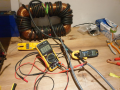
1649739061022.png

Are these results hopeful?

If there is nothing to be done about this then I'll settle for a +-90 amps charge rather than the 125 goal.

But I do have a lot more 35mm2 wire left to add winds to the secondary if that is useful. It will al least reduce the amps in the primary coil and will require the variac to be dialed up less to get to the same output voltage.

Looking forward to suggestions to improve on the design before I start making that acs circuit.
 

Thread Starter

quitenoob

Joined Mar 27, 2022
262
I left it running for about 30 seconds and there is a noticeable temperature rise in the resistor even though heavily insulated. So I am not sure if I dare to leave this setup running much longer than that.

All components are still fine though.
 

strantor

Joined Oct 3, 2010
6,875
Extra extra, read all about it.

I,ve put 5m of 2.5mm2 solid wire between both ends of the 35mm2 secondary coil.

Super nervous while slowly dialing up the variac. Too nervous that I went a bit too far and as I had to make a photo did not want to take the time to dail it back again.

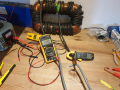
* Amps in primary: 6.7
* VAC in secondary is 3.72 (close enough to 3.65)
* Amps in secondary: 92.2

View attachment 264856

Are these results hopeful?

If there is nothing to be done about this then I'll settle for a +-90 amps charge rather than the 125 goal.

But I do have a lot more 35mm2 wire left to add winds to the secondary if that is useful. It will al least reduce the amps in the primary coil and will require the variac to be dialed up less to get to the same output voltage.

Looking forward to suggestions to improve on the design before I start making that acs circuit.
Yes, much better than I expected!
That is probably a good enough test but if you want to hit the numbers exactly, you could shorten your resistor wire a bit.

The amps in your secondary are dependent upon the resistance of the load. According to Ohm's law, your resistor wire is 40.3mΩ (3.72V ÷ 92.2A = 0.040347Ω). If you want to see 3.72V @ 125A then you'll need the resistor to be around 30mΩ (3.72V ÷ 125A = 0.02976Ω). So your resistor wire can be trimmed by about 25%. The 5m can be shortened to 3.75m.

Be aware that if you do this, the resistor wire will get even hotter than it gets now, and faster. Be ready to pull the plug at the first sign of smoke or odor. If you're not comfortable with that, then don't worry about it. As I said, I think the result is very good and probably the transformer will work for you.

Edit:
If you have voltage on the primary from your test, I would like to know it. To calculate the efficiency of your transformer.
 

Thread Starter

quitenoob

Joined Mar 27, 2022
262
If you have voltage on the primary from your test, I would like to know it. To calculate the efficiency of your transformer.
*Amsp prim: 6.7
* VAC prim: 143
*Ams second: 91.7

I was unable to dial the variac quick enough exactly so that the amps in second were 92.2 to match the previous result.
SHould I try again?

1649744401242.png
The amps in your secondary are dependent upon the resistance of the load
I just got a brainwave. If the resistance of the wire of the load determines the max amps in secondary coil then I could cap the amps going into the battery by making the wires to the battery of the correct length right?
That would safe millions of lives and shorten the war by 5 years.
 

Thread Starter

quitenoob

Joined Mar 27, 2022
262
LTSPICE is a bit complicated for me. I am seeing all these components for the first time ;( I would like to use it to see about ripple and if I can smoothen it without having to resort to hooking up a 3 phase power source. I really am not looking forward to having to make 2 extra transformers ;)
 

Thread Starter

quitenoob

Joined Mar 27, 2022
262
I have hooked up the 35mm2 ends to the single phase bridge rectifier and attached 5m 2.5mm2 solid wire to the + and - terminals of the rectifier.

When measure DCV on the other ends of the 2.5mm2 wire I get +-12VDC even when the variac is at 0%. Does anyone know what is going on there?

Can I short the ends of the 2.5mm2 wires and test both amps in secondary coil and VDC after rectification?
 

strantor

Joined Oct 3, 2010
6,875
*Amsp prim: 6.7
* VAC prim: 143
*Ams second: 91.7

I was unable to dial the variac quick enough exactly so that the amps in second were 92.2 to match the previous result.
SHould I try again?
I will assume you got the same 3.72V on the output as before.

Input power: 143V × 6.7A = 958W
Output power: 3.72V × 91.7A = 341W
Power wasted in transformer: 958W - 341W = 617W
Efficiency: 341W / 958W = 36%

These are not good numbers compared to commercially available transformers, but they are much better than I was expecting.

Screenshot_20220412-063735_Google.jpg

I was actually expecting it wouldn't work at all, but you have proven me wrong and made a functional transformer, and I am impressed. You just need to find out if the wasted power is going to be a problem during long charging sessions, and if the money saved in constructing this will offset the extra cost of electricity that you will pay. The transformer will be dissipating as much heat as a cheap clothes iron. Since it has so much surface area that probably won't be a problem, but if it is a problem, it could be a deadly one.

Screenshot_20220412-062529_Google.jpg

If it were my project I would do a longer test (outdoors) by making a resistor of more wire so that the wire doesn't burn. If 5m gives you the resistance you prefer, you can double the length to 10m which will double the resistance, and then put another 10m length in parallel with it, which will half the resistance, bringing it back down to the same value as before, but now with 4x more wire across which to dissipate all that heat.

I expect tge transformer will get warm, but not too hot to touch, and if that's the case then it should be safe to use, but I would want to verify.

View attachment 264861

I just got a brainwave. If the resistance of the wire of the load determines the max amps in secondary coil then I could cap the amps going into the battery by making the wires to the battery of the correct length right?
That would safe millions of lives and shorten the war by 5 years.
Yes this one way to limit current but it is not the most efficient way. It is more efficient to limit the current by electronic sensing and switching regulation.
 

Hymie

Joined Mar 30, 2018
1,347
With the concern over an overload/fault causing a catastrophic failure of the transformer – I’d recommend you consider embedding one of these in the primary winding:-

https://www.ebay.co.uk/itm/203695922581?hash=item2f6d391d95:g:e8YAAOSwy9RhjQQK

They are commonly used in such a situation to protect against faults. Bear in mind that it is a single-shot device, once tripped the fuse is open circuit. The 10A rating of the thermal fuse is not a fusing current (but a current rating that the component can pass), the temperature rating is the critical parameter.

When soldering the thermal fuse, take care not to apply too much heat which could cause the fuse to operate.
 

Thread Starter

quitenoob

Joined Mar 27, 2022
262
what i'll do is put a 4 amp cuircuit breaker in btween the power source and the variac.
I'll put a 5amp thermal fuse in between the variac and the primary coil
and i'll double the secondary wind count.
That way I only have to dial up the variac to 50% of what I had this time around.
It am assuming that will also increase the efficiency of the transformer.
I am betting 1 unit of internet fame that this will work!
Anyone wants to place a bet? ;)
 

Thread Starter

quitenoob

Joined Mar 27, 2022
262
Can anyone please shed some light on if I can short the 5 meters of 2.5mm2 wires coming out of the rectifier to measure VDC?
 

Thread Starter

quitenoob

Joined Mar 27, 2022
262
It am assuming that will also increase the efficiency of the transformer.
I am betting 1 unit of internet fame that this will work!
Anyone wants to place a bet?
hahah ok no one is of the betting kind here ;) even when only betting units of internet fame ;)

But is one interested in results I find along the way on how to improve on this design?
 

strantor

Joined Oct 3, 2010
6,875
i'll double the secondary wind count.
That way I only have to dial up the variac to 50% of what I had this time around.
It am assuming that will also increase the efficiency of the transformer.
I am betting 1 unit of internet fame that this will work!
Anyone wants to place a bet? ;)
I will place no bet. The ratio of primary to secondary turns is a simple science, but the actual number of turns of each is a less simple science. I would think that by adding turns to the secondary so that the primary can run at lower voltage, will not change much. Primary will require less volts but more amps, same amount of watts though. And the secondary, since it will have more turns, it will have more resistance, and therefore more losses. So maybe, if anything, it will be worse, but I don't know for certain.
 

Thread Starter

quitenoob

Joined Mar 27, 2022
262
Can anyone please shed some light on if I can short the 5 meters of 2.5mm2 wires coming out of the rectifier to measure VDC?
It seems no need to hook up a wire to the + and - terminals of the CRAP(TM) rectifier I used. I can measure VDC without even shorting the attached 2.5mm2 wires.

Can anybody recommend an affordable yet high quality full bridge rectifier capable of handling high amps?

If not then that's ok. i have several projects running to put and end to sad state of affairs and DIY one, including this one ;)

How many windings in your primary? I suspect it is too low by a factor of 10.

Bob
Now we are getting somewhere, do you have any suggestions how to get this project even further?

Buy yourself a diode with at least a 140A rating and see if your transformer can charge the battery at a decent rate (over 100A). I suspect you will need to increase the transformer input voltage to overcome the battery voltage in the secondary circuit.

Bear in mind that very nasty things (fire/explosion) can occur when lithium batteries are abused beyond their ratings (exceeding maximum charge/discharge current/voltage). While developing your circuit, never leave a battery unattended while connected in circuit.
I am now thinking of an outside cage. Would you have any idea on how large of a force I need to be able to contain if sh*t hits the fan?
 
Last edited:

Hymie

Joined Mar 30, 2018
1,347
If you connect the battery as I outlined above, as long as you keep a close eye on the charge current and battery voltage, the battery should be OK.

I’d recommend you slowly increase the primary voltage while monitoring the primary transformer voltage & current, along with the battery charge current and dc battery voltage.

Be prepared to cut the primary power quickly should anything untowards occur. Your bridge rectifier is marked at 100A, under no circumstances should you exceed this – it is likely that this rating is based on the heatsink/block being maintained at 25⁰C. If the set-up permits, I’d limit the battery charge to 50A while closely monitoring all voltages and currents, plus transformer and rectifier block temperature. Do not allow the battery voltage to exceed 4.2V (which is normally the maximum charge voltage for a lithium battery with a nominal 3.7V).

Remember all secondary cables/connections must be rated for the battery charge current applied.

Make a record of the transformer input and output voltages and currents and calculate the transformer losses. This will be the input power (VxA) minus the output power (VxA), assuming unity power factor.
 

strantor

Joined Oct 3, 2010
6,875
It seems no need to hook up a wire to the + and - terminals of the CRAP(TM) rectifier I used. I can measure VDC without even shorting the attached 2.5mm2 wires.

Can anybody recommend an affordable yet high quality full bridge rectifier capable of handling high amps?

If not then that's ok. i have several projects running to put and end to sad state of affairs and DIY one, including this one ;)
You should be able to read VDC without loading the output. Do you think there is a problem? I don't see one, maybe I'm missing something. Been a while since there was a picture...
 

Thread Starter

quitenoob

Joined Mar 27, 2022
262
Make a record of the transformer input and output voltages and currents and calculate the transformer losses. This will be the input power (VxA) minus the output power (VxA), assuming unity power factor.
yes sir, will do! I am looking for an extra mmeter with high resolution as we speak

no big deal.
hahhahhhaha

may I please invite readers of this thread to join me here?
https://forum.allaboutcircuits.com/threads/diy-150amp-power-full-bridge-rectifier-help.186261/
 
Top