DIY power transformer help

Thread Starter

quitenoob

Joined Mar 27, 2022
262
Yes thank you @LowQCab that crappy rectifier is probably what is holding efficiency back more than the already subpar 36%.

However I am not yet mentally ready to start making circuits.

Can one think of freakishly large diodes that can handle 500amps without a sweat? And would that reduce the thermal buildup?
 

LowQCab

Joined Nov 6, 2012
5,101
"" Can one think of freakishly large diodes that can handle 500amps without a sweat?
And would that reduce the thermal buildup? ""


They don't exist.

And it's not "Thermal-Build-Up",
it's a continuous conversion of Electrical-Power directly into Heat,
which must be "Dissipated" somehow,
which means that the Heat must be removed from the device by
some means and put somewhere else.
Which is what "Heat-Sinks" are made for.
.
.
.
 

LowQCab

Joined Nov 6, 2012
5,101
Check Post #100 ..........
"" The alternative is to use huge MOSFETs arraigned as a Bridge-Rectifier, and then create the necessary
supporting Circuitry to make them Switch On and Off in sync with the 60hz AC Line-Voltage. ""
.
.
.
 

Ian0

Joined Aug 7, 2020
13,132
ok,i'll go and give it a try.

in: 110vac * 8 A = 880 Watt
2 VDC after rectification = 1.38VAC before rectification
out: 1.38vac * 58.7 A = crap
efficiency = total crap

I'll try again tomorrow. these numbers can't be correct ;(
What is the primary inductance?
 

Thread Starter

quitenoob

Joined Mar 27, 2022
262
Ahh yes Now I think I am getting somewhere.....

earlier I have tried again several changes to the setup as to improve on the 36% base efficiency.

hahaha I also tried putting the secnd. coil inside of the 75mm pvc pipe ;) that did not work as the core was saturated far too quick that way resulting in the amps in prim. shooting sky high really fast.
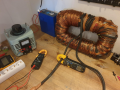
(Since I have to scale down my photo's I am not really posting photo's as much as it is quite a hassle so please just trust me on this)

But the idea did stick with me. The point of a torodail transformer is that the magnetic flux is contained within it. So it makes no sense at all to have a thick 2nd coil on top of the 1st one where there is little flux as all of the flux is within the closed loop core.

So of course I tried again. This time wiring the 2nd coil first on the 75mm pvc pipe filled with iron powder. And putting the 1st coil on top of that.

1651241342033.png
Yes the transformer looks horrendous but to be honest I do not give a rats **s. ;)

But look how little VAC is going into it. I have high hopes for this setup.

Anyway I will be delaying updates a bit until my orders of extra clamps and mmeters come in. Because I want to be able determine the efficiency of the whole system in a single run rather than several.

Give it a few days and the clamp/multi-meters are in and then it's show time again.

I am still looking for a theoretical answer to if higher amp rated components lead to less losses or not
 

Thread Starter

quitenoob

Joined Mar 27, 2022
262
Very interesting - if slightly dangerous.

To answer this original question, what you need to do is add some "leakage inductance". This can be done by adding an air gap in the core but it's usually done by adding a magnetic shunt (with an air gap) across the magnetic circuit.
This is often done in arc welders, microwave ovens and neon sign transformers to limit the secondary current.
For a diagram and a picture of a transformer with an adjustable magnetic shunt see the bottom of this Wikipedia article: https://en.wikipedia.org/wiki/Leakage_inductance
Also see the attached picture.
also I forgot to mention that now it has this variable air gap that was mentioned earlier by you.

Not sure if one can tell but in the middle at the top we can push apart those parts. creating in essence a variable air gap.

May I please ask you (or anyone) for more input regarding this?
 

Ian0

Joined Aug 7, 2020
13,132
If no one knows then no problem. I also do not. Shall I get a 50, 100, 200 and 400 amp and measure if deemed interesting data for the world at large?
A real diode consists of a hypothetical diode (a fixed voltage drop) in series with a resistance. For a higher current rated device the resistance will be lower. For a higher voltage rated device, the resistance will be marginally higher.
 

Ian0

Joined Aug 7, 2020
13,132
I am not sure what inductance is yet. If your questions is still applicable after my latest updates please let me know and I will go through the horrid process of theory reading ;) ;(
Just measure it.
What you have made is an iron powder core. Iron powder has a much higher reluctance than silicon-iron laminations, which means it will have a lower inductance for a given number of turns, and that means a higher magnetisation current.
 

Thread Starter

quitenoob

Joined Mar 27, 2022
262
For a higher current rated device the resistance will be lower.
May I interpret this as to mean that higher amp rated components, in general, incur less loss than lower amp rated ones?
After all that is what I have been trying to get an answer to for quite a while now.

;)
 

Ian0

Joined Aug 7, 2020
13,132
May I interpret this as to mean that higher amp rated components, in general, incur less loss than lower amp rated ones?
After all that is what I have been trying to get an answer to for quite a while now.

;)
Yes they do, especially at 50Hz.
At 50kHz it's a different matter, as switching losses become important, and bigger divices have higher switching losses, but that doesn't affect you.
 

strantor

Joined Oct 3, 2010
6,875
Again, by chance I find this thread at the top of the "recent posts" list but I never received any notification that someone had replied to it. The last post I saw was post #94, which was my own post, and somehow missed post #93 which came before it, asking for efficiency calculations. It's like I keep getting involuntarily unsubscribed from it.

You asked about diodes, here is a list of diodes rated between 150 and 1,000 amps, with a forward voltage drop of 1V or less. There are some affordable options in the list but most are single diodes that you'll need four of, to make a bridge.

https://www.mouser.com/c/semiconduc...s|~If - Forward Current|~Vf - Forward Voltage
 

strantor

Joined Oct 3, 2010
6,875
Yes they do, especially at 50Hz.
At 50kHz it's a different matter, as switching losses become important, and bigger divices have higher switching losses, but that doesn't affect you.
I disagree. If you go to mouser or Newark, any electronics website with a decent sort/filter function and sort by high amps, you'll see all the options with low forward voltage drop disappear. If you filter out everything with high forward voltage drop then it eliminates all the options with high amp capacity. The higher current devices have a higher voltage drop and lower efficiency.
 

Ian0

Joined Aug 7, 2020
13,132
I disagree. If you go to mouser or Newark, any electronics website with a decent sort/filter function and sort by high amps, you'll see all the options with low forward voltage drop disappear. If you filter out everything with high forward voltage drop then it eliminates all the options with high amp capacity. The higher current devices have a higher voltage drop and lower efficiency.
If you are looking at the voltage drop at the rated current, then I agree.
But if you are looking at the voltage drop for a given current, then the higher rated devices will have a lower voltage drop, and Mouser et al 's sort will give you the voltage drop at the rated current.
 

strantor

Joined Oct 3, 2010
6,875
If you are looking at the voltage drop at the rated current, then I agree.
But if you are looking at the voltage drop for a given current, then the higher rated devices will have a lower voltage drop, and Mouser et al 's sort will give you the voltage drop at the rated current.
I thought the voltage drop of a diode was rather fixed, regardless of current. I will need to go back to the books I guess.
 
Top