DIY power transformer help

Hymie

Joined Mar 30, 2018
1,347
I’m impressed with the amount of work that you have put into this project, admitting that you are a novice – having managed to construct a transformer which in principle may do what you want.

To assist, I have attached an outline of a circuit design idea that might work – charging a lithium battery at over 100A. Typically a lithium battery will be fully charged at 4.2V, but you need to check the specification of your battery.

The circuit design (showing the transformer secondary winding) uses a thyristor to control the battery charge current. A thyristor can be considered as a diode that is switched on when an appropriate voltage is applied to the gate.

Not shown in the circuit diagram is the detailed control circuitry providing the gate switch voltage. With the battery voltage less than the fully charged voltage and the charge current less than the maximum, the circuit will switch the thyristor on; should either the battery charge voltage or current exceed the maximum levels the circuit will switch off the thyristor.

A further requirement of the circuit (not shown) is that it must be fault tolerant such that should any component fail, the battery will not be subject to charge/discharge outside its specification.

If your design works using a diode, then you need to replace the diode with a thyristor, with control circuitry. Controlling the gate turn on signal as required, could be achieved through a fairly simple circuit – but the add-on protection circuit might be more complicated.
 

Attachments

Thread Starter

quitenoob

Joined Mar 27, 2022
262
Buy yourself a diode with at least a 140A rating and see if your transformer can charge the battery at a decent rate (over 100A). I suspect you will need to increase the transformer input voltage to overcome the battery voltage in the secondary circuit.

Bear in mind that very nasty things (fire/explosion) can occur when lithium batteries are abused beyond their ratings (exceeding maximum charge/discharge current/voltage). While developing your circuit, never leave a battery unattended while connected in circuit.
Yes sir!! I'll never leave it out of my sight when charging

I’m impressed with the amount of work that you have put into this project, admitting that you are a novice – having managed to construct a transformer which in principle may do what you want.

To assist, I have attached an outline of a circuit design idea that might work – charging a lithium battery at over 100A. Typically a lithium battery will be fully charged at 4.2V, but you need to check the specification of your battery.

The circuit design (showing the transformer secondary winding) uses a thyristor to control the battery charge current. A thyristor can be considered as a diode that is switched on when an appropriate voltage is applied to the gate.

Not shown in the circuit diagram is the detailed control circuitry providing the gate switch voltage. With the battery voltage less than the fully charged voltage and the charge current less than the maximum, the circuit will switch the thyristor on; should either the battery charge voltage or current exceed the maximum levels the circuit will switch off the thyristor.

A further requirement of the circuit (not shown) is that it must be fault tolerant such that should any component fail, the battery will not be subject to charge/discharge outside its specification.

If your design works using a diode, then you need to replace the diode with a thyristor, with control circuitry. Controlling the gate turn on signal as required, could be achieved through a fairly simple circuit – but the add-on protection circuit might be more complicated.
Thank you for the addition. I'll get back to the project later today.

I had weird results yesterday in where reducing the secondary winds increases the amps in the primary. I'll need to confirm this.
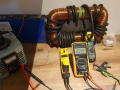
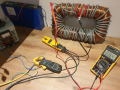
Try swapping the meters from the positions you had them in the picture in post #1. See if you get the same results.
Swapping the meters will yield similar results. However no longer the same as at first as I now have less windings on the secondary. I will see what happens if I wind the secondary back to it's original wind count.

I meant to say that the meters seem to be working and, even though the fluke has a much courser resolution as it is designed for regular household tasks while the others are more for the tinkerers I assume, the results are always comparable while swapping the meters around.

I am confused, you mentioned more than once about there being a difference in amps going into the variac and coming out of the variac, and indeed in your picture I see 8.26A in and 1.0A out, yet I see the variac needle fully to the right, indicating (on most variacs) that output voltage = input voltage (or input × ~1.2). So, why don't your meters agree? They're not even close. What is your input voltage and output voltage of the variac?
Yes I am also confused. I will also get back to that today.

But to be honest I am still confused on why the moon has phases so I am not saying I understand much ;)

Nah.. I am a bit behind knowledge, but not sooo bad.

I’m impressed with the amount of work that you have put into this project, admitting that you are a novice – having managed to construct a transformer which in principle may do what you want.

To assist, I have attached an outline of a circuit design idea that might work – charging a lithium battery at over 100A. Typically a lithium battery will be fully charged at 4.2V, but you need to check the specification of your battery.

The circuit design (showing the transformer secondary winding) uses a thyristor to control the battery charge current. A thyristor can be considered as a diode that is switched on when an appropriate voltage is applied to the gate.

Not shown in the circuit diagram is the detailed control circuitry providing the gate switch voltage. With the battery voltage less than the fully charged voltage and the charge current less than the maximum, the circuit will switch the thyristor on; should either the battery charge voltage or current exceed the maximum levels the circuit will switch off the thyristor.

A further requirement of the circuit (not shown) is that it must be fault tolerant such that should any component fail, the battery will not be subject to charge/discharge outside its specification.

If your design works using a diode, then you need to replace the diode with a thyristor, with control circuitry. Controlling the gate turn on signal as required, could be achieved through a fairly simple circuit – but the add-on protection circuit might be more complicated.
I am not sure how to interpret the contents of that acs file you attached. ;(

I took another stab at the project yesterday and am confused by the different, higher, amp the primary draws after I had changed the secondary windings by reducing them.

So the earlier 1 amp primary draw at 100% variac power I can no longer reproduce weirdly enough. Even when trying to put back the secondary windings as they were originally.

I did find however that if I dail up the variac to 25% i.e roughly 57VAC into the primary the variac in draws about 25% amps compared to primary in (variac out). And when I dail it up to 50% i.e. roughly 110VAC into the primary then the amps in the primary coil are around 2 times of what goes into the variac.
This makes sense to me and is not at all what we saw earlier where the variac in, dialed to 100%, draws around 8 amps while the primary draws 1 amps. I would have expected to see the amps to be similar there correct?

I'll try a toroidal setup for good measure and see what that does in terms of amps.
 

Hymie

Joined Mar 30, 2018
1,347
I created the attached circuit (asc file) using LTspice – I’ll convert it to a pdf for you, but it is a very simple circuit (showing the basic principle of the circuit idea).

I’m not quite sure what is happening with your primary current readings – but when you achieved a 131A secondary current (into a short circuit), you reported a 3.3A primary circuit with the variac input at 33Vac. These numbers seem reasonable, with the input power at around 100W.
If we consider that ultimately your Lithium battery will require a charge of 4V at 140A, the secondary load will be around 560W. Under these conditions you are likely to need a primary input voltage of around 80Vac with the current being approximately 8A.
 

Hymie

Joined Mar 30, 2018
1,347
I’ve modified my circuit slightly to use a thyristor rather than a diode to charge the battery, with the gate supplied via a diode & resistor - ultimately the gate voltage will be supplied by a control circuit. In the circuit, L1 represents the transformer secondary winding and V1 the battery being charged.

I have given a link below to an ebay item for a thyristor at a reasonable price (pack of 5 for £9.99) although only rated to 55A, they can be used for circuit development. A 150A thyristor is likely to cost £30 or more.

Once you sort out the transformer currents, you could consider connecting the thyristor circuit and see what battery charge current you get under various variac input voltages and battery charge states.

https://www.ebay.co.uk/itm/294037703992?hash=item4476034d38:g:5-gAAOSwXFldb2aA
 

Attachments

Thread Starter

quitenoob

Joined Mar 27, 2022
262
Thank you for the pdf. I'll investigate it a bit later once I have a few more experiments completed which I will outline later.

Currently I am able to produce 140 amps in the shorted secondary without breaking a sweat using a toroidal transformer. The amps drawn by primary are 3.1
1649006069948.pngI
The temperature of the primary coil becomes a bit warmer but nothing noteworthy so I believe I can dial up the variac higher as to reach the variac max amp out of 8amp. I believe that the 1mm enameled copper wire in the primary can take that kind of current.

The 50mm2 (7.9mm core diam) wire in the secondary is still sleeping when putting 140 amps on it. No temperature change at all. I left the system running for about 3 minutes.

However I just realized that my BMS (Battery Management System) has a charge cap of 125 amps so I will have to go a bit lower.
1649006584902.png

Regarding the experiements I meantioned earlier. I will try replacing the oversized 50mm2 secondary wire with something much smaller. 3x2.5mm2 to begin with and work my way up in wire size to see where the sweet spot lies.
 

Thread Starter

quitenoob

Joined Mar 27, 2022
262
hahahha I keep calling it a toroidal transformer while the shape is rectangular ;)

But I guess everyone knows I meant to say that it is now a closed loop
 

Hymie

Joined Mar 30, 2018
1,347
At 125A you should be using 35mm2 (2 AWG) cable to avoid excessive heating – you might be able to get away with something a bit smaller (but not much) – certainly not as low as 7.5mm2.

Ideally you should be limiting the maximum normal temperature rise of any transformer parts to 75K – but under short-circuit secondary conditions (with the input power at 100W) the transformer will not be dissipating as much power as when charging a connected battery (delivering a secondary of 4.2V at 125A).
 

Thread Starter

quitenoob

Joined Mar 27, 2022
262
Uggg. And I just had my 3x2.5mm2 wire all prepared to start winding. I'll cancel that experiment then and jump right to the main event.

It will take some time though for the 30mm2 35mm2 wire to arrive. I will order tomorrow.
 

Hymie

Joined Mar 30, 2018
1,347
You could test your transformer using 7.5mm2 cable – but make sure you cut the primary power before the insulation melts, making modification to your construction difficult.
 

Hymie

Joined Mar 30, 2018
1,347
I’ve created the equivalent of the charging circuit in LTspice - attaching the circuit diagram as the LTspice asc file and in pdf (so you can view it if you haven’t downloaded LTspice). I’d recommend you download LTspice, then you can run the simulation, altering the circuit values to see the effect on the charging parameters (current and voltage).

In the circuit, V1 is the sinewave output of the transformer secondary, R1 represents the inherent resistance in the secondary winding. D1 is the rectifying diode with V2 representing the lithium battery voltage being charged and R2 representing the internal battery resistance.

LTspice allows the circuit resistances shown to be incorporated within V1 and V2, but I have deliberately included them as separate components to allow easy adjustment of their values.

The attached LTspice simulation is limited to 0.02s (10 cycles of a 50Hz waveform).

Interestingly with the arbitrary (reasonable?) circuit values assigned, (V1= 14Vp-p sinewave; V2 = 3V; R1 & R2 = 0.01Ω) the charging current peaks at around 150A, with an rms value of around 60A.

Once you get to the point of building the charging part of the circuit, I would recommend you use an oscilloscope to observe the real-time voltage and currents in the circuit.
 

Attachments

Thread Starter

quitenoob

Joined Mar 27, 2022
262
Thank you. I will indeed go the LTspice route soon.

Once I have a bit of time tomorrow I'll also post my findings with the 3x2.5mm2 wire you asked for
 

Thread Starter

quitenoob

Joined Mar 27, 2022
262
I am not sure if I did things correctly but I tried the 3x2.5mm2 wire with more winds to see how much amps the primary is drawing when the secondary outputs 3.65VAC
1649222369982.png
it's around 5.6 amps which is still not too much for the primary as the temperature rise is modest (certainly not 75K) and the growling (the movement of the wires) is also very mild.

Next I shorted the secondary to see how many amps were drawn by it when I dailed up the variac to match 5.6 amps draw in the primary.
1649222541103.png
VAC in primary is 69.7.
Amps in secondary is 62.8 (limited by the small wire size, and or the crappy ring connectors a have clamped together).

I am waiting for the new wire to arrive and will try again with a similar amount of secondary winds.

Also I'll give LTSPICE a try one of these days. Interested to see the simulations based on the acs files shared here
 
Last edited:

Hymie

Joined Mar 30, 2018
1,347
7.5mm2 cable might be OK up to around 60A – I suspect that the resistance in the 7.5mm2 cable is limiting the short circuit current.

When you come to try to charge a battery, I think you are going to need more secondary winding turns to increase the output voltage, to that end you might need a larger wire CSA to get the required current.

In my LTspice simulation the secondary output was 14Vac (peak to peak) circa 10Vac rms, and the secondary winding and battery resistance quite low at 0.01Ω.

The oscilloscope board should be adequate for the purposes of probing the circuit, but as always with such cheap things there is always a compromise in performance/ease of operation. Never connect such a scope board to a primary circuit – you are likely to fry your laptop.
 

Hymie

Joined Mar 30, 2018
1,347
If I had two lithium batteries I wanted to charge (as shown in your photos), I’d look for an off the shelf charging solution. If I could not buy a charger capable of +100A, I think I would start with something like this (at 5Vdc rated to 70A, for a very reasonable price) and add the charge control circuit on the output. It would save the considerable grief of developing the transformer solution, although it would be limited to 70A – but do you really need fast charge of your batteries, at over 70A?

https://www.ebay.co.uk/itm/151886747221?var=452550520856

Ultimately if your home-spun transformer will not do what you want – you might have to fall back on such a solution. And it maybe possible to parallel two of the above supplies to give your desired 140A charge. Anyway for the time being I suggest you persevere with your transformer – but ultimately if you cannot get it to do what you want, the above supply might be the way to go.
 

Thread Starter

quitenoob

Joined Mar 27, 2022
262
First of all let me start by saying thank you for your efforts. I really am helped with your participation quite a lot
If I had two lithium batteries I wanted to charge
The thing is is that I now have 16 of them and am looking for a way to quickly test cells if they are up to specs as I intend to buy 48 more.
As I can't afford to buy cells from a reputable brand I need to take some risks buying from our friends from the east on one of those well known web sites from which the CEO got kidnapped by it's own government recently.

Moreover. Charging batteries is not the only thing I will be needing a custom transformer for as I am also making a DIY vertical windturbine that, if all goes to plan, outputs an insane amount AC volts at low rpm. Think along the lines of 400VAC 3 phase.

Then comes the wanting to learn aspect. When buying from store not much thought goes into the inner workings and if things break one is left clueless. This want I have to become self reliant was born with the recent pandemic that we have lost some good people in. Yeah I am now on a mission to become self reliant, including power generation, storage and what have you. Hopefully I'll get there in my lifetime and will be able to pass on this knowledge to my offspring.
 
Top