Facebook
 Google
 GitHub
 Linkedin

Hi and thanks for the reply,I must admit that I do not use any model.
And in my contributions I did not speak about models but on transistor physics.
I am aware that models do not necessarily always reflect physical laws (in the sense of cause and effect).
Some models are good for calculation purposes only.
In any case, we should really try to distinguish between models and physical explanations - otherwise misunderstandings and misinterpretations cannot be avoided (as we can see here in this thread).
As I can read - you would "really like to hear what he has to say on this subject."
OK - here is my answer:
You are wrong - all detailed Spice models do NOT use a controlled current source.
If you would look into the model descriptions you will notice that all Spice models, of course, are based on the classical exponenetial relationship Ic=f(Vbe).
This is absolutely necessary because these models must work for small-signal as well as large signal operation.
(Do you know about a current-controlled model for large signal operation?)
I hope I have answered all of your questions.
If you do not use any model then how do you calculate the collector current for example?
The Gummel Poon seems to use a current controlled current source, NOT a voltage controlled current source. There is of course more to it though. In the attachment It is dependent on If mostly until we get near saturation.
I am drawing attention to the fact that even a transistor is a passive device, in that it cannot really generate any power on its own without some sort of stimulus. To generate a current in the collector requires energy.
Consider the simple resistor. We of course have V=I*R, but don't we also have I=V/R. Is the resistor current controlled or voltage controlled. How about a simple diode. We can calculate the current from the voltage, or the voltage from the current, so is the diode current controlled or voltage controlled.
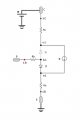
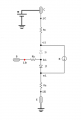
Now consider the drawing in the attachment paying attention to "iB" with direction indicated by the red arrow.
Can you show how you can get iC greater than zero with iB being zero? In other words, how can you get iC to be maybe 10ma with iB=0.
The main diode (darker shade) gets a voltage across it AND a current through it, and that means there has to be current into the base.
It appears that the way we calculate this stuff depends on what we are measuring. If we measure voltage first, it appears that we are looking for the current response, and if we are measuring current first, then we are looking for the voltage response.
The 'physics' of the transistor is still just a model, so I don't think that changes much. In these kinds of devices current and voltage are considered to appear simultaneously. If we apply a voltage we get a current, and if we apply a current we get a voltage. This is why I mention the application of the transistor as a requirement.
Attachments
-
 17.3 KB Views: 2