Facebook
 Google
 GitHub
 Linkedin

I think, I have explained that the large base current (compared with linear operation) results from the forward biased B-C junction.What does that mean?
The base current needs to be above a certain value to achieve saturation.
How is that nothing to do with current control?
This happens because the product Ic*Rc makes Vce<Vbe.
Hence, the Ib increase is the RESULT of saturation (and it is not the current to "achieve saturation").
For me, this is one of several indications that the BJT is not current-controlled.
Don`t you agree to this description?
Did I ever deny the existence of a base current? Why such a question?So how do you know what is a "low-resistance" without knowing approximately what the base current will be?
I think you know me well enough from other discussions to know what I mean.
Of course I can - even without a calculator - estimate the expected base current Ib for a selected Ic - and then select resistors that allow a current through the divder chain of at least 10*Ib.
I disagree. Here are the steps for designing a simple switch:For AC consideration the voltage-control transconductance model is fine, but for biasing and switching applications the current-controlled black-box model is useful.
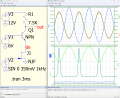
* Select Vcc, load Rc and a current Ic to make Vce<Vbe=(0.7...0.8) volts
* Calculate the value for a resistor Rs=Vs/Is between the base node and the switching source Vs. For this purpose, use a current Is which is large enough to be on the "safe side" because one (additional) portion of this current Is results from the forward biased B-C juncton. There are some "rule of thumbs" to find a suitable Is value, much larger than Ib=Ic/B.
This is the last step of the design process - don`t you agree?
Where is any indication for Ib-control?
Nevertheless, this is the last step
Is that really a serious question?Why do you think they put the value of Beta and/or Hfe in the data sheets?
Is the appearance of B for you an indication for current-control?
Beta (resp hfe or h21) is one of various parameters describing the BJT.
It is used (as I have mentioned above) for finding a good guess for Ib=Ic/B (iib=ic/hfe) - however with extremely large tolerance for B (resp hfe). In any case, normally the design starts with selecting a suitable vaue for Ic (which determins gm).
And, finally, the base current determines the input resistance which is a very important parameter for amplfier stages.
Finally, may I ask you something? Just one short and simple question:
What do you think is the justification (reason) for using a darlington combination instead of a single BJT?
Can we expect a large voltage gain due to the extremely large current gain (same or similar collector current assumed)?
Thank you and Merry Christmas
LvW
Last edited: