Diode question

Thread Starter

Phycho_cat

Joined Aug 23, 2024
26
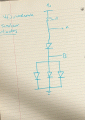
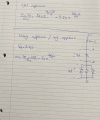
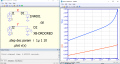
Hello! so I came across this question today , it's simply asking for Vab and I can not understand why my approach is wrong. I think I'm misunderstanding a basic rule here. Any explanation or advice on how to approach these kind of problems will be highly appreciated!

please check the attached files
 

Attachments

MisterBill2

Joined Jan 23, 2018
27,159
First, I do not understand your answer, nor the part with the exponent.
Really, the first question I have is how close to exact an answer is wanted??
I think that the applied voltage is "10V", although it is hard to read. And the resistor is 500 ohms. Now I am choosing the diodes to be type 1N4001, rated 1 Amp forward current , Max PRV of 50 volts.
So without the diodes the current would be 10v/.5K=20mA. At this point we can assume that the diodes are biased into conduction. That was the reason for the first part. So now we can assume that they are all exhibiting a forward voltage drop of 0.7 volts, making the actual voltage across the resistor to be (10-2x0.7)=8.6 volts, and the current being 8.6/500=17.2mA, a bit less.
At this point we need some caution because additional resolution has been created, without adding any accuracy. The data book lists the forward voltage MAX as 0.8 volts, but typically it is closer to 0.7 volts .
What becomes interesting is that at the lower current the diode is not biased so far into conduction, and the forward voltage drop can be a bit higher.
BUT to answer the question as posed, VAB would be 0.7 volts.
 

WBahn

Joined Mar 31, 2012
32,702
Hello! so I came across this question today , it's simply asking for Vab and I can not understand why my approach is wrong. I think I'm misunderstanding a basic rule here. Any explanation or advice on how to approach these kind of problems will be highly appreciated!

please check the attached files
Your approach is mixing two incompatible diode models.

Your claim that Va = 2·Vd is based on a model in which the voltage across a forward-biased diode is constant independent of the current through it. But then you use the exponential model in the same equation, which specifically relates the voltage across the diode as a function of the current through it. Pick one or the other.

The use of three diodes in parallel is a hint that the problem is intended to take into account that the voltage drop across a forward-biased diode is current-dependent, which means that you need to use a current-dependent diode model, likely either a piecewise linear model or the exponential model, which appears to be what you have been told to use.
 

Thread Starter

Phycho_cat

Joined Aug 23, 2024
26
Yes, this actually answers all my questions.I understand now; I shouldn’t have assumed the constant voltage across diodes in this question, and more importantly, I shouldn’t have combined it with another model! Thanks for the clarification!
 

Thread Starter

Phycho_cat

Joined Aug 23, 2024
26
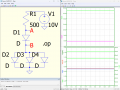
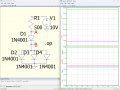
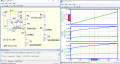
Thank you so much! This really helps deepen my understanding of the question. I have a quick follow-up question regarding the first graph. I'm still relatively new to this, so I may be misinterpreting it, but why are there two different values for Va one around 1.4 volts and another around 1.2 volts? Does this mean that VA can take any value between these two points?
 

LvW

Joined Jun 13, 2013
1,993
Your approach is mixing two incompatible diode models.
...................
The use of three diodes in parallel is a hint that the problem is intended to take into account that the voltage drop across a forward-biased diode is current-dependent, which means that you need to use a current-dependent diode model, likely either a piecewise linear model or the exponential model, which appears to be what you have been told to use.
Just a short comment: The term "current-dependent diode model" sounds as would be the voltage Vd across the diode the result of a corresponding current Id through the device.
I think that in reality the opposite is true: We have a voltage-dependent diode model.
The flowing current Id is always the result of the controlling voltage Vd.
It is the externally applied voltage that counteracts the internal diffusion voltage and thus allows the forward current Id..
This relationship is expressed by the well-known exponential relationship Id=f(Ud).
 

Bordodynov

Joined May 20, 2015
3,429
As one joke says: Only mathematicians give an absolutely accurate, but completely useless answer. Here is an example showing how the voltage on a diode depends on the current:
1734870784682.png

In this example, I have shown the dependence of voltage on current.
Vdiode=rs*i+n*K*T/q*Ln((i+is)/is)
I'll see how easy it is for you to calculate the current at a given voltage given the ohmic resistance of the diode. Write a formula for the functional dependence of current on voltage, which is mentioned above.
 
Last edited:

LvW

Joined Jun 13, 2013
1,993
As one joke says: Only mathematicians give an absolutely accurate, but completely useless answer. Here is an example showing how the voltage on a diode depends on the current:
..................
In this example, I have shown the dependence of voltage on current.
Vdiode=rs*i+n*K*T/q*Ln((i+is)/is)
I'll see how easy it is for you to calculate the current at a given voltage given the ohmic resistance of the diode. Write a formula for the functional dependence of current on voltage, which is mentioned above.
I am not a mathematician (but an engineer) and I did not comment on alternatives to manipulate mathematical relations.
The purpose of my comment was only to point to the fact that - from a physical point of view - a current through electronic devices (like a diode) is always the result of an applied voltage.

With reference to your simulation example: You surely know that (1) there are no ideal current sources and (2) that the simulator merely processes an entered formula - regardless of physial causes and effects.

More than that, I have the impression that the TO is - more or less - a newcomer to electronics.
That's why I think it makes sense to describe the behavior of a diode in physically correct terms.

Similar consideations apply to the Bipolar Transistor (BJT).
During calculations, some people treat the BJT as a current-controlled device (Ic=f(Ib) - and the numerical results are OK.
However, from the physical point of view is the BJT surely a voltage-controlled device Ic=f(Vbe).
The latter view is certainly the only way to understand the working principle of BJT-based circuits and/or develop new circuits.
 
Last edited:

Bordodynov

Joined May 20, 2015
3,429
Here I have given an example of a current source circuit that behaves like an ideal current source. As a practicing engineer, when designing circuits, I don't need to understand what physical laws determine the behavior of a diode. I use concepts that allow me to easily calculate circuits. And let the theorists use the physics of processes. Why bother with unnecessary information?
What good would it do a person to know the physics of a process, but not be able to use such valuable knowledge practically?

1734875590868.png
 
Last edited:

LvW

Joined Jun 13, 2013
1,993
As a practicing engineer, when designing circuits, I don't need to understand what physical laws determine the behavior of a diode. I use concepts that allow me to easily calculate circuits. And let the theorists use the physics of processes. Why bother with unnecessary information?
Really unnecessary?
Do you really "calculate circuits" only? Are you not interested to know how and why circuits work?
I cannot believe.
Is it really unnecessary to know (and be able to explain) how and why a simple current mirror (one diode, one transistor) works or why a resistor in the emitter path of a CE-stage is the best Ic-stabilizing method?
 

Bordodynov

Joined May 20, 2015
3,429
Now let's check how your knowledge will help you determine the LED current at a voltage of 2.6V. At the same time, I can easily calculate the voltage across the diode using the spice parameters and the diode current using the formula given earlier. Here is the spice model:
.MODEL XB-DRDORED D IS=1.30762E-13 N=2.733355755 RS=0.685855897 XTI=18.31610277 EG=2.1 Iave=1 mfg=CREE type=LED
I'm currently turning on the lasers by setting the current through it. In particular, I get 30W of radiated optical power.
 

crutschow

Joined Mar 14, 2008
38,316
Similar consideations apply to the Bipolar Transistor (BJT).
During calculations, some people treat the BJT as a current-controlled device (Ic=f(Ib) - and the numerical results are OK.
However, from the physical point of view is the BJT surely a voltage-controlled device Ic=f(Vbe).
The latter view is certainly the only way to understand the working principle of BJT-based circuits and/or develop new circuits.
The voltage controlled model of the BJT is certainly correct from the solid-state physics point-of-view, but the current controlled model is much easier to use (for most people, not just "some") when designing some circuits, such as for switching circuits, or determining the biasing of an an AC amplifier.
That's why the value of Beta is included in BJT data sheets, and the current gain Hfe, is part of the BJT hybrid parameters.
 

LvW

Joined Jun 13, 2013
1,993
The voltage controlled model of the BJT is certainly correct from the solid-state physics point-of-view, but the current controlled model is much easier to use (for most people, not just "some") when designing some circuits, such as for switching circuits, or determining the biasing of an an AC amplifier.
That's why the value of Beta is included in BJT data sheets, and the current gain Hfe, is part of the BJT hybrid parameters.
Here are my comments to your examples.
* Switching circuits: For calculating the value for the resistor Rs between base and the controlling voltage we need, of course, the base current. And we know that it must be much larger than the current Ib=Ic/B which is valid for linear operation.
But - should a designer not know WHY it must be so much larger (for example 0.1...0.05*Ic) ?
And this has nothing to do with current control of the BJT.
It is the additional current through B-C junction which now is forward biased during saturation - as a result of a collector current Ic=f(Vbe) which causes the voltage Ic*Rc large enough to make Vce<Vbe. Hence, This Ib increase is the RESULT of saturation - not its cause!

* Biasing of an AC amplifier: For a rough design with a low-resistive voltage divider at the base we even can neglect the base current. For a somewhat more exact design we are using the relation Ib=Ic/B (for a specified Ic value).
Of course, the base current does exist - but its consideration during calculations has nothing to do with any control function.
More than that, each good design uses Re-stabilization which only works because Vbe reduces as a result of an increase in Ie resp. Ic.
This stabilization effect requires voltage control Ic=f(Vbe).

* My fazit: B resp beta are important parameters because they give us the base current Ib (ib) for a selected collector current.
This current Ib is important for determining the transistors input resistance at the base.
But I see no necessity and absolutely no reason to consider Ib (resp ib) as a parameter which would determine the curreent Ic.
Normally, we are using the ratio B=Ic/Ib only in the form of Ib=Ic/B (which simply means that Ib is a small part of Ic - nothing else).

(Remember Barrie Gilbert: "Ic is best viewed as a defect"; "it is purely incidental"; "an unwanted side effect")
 

Bordodynov

Joined May 20, 2015
3,429
LvW
You're skirting the subject. When I showed that the voltage across the diodes is powered by a current source, you replied that there are no current sources in nature. I demonstrated such a device on an operational amplifier and a field-effect transistor. I've already had a discussion with you about current generators. At that time, I used a photodiode as a current source, but you probably forgot. That is, there are current sources in nature. You did not answer my call, as knowing the physical mechanism of the diode will help you calculate the LED current at a fixed voltage! I think you won't succeed. And here's a comment on your comments: for some reason, you're trying to use the simplest common-emitter circuit with an emitter resistor and a base voltage divider. This scheme can only be used for teaching students. Normal circuit engineers do not use such circuits, as I have done many times. I prefer general negative feedback stabilization. I am especially touched by two or more identical cascades using separation tanks in textbooks. It's primitive.
 

WBahn

Joined Mar 31, 2012
32,702
Just a short comment: The term "current-dependent diode model" sounds as would be the voltage Vd across the diode the result of a corresponding current Id through the device.
I think that in reality the opposite is true: We have a voltage-dependent diode model.
The flowing current Id is always the result of the controlling voltage Vd.
It is the externally applied voltage that counteracts the internal diffusion voltage and thus allows the forward current Id..
This relationship is expressed by the well-known exponential relationship Id=f(Ud).
Either description works fine. My choice of words was in the context of the problem the TS is working in which three diodes in parallel share the current that goes through the fourth, hence, from a practical and mathematical standpoint, you are controlling the current in the lower diodes a function of the other current in the top one. This change in current corresponds to a change in voltage in one model and not in the other and it is that aspect that was the target of the post.
 

LvW

Joined Jun 13, 2013
1,993
LvW
You're skirting the subject. When I showed that the voltage across the diodes is powered by a current source, you replied that there are no current sources in nature. I demonstrated such a device on an operational amplifier and a field-effect transistor.
OK - let`s not fight about wording.
I understand that you are looking into the subject from another position (You wrote: " As a practicing engineer, when designing circuits, I don't need to understand what physical laws determine the behavior of a diode.").
I was also a practicing engineer before I started teaching.
Of course, it is common practice that a circuit is called "current source" when it is able to drive a (nearly constant) current through a load - independent on the resistance of the load (within certain upper and lower limits determined by the "voltage compliance").
Nevertheless - physics does not allow a current through a load without a driving voltage. That is why it is said that every “current source” is realized by a voltage source with a very large static source resistance, or better: With a very large dynamic source resistance (feedback principle).
(Perhaps we should ask ourselves: Using the term “source resistance” for a real circuit, don't we automatically think of a voltage source? )

I used a photodiode as a current source, but you probably forgot. That is, there are current sources in nature.
Of course, you can "use" a photodiode as a current source - but it certainly shows an open-circuit voltage (without a connected load). You just have to remember that it is common practice to connect several units in series for a higher voltage. This is not possible for current sources.

And here's a comment on your comments: for some reason, you're trying to use the simplest common-emitter circuit with an emitter resistor and a base voltage divider. This scheme can only be used for teaching students. Normal circuit engineers do not use such circuits, as I have done many times. I prefer general negative feedback stabilization.
Regarding the "simplest common-emitter circuit":
Do you think that the physical background of a simple circuit is different from that of more complicated circuits?
By the way: Because you "prefer general negative feedback", I like to mention that the Re-stabilization technique I have mentioned is nothing else than negative feedback.

Finally, I am sure that we are not “far apart” at all. We just see and explain some observed effects from different perspectives. Both are equally valid.

Happy Christmas
LvW
 
Last edited:

Bordodynov

Joined May 20, 2015
3,429
LvW,
It's just that the photodiode is a PN junction. And when idling, it turns on. In fact, it is a current source with a limiting diode. Photovoltaic mode. In this sense, a photodiode is not an ideal light source. And my current source circuit with a diode load behaves like an ideal one (for direct current, of course, because there is a capacity). And the fact that you are a teacher, I realized a long time ago. The main thing for you is the correct theoretical justification. It doesn't matter to me.
Merry Christmas and Happy New Year.
Alexander.
 

crutschow

Joined Mar 14, 2008
38,316
But - should a designer not know WHY it must be so much larger (for example 0.1...0.05*Ic) ?
What does that mean?
And this has nothing to do with current control of the BJT.
The base current needs to be above a certain value to achieve saturation.
How is that nothing to do with current control?
Biasing of an AC amplifier: For a rough design with a low-resistive voltage divider at the base we even can neglect the base current
So how do you know what is a "low-resistance" without knowing approximately what the base current will be?

I've gone round and round with various posters on these sites who are pedantic about the BJT being a voltage-controlled device, and I don't disagree that the physics theory says it is.
For AC consideration the voltage-control transconductance model is fine, but for biasing and switching applications the current-controlled black-box model is useful.
Certainly, externally it does appear to be a current-controlled device with a current gain, and the Vbe looks like the voltage of a forward-biased diode due to the base current.
Why do you think they put the value of Beta and/or Hfe in the data sheets?
 
Top