Diode - Deplete region- help

Thread Starter

linhvn

Joined Nov 6, 2024
297
1745569547147.png
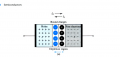
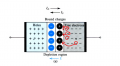
Can someone explain, why free electrons in N - side don't continue to combine with holes (positive charges) in depletion region?
 

ericgibbs

Joined Jan 29, 2010
21,423
hi lin,
This link explains how the PN barrier charge builds and neutralises the potential differnce.

E
https://www.google.com/search?client=firefox-b-d&q=PN+junction+barrier+build+up


Clip:
In a P-N junction, a barrier potential builds up due to the diffusion of charge carriers (electrons and holes) across the junction, leading to the formation of a space charge region (depletion region). This region creates an electric field that opposes further diffusion, establishing an equilibrium where the movement of charge carriers across the junction is minimized
 

Thread Starter

linhvn

Joined Nov 6, 2024
297
hi lin,
This link explains how the PN barrier charge builds and neutralises the potential differnce.

E
https://www.google.com/search?client=firefox-b-d&q=PN+junction+barrier+build+up


Clip:
In a P-N junction, a barrier potential builds up due to the diffusion of charge carriers (electrons and holes) across the junction, leading to the formation of a space charge region (depletion region). This region creates an electric field that opposes further diffusion, establishing an equilibrium where the movement of charge carriers across the junction is minimized
it means that free electrons in N type are pushed back by electrons in depletion region and cannot continue to diffuse?
 

ericgibbs

Joined Jan 29, 2010
21,423
hi,
Think of when an electron/hole combination occurs at the junction of the PN material.
It will result in a reduction of the electric field strength across the junction, after a number of such combinations, the field strength across the junction will be reduced to close to zero, so no more electrons will be 'attracted' across the PN junction barrier.

E
Check out this PDF.
Clip:
At the same time, the holes
in the P material diffuse across the junction into the N material and are filled by N
material electrons. This process, called junction recombination, reduces the number
of free electrons and holes in the vicinity of the junction. Because there is a depletion,
or lack of free electrons and holes in this area, it is known as the depletion region.
 

Attachments

Thread Starter

linhvn

Joined Nov 6, 2024
297
hi,
Think of when an electron/hole combination occurs at the junction of the PN material.
It will result in a reduction of the electric field strength across the junction, after a number of such combinations, the field strength across the junction will be reduced to close to zero, so no more electrons will be 'attracted' across the PN junction barrier.

E
Check out this PDF.
Clip:
At the same time, the holes
in the P material diffuse across the junction into the N material and are filled by N
material electrons. This process, called junction recombination, reduces the number
of free electrons and holes in the vicinity of the junction. Because there is a depletion,
or lack of free electrons and holes in this area, it is known as the depletion region.
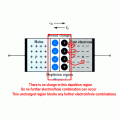
1745571885964.png
Do you know why electrons marked with red arrow not combine with + holes(normally they attract each other)?
 

ericgibbs

Joined Jan 29, 2010
21,423
hi,
Initially, when the PN junction is formed, you have a Silicon interface formed by Boron atoms, which are capable of adding and a free electron to themselves. On the other side of the Silicon PN junction, you have a Phosphorous based material which has a loosely bound free electron.
The Boron and Phosphorus atoms share that electron, so you have effectively an electrically neutral pair, this happens along the whole PN interface, so you now have a neutral charge barrier between the PN materials, formed of neutral charged atom pairs.

This barrier effectively blocks any further Boron/Phosphorous electron sharing, as the Boron/Phosphorous holes/electrons in the remainder of the PN materials are no longer in direct physical contact in order to allow the free electron to be shared.

The PN junction now will require an external voltage in order for a current to flow through the junction.

E
 

Thread Starter

linhvn

Joined Nov 6, 2024
297
hi,
Initially, when the PN junction is formed, you have a Silicon interface formed by Boron atoms, which are capable of adding and a free electron to themselves. On the other side of the Silicon PN junction, you have a Phosphorous based material which has a loosely bound free electron.
The Boron and Phosphorus atoms share that electron, so you have effectively an electrically neutral pair, this happens along the whole PN interface, so you now have a neutral charge barrier between the PN materials, formed of neutral charged atom pairs.

This barrier effectively blocks any further Boron/Phosphorous electron sharing, as the Boron/Phosphorous holes/electrons in the remainder of the PN materials are no longer in direct physical contact in order to allow the free electron to be shared.

The PN junction now will require an external voltage in order for a current to flow through the junction.

E
Can you shortly explain?
 
Top