Differential Amplifier

Thread Starter

Ayden1717

Joined May 17, 2022
8
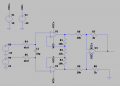
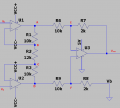
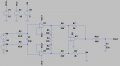
Hi all I was wondering if somebody could explain to me how this circuit works. I have tried simulating it in LTSpice and used the theory I know and what I could find online but for some reason cannot get very far ..

I understand the basic concept of the circuit. The first stage takes in a differential input between +-15V at the output of the PI filter and produces an output differential voltage (still includes common mode voltage) which is fed into the second stage which removes the common mode voltage and scales up the differential signal by the voltage Vb which I currently have grounded but is adjustable, which is then passed through a low pass filter.

I am having troubles connecting theory I learned from the basic op amp principles to solving for the gains of this multi-stage amplifier due to the connecting resistor R3. Some help with this would be greatly appreciated!

1739202591924.png
 

Attachments

MrChips

Joined Oct 2, 2009
34,628
Your circuit is incorrect.
U1 and U2 ought to be non-inverting buffers. U2 is correct. The inputs on U1 are reversed.
U3 is the differential stage.
 

LvW

Joined Jun 13, 2013
1,995
...................
I am having troubles connecting theory I learned from the basic op amp principles to solving for the gains of this multi-stage amplifier due to the connecting resistor R3. Some help with this would be greatly appreciated!
1) As a first step, we compute the difference (V1,out-V2,out) using ohms law (with R1=R2=R)
V1,out-V2,out=I*(R3+2R) with I=(V3-V4)/R3 (bcause input voltages V3 and V4 appear also across R3)

Therefore: V1,out-V2,out=(V3-V4)+2R*(V3-V4)/R3 and
V1,out-V2,out=(V3-V4)(1+2R/R3)

2)
Second step: The voltage difference (V1,out-V2,out) is amplified in the 2nd gain unit (classical diff. amplifier)
 

MisterBill2

Joined Jan 23, 2018
27,178
As the first step, the amplifier with the feedback to the non-inverting input "will not work", it will quickly reach a saturated state. Connect tghe feedback to the inverting input and then you have a classic instrument amplifier
 

LvW

Joined Jun 13, 2013
1,995
As the first step, the amplifier with the feedback to the non-inverting input "will not work", it will quickly reach a saturated state. Connect tghe feedback to the inverting input and then you have a classic instrument amplifier
Yes, of course.!
In my answer (post#4) I have overlooked this obvious error.
 

crutschow

Joined Mar 14, 2008
38,316
I am having troubles connecting theory I learned from the basic op amp principles to solving for the gains of this multi-stage amplifier due to the connecting resistor R3.
You can simplify the calculations some if you calculate each input gain separately and then use superposition to combine the two.
So set one input to zero and calculate the gain from the other input to output, do the same for the opposite input, and then combine the two to get the total gain.
 
Last edited:

MisterBill2

Joined Jan 23, 2018
27,178
In the classic instrument amplifier the overall gain is a bit more complex. The good news is that the design and equations for instrument amplifiers has been documented well beyond exhaustion by a lot of smart folks who have been very accurate in their presentations. Check out the applications notes for the ANALOG DEVICES instrument amplifiers.
 

WBahn

Joined Mar 31, 2012
32,703
This is pretty clearly schoolwork of some kind, so don't expect people to just feed you a solution. We'll help you figure it out so that you can improve your analysis skills.

Once you correct the polarity of U1...

To analyze the circuit, assume that you have two voltages applied to the inputs, V1 and V2.

1739430010006.png

Given V1 and V2, which nodes can you immediately determine the voltages for (assuming the opamps are ideal).

Given the voltages on those nodes, can you determine the current through any of the resistors?

Given those currents, can you determine the voltages on any other nodes?

Keep chipping away at it until you can finally write Vout in terms of V1, V2 and circuit resistances.
 

MisterBill2

Joined Jan 23, 2018
27,178
I already reminded the group and the TS that instrument amplifiers are a very mature concept and already VERY WELL DOCUMENTED, so possibly the TS has now found the helpful articles.
 
Top