Facebook
 Google
 GitHub
 Linkedin
@Art Vandelay
I have a project I'm using to drive a PWM fan for my car. I am using a Nano 3.3 BLE that has a 3.3V pin. All works fine when using the 3.3V pin to power the three thermisters and the PWM circuit.
But I decided I wanted to use less power when the car was off and not drain the battery, so I moved the three thermisters and the PWM circuit to separate IO pins which I turn on when the car is started and turn off 30 seconds after the car is shut off. Unfortunately I found that this only worked right for the one high resistance thermister that is backed by a 3.3KΩ resistor. I have two lower resistance thermisters that are backed by 220Ω resistors.
I did find I can back the low resistance thermisters with a 3.3KΩ resistor as well and it gets much better but the resolution becomes very low using up ~ 0.1 V for the entire operating range of the thremisters and it becomes close like withing +/- 3° C accuracy but still not as close as it was on the 3.3V buss.
I can get different higher resistance thermisters, but I prefer to use these genuine Delphi automotive ones if possible.
So for the moment I would really like to know why this isn't working. For reference the 3.3V buss on the Nano 3.3 BLE can handle up to 1A total. The IO pins can do 10mA each. I cant see me exceeding that on this circuit.
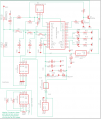
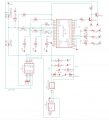
The first picture is the schematic that works with all power coming from the 3.3V buss.
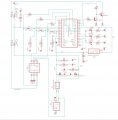
The second picture is with power taken off individual I/O pins.
I have a project I'm using to drive a PWM fan for my car. I am using a Nano 3.3 BLE that has a 3.3V pin. All works fine when using the 3.3V pin to power the three thermisters and the PWM circuit.
But I decided I wanted to use less power when the car was off and not drain the battery, so I moved the three thermisters and the PWM circuit to separate IO pins which I turn on when the car is started and turn off 30 seconds after the car is shut off. Unfortunately I found that this only worked right for the one high resistance thermister that is backed by a 3.3KΩ resistor. I have two lower resistance thermisters that are backed by 220Ω resistors.
I did find I can back the low resistance thermisters with a 3.3KΩ resistor as well and it gets much better but the resolution becomes very low using up ~ 0.1 V for the entire operating range of the thremisters and it becomes close like withing +/- 3° C accuracy but still not as close as it was on the 3.3V buss.
I can get different higher resistance thermisters, but I prefer to use these genuine Delphi automotive ones if possible.
So for the moment I would really like to know why this isn't working. For reference the 3.3V buss on the Nano 3.3 BLE can handle up to 1A total. The IO pins can do 10mA each. I cant see me exceeding that on this circuit.
The first picture is the schematic that works with all power coming from the 3.3V buss.
The second picture is with power taken off individual I/O pins.