Different Amperage Depending on Where I Measure

Thread Starter

mulu

Joined Aug 4, 2024
16
@wraujr I will give this a try. Though, usually people who do this kind of stuff provide power both on the side where the data is coming and tie the V- from the PSU with the V- from the controller. Then they power inject from the other side as in your corrected drawing. I am not saying what that community does is correct but that is how most seem to be doing it.

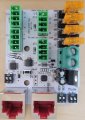
@MisterBill2 Attached is an image of the controller. It has some chips on it which I assume(!) require power from that big green terminal. On the controller, the GND and V is also connected to the G and V on the 4 green ports. I don't use the V on those 4 green port, though. That's to avoid voltage drop between the controller and the LED strip (the controller is further away than the PSU).
 

Attachments

MisterBill2

Joined Jan 23, 2018
27,637
OK, and thanks for the clear and in focus picture of half of the controller. So it is not really clear about what connections go to what. Can you take as good a photo of the whole board turned horizontal so I can see more of it at once??
It seems to me that running all four wires to the LED strips from each 4 position connector would reduce the amount of wiring, It seems like you might then just have one cable of four coductors going to each string of LEDs, and no splicing at all.
 

Thread Starter

mulu

Joined Aug 4, 2024
16
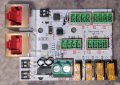
@MisterBill2 I am not sure why you only see half the controller but I took another picture and also rotated it 90 degrees. I marked the 4 connectors and GND and D for each of the 4 connector with red rectangles. For this whole thread, I am running one CAT6 cable. The twisted wires of CAT6 also helps with noise/correlation immunization on the data line which I don't have with "regular" 4 conductor wires.

* Twisted pair 1 (green=D & green/white=GND) from the CAT6 cable goes to GND and D of connector 1
* Twisted pair 2 (orange=D & orange/white=GND) from the CAT6 cable goes to GND and D of connector 2
* Twisted pair 3 (blue=D & blue/white=GND) from the CAT6 cable goes to GND and D of connector 3
* Twisted pair 4 (brown=D & brown/white=GND) from the CAT6 cable goes to GND and D of connector 4

The big green connector at the bottom is connected to the PSU.
 

Attachments

MisterBill2

Joined Jan 23, 2018
27,637
OK, this photo works very well! And it looks like the LED ribbons are intended to be powered and controlled exclusively thru the cables connected to the four 4 conductor connectors, without separate power wires direct . AND, I am suspecting that the installation could work with CAT5 cable, which has similar but not identical properties, since the data runs are not that long. BUT there is one thing that seems very wrong, which is the DATA and power sharing one conductor (GND). THAT is always a poor choice, because it always adds unintended noise to the data circuit. There should always be a return line to support the data signal line, and that line should never carry power.
I understand how convenient it is with the three wire cords, black, white, and green, but that does not make it work correctly.
 

LesJones

Joined Jan 8, 2017
4,509
Some more thoughts. The current sharing between the two cable runs will not be as bad without the meter in circuit. The ratio of the currents in the two paths will be in inverse proportion to the ratio of the resistances of the two paths.
The test leads on the meter will probably be a significant proportion of the 125 mil ohms so connecting directly to the meter sockets will probably give a closer reading to the actual value without the meter in circuit.
If you had a 0.01 ohm resister you could use this as a shunt and measure the voltage drop across it on the mV range of your meter. As it is unlikely that you will have a 0.01 ohm resistor I looked up the resistance per foot of 24 AWG wire. It is about 25.5 mohms (lower case m for milli) so 4.7 inches of 24 AWG wire will be 0.01 ohms.
Using this method should give a closer reading to the current without the meter in circuit.
Two questions.
1 Is the signals on the data line logic level (3.3 or 5 volts.) or is it 12 volts amplitude ?
2 Is the TO220 device a voltage regulator ?

Les.
 

MisterBill2

Joined Jan 23, 2018
27,637
What is the intended purpose of the unused pin on the four position connectors?? I see clearly that the LED strings have only three connections, V+, V-, and "D", and so the Data line seems to be sharing a return path with the V- line. We always worked to avoid sharing data paths with power paths for industrial systems, because it tends to couple assorted disturbances into the data system, if not at the start, it happens when some connection becomes less than good enough.
In this application it does not seem possible to separate the data return line from the power return line conveniently, but that is why I am asking about that one non-utilized fourth pin on the connector.
 

BobTPH

Joined Jun 5, 2013
11,553
In all likelihood, you don’t need any connection from the controller to the strips except the data line. The others are (presumably) just pass throughs, and all you have done is introduce extra resistance.

I would just connect + and - from the power supply to both the controller and strips via completely separate wiring, and the connect the data lines from controller to the strips.

Your wiring has created a ground loop, which is something to avoid when possible.

If using two power supplies, connect the two - terminals together at the power supplies. Do not connect the + ones together.
 

Tonyr1084

Joined Sep 24, 2015
9,744
Put the meters here!
Screenshot 2024-11-16 at 11.23.52 AM.png
I bet you'll get the same amperage.

Looking closely at the negative rail going to the controller, through the controller and to the same negative rail and back. Some of the current is bypassing the meter. Approximately half. And we don't know if your meter read 6A or 6.4A. You might be rounding down. Perhaps the 13A is actually 12.6A and you rounded up. In cases like this milliamps and millivolts matter.

Some fundamental problems with your drawing is that it doesn't make clear what lines are connected except by color. We'll assume the green (if it's green, color blind here) is the negative rail and black is the positive rail. To each LED strip there are two negative pathways, directly back and through the controller while only one pathway exists for the positive rail. And it's the positive rail that is giving you the true amperage reading.
 
Last edited:

Tonyr1084

Joined Sep 24, 2015
9,744
A simple test would be to take 2 identical meters and read both currents at the same time. Odds are they will be the same value (or close, less controller current).
Putting resistance on the negative leg may be raising the LED+ to a higher potential, acting like a higher LED forward voltage drop. Your controller will act on this.
I then disconnected the 4x 24AWG V- from the controller. When I do that, the LEDs start flickering.
Probably due to the lack of control. The PS could be trying to pump full current to the LED's and it might be topping out and going into safety shutdown mode. As soon as it shuts off current it turns back on, thus, giving a flickering effect.

I did say "Probably".
 

MisterBill2

Joined Jan 23, 2018
27,637
Consider what the effect on a control input if the voltage between the ends of the return portion of the loop keeps changing. It will be similar to the effect of the sent signal voltage keeps changing. and by using a single conductor for both power and signal return that is exactly what happens.
So the circuit as built requires that return conductor for the control signal, despite the fact that it is less convenient.
 

Tonyr1084

Joined Sep 24, 2015
9,744
MisterBill2 has sparked a notion in my - between my ears. Perhaps a snubber diode across the motor leads would help. Give me a few min's and I'll throw a drawing together, just of the motor and some basic representations of the solar lamp.
Forgive me, don't know how this got put on the wrong thread. Obviously I did something wrong.
 
Last edited:

wraujr

Joined Jun 28, 2022
260
Reply to: "@wraujr I will give this a try. Though, usually people who do this kind of stuff provide power both on the side where the data is coming and tie the V- from the PSU with the V- from the controller. Then they power inject from the other side as in your corrected drawing. I am not saying what that community does is correct but that is how most seem to be doing it."

Would be great if had part numbers and datasheets. Assume this grid/matrix is from AliExpress where real data/datasheets are non-existent. Looking at what's on AliExpress:

(1) While a physical matrix, it is functionally a string of "LED Elements"
(2) An "LED Element" consists of a controller IC and LEDs (see datasheet for WS2815 or similar)
(3) The "LED Element" is supplied with 12VDC (i.e. V+/V-) and serially controlled via D
(4) This element is encased in clear goop for weather proofing.

For this design, V+/V- are simply running from the input connect, to each LED and then onto the second connector.
These "Matrix" are designed for "daisy chaining" (notice there is a male and female connector).
You can verify by using your ohmmeter to measure resistance between the V+ pins of both connectors and you will most likely get about 0.1 to 1.5 ohms. Same for V+.
The "LED Element" (if WS2815) has its own regulator and accepts 9.5-13.5V input so any voltage drop across the 18AWG wiring of the matrix will not affect operation, therefore supplying power from both ends is not needed (never heard of power injection??)
So it does not matter which end you connect the V+/V- from the PSU to.

The D input is your serial control line and and the 400 LEDs in your 10x40 matrix looks like a big 400 element shift register.
Since each element is 8-bit RGB, then each element gets 24-bits, so in terms of bits your serial D is a 9600 bit shift register.
As the D signal is propagated, the controller in each "LED Element" re-transmits to the next element in line, preserving signal quality.
So from your controller board, the D and V- twisted together is the proper connection for signal quality.

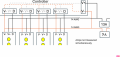
The diagram I posted in post #40 is the way to go if you are looking for distance between your controller and the LED matrixes.
 
Last edited:

Thread Starter

mulu

Joined Aug 4, 2024
16
@wraujr Thank you for your response. This is what I have:

https://www.aliexpress.us/item/3256806315001868.html

As you said, while it's arranged in a matrix, each matrix is actually just a 400 LED long string going zig-zag. I ran a simple test connecting just one such matrix to a controller using very short cables (about 2 feet). I set the lights to white at 100% brightness which based on previous measurements pulls about 3.4A. On the controller I measured 11.92V and then on the other side of the matrix I measured 11.17V, i.e. a voltage drop of 0.75V.

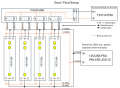
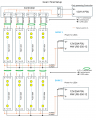
As for power injection, this is done for long strings. Let's say you have a string that has 400 LEDs. This might give you a voltage drop of 2V which can lead to LEDs starting to dim, flicker, etc. Hence, after about every 200 LEDs you insert a T into the V- and V+ and hook up another (small) power supply to get the voltage up again. D stays untouched. Now, with 400 LEDs, instead of power inject after 200 LEDs, you could also power inject on the other end (at least that's what people do). So you cover 200 LEDs from one side and the other 200 LEDs from the other side. That's why I came up with the drawing in post #26 which I am attaching here again for convenience.

Note that the recommendation is to power inject every 200 pixels. Pixels consume more power than the pebble pixels I am using. With just a 0.75V power drop through the matrix, I shouldn't actually have to power inject. That's why I am a bit puzzled why I get this flickering when I use 4 matrixes but not when I use 3 matrixes.
 

Attachments

wraujr

Joined Jun 28, 2022
260
You said " So you cover 200 LEDs from one side and the other 200 LEDs from the other side "

It doesn't work that way (unless you have gone into middle of the grid/string and cut the V+ wire)
By supplying voltage at both ends of matrix and with V+ and V- simply being be straight through wires (had to infer as we have no proper datasheet) you have created a resistor network with loops in V+ and V-.
In reality the LEDs at the end will get MOST of their current via the nearest connection, but the LEDs in the middle will get approx half their current from each end. This along with the loops will create all sorts of fun when the LEDs start switching.
You should only supply voltage from one end and at the 3.5A and 0.75V drop the LEDs at the far end should have no problem operating as the supply voltage to the "LED Element" will be well within the 9.5-13.5 operating range.

(1) Have you tried the single power connection as shown in Post #40?

(2) Have you measured the resistance of V+ and V- between the two connectors to verify that it is simple wire?

You do not need to keep repeating what the "community" says or does because that doesn't seem to be working for you. Please try circuit in post #40 and we can go from there.
 

MisterBill2

Joined Jan 23, 2018
27,637
I have been seeing that reference to "Community" as the compromise that has been accepted as "adequate", meaning not optimum but within requirements. Consider that most engineering results in a compromise that is usually not "perfect" but within the requirements. SWPPaC, (Size, Weight, Power, Performance, and Cost) is always the main realm of most compromise.
Feeding a string of lights from both ends makes very good sense because with LEDs the effect of the voltage drop is very non-linear.
 

MisterBill2

Joined Jan 23, 2018
27,637
I am also wondering. It was an interesting discussion.Especially the design versus application part. I wonder how they got around the three-wire cable issue.
 
Top