Desoldering DIP48

Thread Starter

frpr666

Joined Feb 2, 2010
53
Dear forum members,
I followed this tip to desolder DIP48 package. https://www.youtube.com/shorts/qwMS8EcvPJo
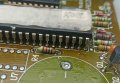
However in the very end of this procedure the chip package is stuck in place because of the top layer pad and the remains of the tin there was not heated properly.
My intention is not to damage the chip and the PCB as well. I have at my hand avilable two soldering stations with chisel iron tip and one hot air station. Please what next steps would you recommend here.

PS. I think about to make something like a metal sheet collar. Put it on PCB top side. The collar would isolate the surrounding components, then blowing the hot air on terminals while pulling the chip up.
 

Attachments

MrChips

Joined Oct 2, 2009
34,698
A few questions so that we understand the situation.

I see some pins bent over on the solder side. This is going to prevent the IC from coming off the board.
Was the DIP48 originally flush against the PCB? In other words, were the pins visibly protruding on the solder side of the PCB?

Have you tried a solder sucker?
1776351784999.png

Why do you want to remove the IC?
Why do you want to save the IC?
 

dl324

Joined Mar 30, 2015
18,266
I followed this tip to desolder DIP48 package.
Obviously that method can't be used on a DIP device. Plus, you still need to remove the solder before the holes can be used. I consider that method to be of little value.
However in the very end of this procedure the chip package is stuck in place because of the top layer pad and the remains of the tin there was not heated properly.
My intention is not to damage the chip and the PCB as well. I have at my hand avilable two soldering stations with chisel iron tip and one hot air station. Please what next steps would you recommend here.
I'm surprised you got that far with that bogus technique. You need to remove the solder. You need to melt all of the solder on both sides of the board before using a solder sucker.

My hot air soldering station has a solder sucker attachment. I only use it when I have a lot of pins to remove. Otherwise, I use an Edsyn Soldapullt.
soldapullt-DS017.jpg
 

Thread Starter

frpr666

Joined Feb 2, 2010
53
The bent over pins are not relevant it is different component.
I can confirm the pins were protruding to the bottom side of PCB before my desoldering attempt.
I want to save the DIP device, it is MC68HCP11A1P. I suspect one of ports has damaged pin. No documentation available for the board. It is more than 2 layers PCB. However other IC ports seems working. It contains internal EEPROM which might be read when IC released from PCB.
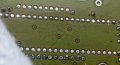
I have also desoldering gun available at my hand. However I am little worried whether it is strong enough vacuume able to suck the tin from TOP side via small hole. I will give it a try at least.
 

Attachments

Ian0

Joined Aug 7, 2020
13,112
Set the soldering iron to 400°C. Apply the tip to the pad and count to five. Then operate the solder sucker. If you do it too soon the solder hasn't melted all the way through to the other side of the board, which results in your removing half of it, and making it more difficult to melt the half that is remaining.
 

panic mode

Joined Oct 10, 2011
4,929
yup, desoldering takes practice and you don't want to practice on part or board that you need to save. in many cases even proper solder sucker technique does not clear the joint since hole may be too tight or pin is bent or there is not enough solder to start sucking. so yes, adding a bit of solder to form a blob, and minimize air leaks is important and commonly used practice.
also make sure that your solder sucker (if you use one) is well maintained. that means clean and retracting rapidly. if needed add a drop of oil. this REALLY needs to fly when button is pressed. also the nozzle on 99% of solder suckers are garbage - they are rigid teflon which does not make job easy. there a compact version that uses silicone tip. this is much better, it dramatically reduces leask in a ways that teflon never could. this is known as SS02 or and costs about the same as the crappy 99% of suckers.
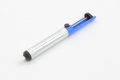
finally, the easier to use desoldering tool will combine both soldering iron and sucker, such as this el-cheapo. this makes one-handed use possible so other hand is free. a pro tool will not rely on silly spring loaded cylinder, it will have a continuous sucker
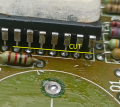
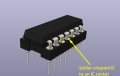
so since the chip is partially out, you may want to consider alternatives. one is to cut the pins off near PCB, then you should have no problem removing the pins one by one.
the downside is that chip pins are no longer in usable shape. this is easily fixed by placing and then soldering OC onto IC socket. since soldering is done manually, one pin at a time, it is much simpler/safer process for rookies.
with both tasks done, you can try reading the content of the IC. if successful or if you can find the file from someone else, solder another socket to the PCB and buy me a beer.
 
Last edited:

panic mode

Joined Oct 10, 2011
4,929
there are many ways to handle this but board and parts already look like battlefield. to read content of the IC you do need a survivor which is i proposed gentler approach.
and don't forget to clean the board. hot tap water set to scalding and old toothbrush should do the trick. then squirt the board with isopropyl alcohol i clean it again. it will be sparkling clean.

no more flux, solder blobs or charred parts

1776428835491.pngp

once the survivor is triaged, it will fit into breadboard or ZIF socket of your programmer

1776429507151.png

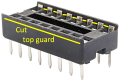
and this socket works as well but you will want to expose the contacts. normally even single scribe by scalpel and bending th excess should get the result. just don't get hurt...
1776429909743.png
 
Last edited:

Thread Starter

frpr666

Joined Feb 2, 2010
53
Thank you for advices. I have some previous experience with desoldering but not much. I also know the trick with adding fresh tin and use the braided cooper wire to remove the excess of the tin.
I will definitely try the spring loaded pump with proper tip end and will train to get practice first on some old DIL14 chips...
I have also an older desolering station with hollow heated tip and with vacuum pump for continous sucking, but it seems to me the vaccume is not as strong as the mechanical spring loaded pump.
I will let you know the result later...
 

dl324

Joined Mar 30, 2015
18,266
I have some previous experience with desoldering but not much.
Since you have the leads of the DIP pulled mostly through the holes, you could try heating the solder and using a tool to pry the lead out of the solder. I'd start at one end of the DIP and alternate side to side, working from pins 1+48 and moving back to 24+25. That would make removing solder from the holes more straightforward.
I have also an older desolering station with hollow heated tip and with vacuum pump for continous sucking, but it seems to me the vaccume is not as strong as the mechanical spring loaded pump.
It seems to me that there would be a switch to turn the vacuum on because running it before the solder is melted could be problematic.
 

MrChips

Joined Oct 2, 2009
34,698
As far as I know, vacuum desoldering stations do not run continuously. Doing so would lower the temperature of the tip. They are usually operated by a foot switch to turn on the pump on demand. I have one here.
 
Top