turns out I have already bought a crash course before and it has a 35min video explaining decibels and a link to the decibel wiki with these I'm sure I can get it sussed!
because in the example I have it shows me how to derive the dBm from a starting point p, and p is in milli-watts
but in the question at the end of the video it asks to add p1 to p2 and their units are dBm
I now know the difference between power gain and voltage gain and I also found out that the decibel scale is a logarithmic scale which defines the ratio of 2 quantities
Not quite. If expressing gains, the units do not matter. They are ratios.
power gain from P1 to P2 is 10 log(P2 / P1)
voltage gain from V1 to V2 is 20 log(V2 / V1)
since power is proportional to voltage squared, 3 db is twice the power whether expressed as a voltage or a power.
but 3 dbV is only sqrt(2) times the voltage. 6dbV is 2 times the voltage.
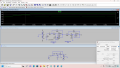
You graph for a filter is showing the dbV, so the 3 db point is where the voltage is 1/sqrt(2), or 0.707 times the unfiltered voltage.
Not quite. If expressing gains, the units do not matter. They are ratios.
I get that part
power gain from P1 to P2 is 10 log(P2 / P1)
voltage gain from V1 to V2 is 20 log(V2 / V1)
since power is proportional to voltage squared, 3 db is twice the power whether expressed as a voltage or a power.
but 3 dbV is only sqrt(2) times the voltage. 6dbV is 2 times the voltage.
I don't get that part.
You graph for a filter is showing the dbV, so the 3 db point is where the voltage is 1/sqrt(2), or 0.707 times the unfiltered voltage.
I don't get that part.
Try this link. I think it gives a clearer explanation than your link in post # 33.
If you were tought physics at school you will probably have been taught this. (I was.)
ok thats much clearer, you find the sum of the series impedance by
sqrt (resistor)^2 + (XL - XC)^2
and the phase angle by
tan^-1 (XL - XC/ resistance)
now I want to find the
Current soure
I and phase angle
VR and phase angle
VC and phase angle
VL and phase angle
I think I have gone off topic but I'm doing a course in order and it says I need to learn these things before getting to Narrow (Single Frequency) Band Pass filters!
ok thats much clearer, you find the sum of the series impedance by
sqrt (resistor)^2 + (XL - XC)^2
and the phase angle by
tan^-1 (XL - XC/ resistance)
now I want to find the
Current soure
I and phase angle
VR and phase angle
VC and phase angle
VL and phase angle

 Facebook
 Google
 GitHub
 Linkedin