Designing a Spectrum Analiser Graphic Equilizer

Thread Starter

Maglatron

Joined Nov 3, 2023
154
C:
// (Heavily) adapted from https://github.com/G6EJD/ESP32-8266-Audio-Spectrum-Display/blob/master/ESP32_Spectrum_Display_02.ino
// Adjusted to allow brightness changes on press+hold, Auto-cycle for 3 button presses within 2 seconds
// Edited to add Neomatrix support for easier compatibility with different layouts.
#include <FastLED_NeoMatrix.h>
#include <arduinoFFT.h>
#include <EasyButton.h>
#define SAMPLES 1024 // Must be a power of 2
#define SAMPLING_FREQ 40000 // Hz, must be 40000 or less due to ADC conversion time. Determines maximum frequency that can be analysed by the FFT Fmax=sampleF/2.
#define AMPLITUDE 1000 // Depending on your audio source level, you may need to alter this value. Can be used as a 'sensitivity' control.
#define AUDIO_IN_PIN 35 // Signal in on this pin
#define LED_PIN 5 // LED strip data
#define BTN_PIN 4 // Connect a push button to this pin to change patterns
#define LONG_PRESS_MS 200 // Number of ms to count as a long press
#define COLOR_ORDER GRB // If colours look wrong, play with this
#define CHIPSET WS2812B // LED strip type
#define MAX_MILLIAMPS 2000 // Careful with the amount of power here if running off USB port
const int BRIGHTNESS_SETTINGS[3] = {5, 70, 200}; // 3 Integer array for 3 brightness settings (based on pressing+holding BTN_PIN)
#define LED_VOLTS 5 // Usually 5 or 12
#define NUM_BANDS 16 // To change this, you will need to change the bunch of if statements describing the mapping from bins to bands
#define NOISE 500 // Used as a crude noise filter, values below this are ignored
const uint8_t kMatrixWidth = 16; // Matrix width
const uint8_t kMatrixHeight = 16; // Matrix height
#define NUM_LEDS (kMatrixWidth * kMatrixHeight) // Total number of LEDs
#define BAR_WIDTH (kMatrixWidth / (NUM_BANDS - 1)) // If width >= 8 light 1 LED width per bar, >= 16 light 2 LEDs width bar etc
#define TOP (kMatrixHeight - 0) // Don't allow the bars to go offscreen
#define SERPENTINE true // Set to false if you're LEDS are connected end to end, true if serpentine
// Sampling and FFT stuff
unsigned int sampling_period_us;
byte peak[] = {0,0,0,0,0,0,0,0,0,0,0,0,0,0,0,0}; // The length of these arrays must be >= NUM_BANDS
int oldBarHeights[] = {0,0,0,0,0,0,0,0,0,0,0,0,0,0,0,0};
int bandValues[] = {0,0,0,0,0,0,0,0,0,0,0,0,0,0,0,0};
double vReal[SAMPLES];
double vImag[SAMPLES];
unsigned long newTime;
arduinoFFT FFT = arduinoFFT(vReal, vImag, SAMPLES, SAMPLING_FREQ);
// Button stuff
int buttonPushCounter = 0;
bool autoChangePatterns = false;
EasyButton modeBtn(BTN_PIN);
// FastLED stuff
CRGB leds[NUM_LEDS];
DEFINE_GRADIENT_PALETTE( purple_gp ) {
0, 0, 212, 255, //blue
255, 179, 0, 255 }; //purple
DEFINE_GRADIENT_PALETTE( outrun_gp ) {
0, 141, 0, 100, //purple
127, 255, 192, 0, //yellow
255, 0, 5, 255 }; //blue
DEFINE_GRADIENT_PALETTE( greenblue_gp ) {
0, 0, 255, 60, //green
64, 0, 236, 255, //cyan
128, 0, 5, 255, //blue
192, 0, 236, 255, //cyan
255, 0, 255, 60 }; //green
DEFINE_GRADIENT_PALETTE( redyellow_gp ) {
0, 200, 200, 200, //white
64, 255, 218, 0, //yellow
128, 231, 0, 0, //red
192, 255, 218, 0, //yellow
255, 200, 200, 200 }; //white
CRGBPalette16 purplePal = purple_gp;
CRGBPalette16 outrunPal = outrun_gp;
CRGBPalette16 greenbluePal = greenblue_gp;
CRGBPalette16 heatPal = redyellow_gp;
uint8_t colorTimer = 0;
// FastLED_NeoMaxtrix - see https://github.com/marcmerlin/FastLED_NeoMatrix for Tiled Matrixes, Zig-Zag and so forth
FastLED_NeoMatrix *matrix = new FastLED_NeoMatrix(leds, kMatrixWidth, kMatrixHeight,
NEO_MATRIX_TOP + NEO_MATRIX_LEFT +
NEO_MATRIX_ROWS + NEO_MATRIX_ZIGZAG +
NEO_TILE_TOP + NEO_TILE_LEFT + NEO_TILE_ROWS);
void setup() {
Serial.begin(115200);
FastLED.addLeds<CHIPSET, LED_PIN, COLOR_ORDER>(leds, NUM_LEDS).setCorrection(TypicalSMD5050);
FastLED.setMaxPowerInVoltsAndMilliamps(LED_VOLTS, MAX_MILLIAMPS);
FastLED.setBrightness(BRIGHTNESS_SETTINGS[1]);
FastLED.clear();
modeBtn.begin();
modeBtn.onPressed(changeMode);
modeBtn.onPressedFor(LONG_PRESS_MS, brightnessButton);
modeBtn.onSequence(3, 2000, startAutoMode);
modeBtn.onSequence(5, 2000, brightnessOff);
sampling_period_us = round(1000000 * (1.0 / SAMPLING_FREQ));
}
void changeMode() {
Serial.println("Button pressed");
if (FastLED.getBrightness() == 0) FastLED.setBrightness(BRIGHTNESS_SETTINGS[0]); //Re-enable if lights are "off"
autoChangePatterns = false;
buttonPushCounter = (buttonPushCounter + 1) % 6;
}
void startAutoMode() {
autoChangePatterns = true;
}
void brightnessButton() {
if (FastLED.getBrightness() == BRIGHTNESS_SETTINGS[2]) FastLED.setBrightness(BRIGHTNESS_SETTINGS[0]);
else if (FastLED.getBrightness() == BRIGHTNESS_SETTINGS[0]) FastLED.setBrightness(BRIGHTNESS_SETTINGS[1]);
else if (FastLED.getBrightness() == BRIGHTNESS_SETTINGS[1]) FastLED.setBrightness(BRIGHTNESS_SETTINGS[2]);
else if (FastLED.getBrightness() == 0) FastLED.setBrightness(BRIGHTNESS_SETTINGS[0]); //Re-enable if lights are "off"
}
void brightnessOff(){
FastLED.setBrightness(0); //Lights out
}
void loop() {
// Don't clear screen if waterfall pattern, be sure to change this is you change the patterns / order
if (buttonPushCounter != 5) FastLED.clear();
modeBtn.read();
// Reset bandValues[]
for (int i = 0; i<NUM_BANDS; i++){
bandValues = 0;
 }
 // Sample the audio pin
 for (int i = 0; i < SAMPLES; i++) {
 newTime = micros();
vReal = analogRead(AUDIO_IN_PIN); // A conversion takes about 9.7uS on an ESP32
vImag = 0;
 while ((micros() - newTime) < sampling_period_us) { /* chill */ }
 }
 // Compute FFT
 FFT.DCRemoval();
 FFT.Windowing(FFT_WIN_TYP_HAMMING, FFT_FORWARD);
 FFT.Compute(FFT_FORWARD);
 FFT.ComplexToMagnitude();
 // Analyse FFT results
 for (int i = 2; i < (SAMPLES/2); i++){ // Don't use sample 0 and only first SAMPLES/2 are usable. Each array element represents a frequency bin and its value the amplitude.
if (vReal > NOISE) { // Add a crude noise filter
 /*8 bands, 12kHz top band
 if (i<=3 ) bandValues[0] += (int)vReal;
if (i>3 && i<=6 ) bandValues[1] += (int)vReal;
if (i>6 && i<=13 ) bandValues[2] += (int)vReal;
if (i>13 && i<=27 ) bandValues[3] += (int)vReal;
if (i>27 && i<=55 ) bandValues[4] += (int)vReal;
if (i>55 && i<=112) bandValues[5] += (int)vReal;
if (i>112 && i<=229) bandValues[6] += (int)vReal;
if (i>229 ) bandValues[7] += (int)vReal;*/
 //16 bands, 12kHz top band
 if (i<=2 ) bandValues[0] += (int)vReal;
if (i>2 && i<=3 ) bandValues[1] += (int)vReal;
if (i>3 && i<=5 ) bandValues[2] += (int)vReal;
if (i>5 && i<=7 ) bandValues[3] += (int)vReal;
if (i>7 && i<=9 ) bandValues[4] += (int)vReal;
if (i>9 && i<=13 ) bandValues[5] += (int)vReal;
if (i>13 && i<=18 ) bandValues[6] += (int)vReal;
if (i>18 && i<=25 ) bandValues[7] += (int)vReal;
if (i>25 && i<=36 ) bandValues[8] += (int)vReal;
if (i>36 && i<=50 ) bandValues[9] += (int)vReal;
if (i>50 && i<=69 ) bandValues[10] += (int)vReal;
if (i>69 && i<=97 ) bandValues[11] += (int)vReal;
if (i>97 && i<=135) bandValues[12] += (int)vReal;
if (i>135 && i<=189) bandValues[13] += (int)vReal;
if (i>189 && i<=264) bandValues[14] += (int)vReal;
if (i>264 ) bandValues[15] += (int)vReal;
 }
 }
 // Process the FFT data into bar heights
 for (byte band = 0; band < NUM_BANDS; band++) {
 // Scale the bars for the display
 int barHeight = bandValues[band] / AMPLITUDE;
 if (barHeight > TOP) barHeight = TOP;
 // Small amount of averaging between frames
 barHeight = ((oldBarHeights[band] * 1) + barHeight) / 2;
 // Move peak up
 if (barHeight > peak[band]) {
 peak[band] = min(TOP, barHeight);
 }
 // Draw bars
 switch (buttonPushCounter) {
 case 0:
 rainbowBars(band, barHeight);
 break;
 case 1:
 // No bars on this one
 break;
 case 2:
 purpleBars(band, barHeight);
 break;
 case 3:
 centerBars(band, barHeight);
 break;
 case 4:
 changingBars(band, barHeight);
 break;
 case 5:
 waterfall(band);
 break;
 }
 // Draw peaks
 switch (buttonPushCounter) {
 case 0:
 whitePeak(band);
 break;
 case 1:
 outrunPeak(band);
 break;
 case 2:
 whitePeak(band);
 break;
 case 3:
 // No peaks
 break;
 case 4:
 // No peaks
 break;
 case 5:
 // No peaks
 break;
 }
 // Save oldBarHeights for averaging later
 oldBarHeights[band] = barHeight;
 }
 // Decay peak
 EVERY_N_MILLISECONDS(60) {
 for (byte band = 0; band < NUM_BANDS; band++)
 if (peak[band] > 0) peak[band] -= 1;
 colorTimer++;
 }
 // Used in some of the patterns
 EVERY_N_MILLISECONDS(10) {
 colorTimer++;
 }
 EVERY_N_SECONDS(10) {
 if (autoChangePatterns) buttonPushCounter = (buttonPushCounter + 1) % 6;
 }
 FastLED.show();
 }
// PATTERNS BELOW //
void rainbowBars(int band, int barHeight) {
 int xStart = BAR_WIDTH * band;
 for (int x = xStart; x < xStart + BAR_WIDTH; x++) {
 for (int y = TOP; y >= TOP - barHeight; y--) {
 matrix->drawPixel(x, y, CHSV((x / BAR_WIDTH) * (255 / NUM_BANDS), 255, 255));
 }
 }
 }
void purpleBars(int band, int barHeight) {
 int xStart = BAR_WIDTH * band;
 for (int x = xStart; x < xStart + BAR_WIDTH; x++) {
 for (int y = TOP; y >= TOP - barHeight; y--) {
 matrix->drawPixel(x, y, ColorFromPalette(purplePal, y * (255 / (barHeight + 1))));
 }
 }
 }
void changingBars(int band, int barHeight) {
 int xStart = BAR_WIDTH * band;
 for (int x = xStart; x < xStart + BAR_WIDTH; x++) {
 for (int y = TOP; y >= TOP - barHeight; y--) {
 matrix->drawPixel(x, y, CHSV(y * (255 / kMatrixHeight) + colorTimer, 255, 255));
 }
 }
 }
void centerBars(int band, int barHeight) {
 int xStart = BAR_WIDTH * band;
 for (int x = xStart; x < xStart + BAR_WIDTH; x++) {
 if (barHeight % 2 == 0) barHeight--;
 int yStart = ((kMatrixHeight - barHeight) / 2 );
 for (int y = yStart; y <= (yStart + barHeight); y++) {
 int colorIndex = constrain((y - yStart) * (255 / barHeight), 0, 255);
 matrix->drawPixel(x, y, ColorFromPalette(heatPal, colorIndex));
 }
 }
 }
void whitePeak(int band) {
 int xStart = BAR_WIDTH * band;
 int peakHeight = TOP - peak[band] - 1;
 for (int x = xStart; x < xStart + BAR_WIDTH; x++) {
 matrix->drawPixel(x, peakHeight, CHSV(0,0,255));
 }
 }
void outrunPeak(int band) {
 int xStart = BAR_WIDTH * band;
 int peakHeight = TOP - peak[band] - 1;
 for (int x = xStart; x < xStart + BAR_WIDTH; x++) {
 matrix->drawPixel(x, peakHeight, ColorFromPalette(outrunPal, peakHeight * (255 / kMatrixHeight)));
 }
 }
void waterfall(int band) {
 int xStart = BAR_WIDTH * band;
 double highestBandValue = 60000; // Set this to calibrate your waterfall
 // Draw bottom line
 for (int x = xStart; x < xStart + BAR_WIDTH; x++) {
 matrix->drawPixel(x, 0, CHSV(constrain(map(bandValues[band],0,highestBandValue,160,0),0,160), 255, 255));
 }
 // Move screen up starting at 2nd row from top
 if (band == NUM_BANDS - 1){
 for (int y = kMatrixHeight - 2; y >= 0; y--) {
 for (int x = 0; x < kMatrixWidth; x++) {
 int pixelIndexY = matrix->XY(x, y + 1);
 int pixelIndex = matrix->XY(x, y);
 leds[pixelIndexY] = leds[pixelIndex];
 }
 }
 }
 }
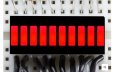
so I think the code is fine, I should use the LM3914 and the pwm pins of the esp32 dev board (there are 16) each pin to represent a column and band width and set the max signal of the LM3914to 5V so that means that when the signal is at 5v, all the LED's in that column would lit. so I have this code and it compiled fine for the esp32 dev board and I'm not using WS2812B LED strip, I am using bar graph type LED's, can you help me modify the code for my needs and explain please!? with 16 columns and 20 rows (instead of 30) thats 320 LED's! but I need the bar graph type because I want a certain "look", thank you! also I can change the amplitude to make the columbs go up to the desired 20 LED's this is the actual size of the LED matrix that I'll be using.
20 leds will light in each band? when the pwm signal is 5v into the LM3014
A quirky way to go about it:

  1. First you digitize an analog signal.
  2. Second you output the digital values as a (quasi-)analog signal using pwm.
  3. Third you digitize the analog signal using the LM3914 to digitize the analog signal for display.

Personally, my approach would be to use e.g. shift registers:

  1. Output the digital data from the microcontroller into the shift registers. You ned 1 clock pin and as many data pins as there are columns in your display (alternatively you could reduce the number of pins by multiplexing them).
  2. Drive the LEDs from the shift register's outputs (with the appropriate series resistors, of course).
If you can read/write arduino code can you tell me how to modify this code to work with shift registers!?
 

Attachments

Last edited:

BobTPH

Joined Jun 5, 2013
11,560
Let's start at the beginning. What are you trying to display on the bar graph?

You said you wanted a spectrum analyzer AND graphic equalizer. To me, that suggests two different displays, one for the spectral content of the signal you are processing, the other for the settings of the equalizer.
 

Thread Starter

Maglatron

Joined Nov 3, 2023
154
sorry for the confusion I thought they were both one and the same thing, I want a spectrum analyzer that has 16 columns and 20 rows I want the low frequencies on the left and high pitch on the right ranging from 32Hz to 20kHz, what are your thoughts? thanks
 
Last edited:

ci139

Joined Jul 11, 2016
2,000
you do realize that "detecting" of the longer wavelength takes more time than for shorter ones
if it is a real time synchronous thingy, you likely want to pre-detect the lower band or entire time buffer before it's audio-visual reproduction
 

BobTPH

Joined Jun 5, 2013
11,560
Okay, so you are not going to have sliders or pots to control the frequencies that are cut or boosted. That is what a graphic equalizer does.

How do you expect to separate the frequencies? If you use filters for each band, you can produce the output completely analog. The only reason to digitize it is if you are going to do digital signal processing to get each amplitude. That would require a fast DSP or a very fast micro.
 

Thread Starter

Maglatron

Joined Nov 3, 2023
154
no that's right no graphic equalizer for the speed I have dual core esp32 chips

have any ideas about charlieplexing and multiplexing with the esp32 and the 20 pins I need for the 320 LED's I'm using in my LED matrix which I'm making, and the FFT stuff, including that code that I posted ealier, with all the components that I may come accross and have to use and maybe shift registers transistors everything you can think of and just things I need to learn in general to do with this project, thanks.

so I think I have a few options, use LM3914 in conjunction with pass-band filters, made from opamps resistors and capacitors and positive negative power supply
multiplexing with shift registers
PWM of esp32 pins and LM3914, said to be a "quirky" approach
I still don't know how to use the program to be modified for the spectrum analyzer and the LED matrix of 16 columns by 20 rows, tell me If you need to see the code again. Ideas anyone?
The FFT library for arduino has whats called frequency bins to separate the frequencies


Quote Reply

Report
 

Thread Starter

Maglatron

Joined Nov 3, 2023
154
C:
// (Heavily) adapted from https://github.com/G6EJD/ESP32-8266-Audio-Spectrum-Display/blob/master/ESP32_Spectrum_Display_02.ino
// Adjusted to allow brightness changes on press+hold, Auto-cycle for 3 button presses within 2 seconds
// Edited to add Neomatrix support for easier compatibility with different layouts.
#include <FastLED_NeoMatrix.h>
#include <arduinoFFT.h>
#include <EasyButton.h>
#define SAMPLES 1024 // Must be a power of 2
#define SAMPLING_FREQ 40000 // Hz, must be 40000 or less due to ADC conversion time. Determines maximum frequency that can be analysed by the FFT Fmax=sampleF/2.
#define AMPLITUDE 1000 // Depending on your audio source level, you may need to alter this value. Can be used as a 'sensitivity' control.
#define AUDIO_IN_PIN 35 // Signal in on this pin
#define LED_PIN 5 // LED strip data
#define BTN_PIN 4 // Connect a push button to this pin to change patterns
#define LONG_PRESS_MS 200 // Number of ms to count as a long press
#define COLOR_ORDER GRB // If colours look wrong, play with this
#define CHIPSET WS2812B // LED strip type
#define MAX_MILLIAMPS 2000 // Careful with the amount of power here if running off USB port
const int BRIGHTNESS_SETTINGS[3] = {5, 70, 200}; // 3 Integer array for 3 brightness settings (based on pressing+holding BTN_PIN)
#define LED_VOLTS 5 // Usually 5 or 12
#define NUM_BANDS 16 // To change this, you will need to change the bunch of if statements describing the mapping from bins to bands
#define NOISE 500 // Used as a crude noise filter, values below this are ignored
const uint8_t kMatrixWidth = 16; // Matrix width
const uint8_t kMatrixHeight = 16; // Matrix height
#define NUM_LEDS (kMatrixWidth * kMatrixHeight) // Total number of LEDs
#define BAR_WIDTH (kMatrixWidth / (NUM_BANDS - 1)) // If width >= 8 light 1 LED width per bar, >= 16 light 2 LEDs width bar etc
#define TOP (kMatrixHeight - 0) // Don't allow the bars to go offscreen
#define SERPENTINE true // Set to false if you're LEDS are connected end to end, true if serpentine
// Sampling and FFT stuff
unsigned int sampling_period_us;
byte peak[] = {0,0,0,0,0,0,0,0,0,0,0,0,0,0,0,0}; // The length of these arrays must be >= NUM_BANDS
int oldBarHeights[] = {0,0,0,0,0,0,0,0,0,0,0,0,0,0,0,0};
int bandValues[] = {0,0,0,0,0,0,0,0,0,0,0,0,0,0,0,0};
double vReal[SAMPLES];
double vImag[SAMPLES];
unsigned long newTime;
arduinoFFT FFT = arduinoFFT(vReal, vImag, SAMPLES, SAMPLING_FREQ);
// Button stuff
int buttonPushCounter = 0;
bool autoChangePatterns = false;
EasyButton modeBtn(BTN_PIN);
// FastLED stuff
CRGB leds[NUM_LEDS];
DEFINE_GRADIENT_PALETTE( purple_gp ) {
0, 0, 212, 255, //blue
255, 179, 0, 255 }; //purple
DEFINE_GRADIENT_PALETTE( outrun_gp ) {
0, 141, 0, 100, //purple
127, 255, 192, 0, //yellow
255, 0, 5, 255 }; //blue
DEFINE_GRADIENT_PALETTE( greenblue_gp ) {
0, 0, 255, 60, //green
64, 0, 236, 255, //cyan
128, 0, 5, 255, //blue
192, 0, 236, 255, //cyan
255, 0, 255, 60 }; //green
DEFINE_GRADIENT_PALETTE( redyellow_gp ) {
0, 200, 200, 200, //white
64, 255, 218, 0, //yellow
128, 231, 0, 0, //red
192, 255, 218, 0, //yellow
255, 200, 200, 200 }; //white
CRGBPalette16 purplePal = purple_gp;
CRGBPalette16 outrunPal = outrun_gp;
CRGBPalette16 greenbluePal = greenblue_gp;
CRGBPalette16 heatPal = redyellow_gp;
uint8_t colorTimer = 0;
// FastLED_NeoMaxtrix - see https://github.com/marcmerlin/FastLED_NeoMatrix for Tiled Matrixes, Zig-Zag and so forth
FastLED_NeoMatrix *matrix = new FastLED_NeoMatrix(leds, kMatrixWidth, kMatrixHeight,
NEO_MATRIX_TOP + NEO_MATRIX_LEFT +
NEO_MATRIX_ROWS + NEO_MATRIX_ZIGZAG +
NEO_TILE_TOP + NEO_TILE_LEFT + NEO_TILE_ROWS);
void setup() {
Serial.begin(115200);
FastLED.addLeds<CHIPSET, LED_PIN, COLOR_ORDER>(leds, NUM_LEDS).setCorrection(TypicalSMD5050);
FastLED.setMaxPowerInVoltsAndMilliamps(LED_VOLTS, MAX_MILLIAMPS);
FastLED.setBrightness(BRIGHTNESS_SETTINGS[1]);
FastLED.clear();
modeBtn.begin();
modeBtn.onPressed(changeMode);
modeBtn.onPressedFor(LONG_PRESS_MS, brightnessButton);
modeBtn.onSequence(3, 2000, startAutoMode);
modeBtn.onSequence(5, 2000, brightnessOff);
sampling_period_us = round(1000000 * (1.0 / SAMPLING_FREQ));
}
void changeMode() {
Serial.println("Button pressed");
if (FastLED.getBrightness() == 0) FastLED.setBrightness(BRIGHTNESS_SETTINGS[0]); //Re-enable if lights are "off"
autoChangePatterns = false;
buttonPushCounter = (buttonPushCounter + 1) % 6;
}
void startAutoMode() {
autoChangePatterns = true;
}
void brightnessButton() {
if (FastLED.getBrightness() == BRIGHTNESS_SETTINGS[2]) FastLED.setBrightness(BRIGHTNESS_SETTINGS[0]);
else if (FastLED.getBrightness() == BRIGHTNESS_SETTINGS[0]) FastLED.setBrightness(BRIGHTNESS_SETTINGS[1]);
else if (FastLED.getBrightness() == BRIGHTNESS_SETTINGS[1]) FastLED.setBrightness(BRIGHTNESS_SETTINGS[2]);
else if (FastLED.getBrightness() == 0) FastLED.setBrightness(BRIGHTNESS_SETTINGS[0]); //Re-enable if lights are "off"
}
void brightnessOff(){
FastLED.setBrightness(0); //Lights out
}
void loop() {
// Don't clear screen if waterfall pattern, be sure to change this is you change the patterns / order
if (buttonPushCounter != 5) FastLED.clear();
modeBtn.read();
// Reset bandValues[]
for (int i = 0; i<NUM_BANDS; i++){
bandValues = 0;
 }
 // Sample the audio pin
 for (int i = 0; i < SAMPLES; i++) {
 newTime = micros();
vReal = analogRead(AUDIO_IN_PIN); // A conversion takes about 9.7uS on an ESP32
vImag = 0;
 while ((micros() - newTime) < sampling_period_us) { /* chill */ }
 }
 // Compute FFT
 FFT.DCRemoval();
 FFT.Windowing(FFT_WIN_TYP_HAMMING, FFT_FORWARD);
 FFT.Compute(FFT_FORWARD);
 FFT.ComplexToMagnitude();
 // Analyse FFT results
 for (int i = 2; i < (SAMPLES/2); i++){ // Don't use sample 0 and only first SAMPLES/2 are usable. Each array element represents a frequency bin and its value the amplitude.
if (vReal > NOISE) { // Add a crude noise filter
 /*8 bands, 12kHz top band
 if (i<=3 ) bandValues[0] += (int)vReal;
if (i>3 && i<=6 ) bandValues[1] += (int)vReal;
if (i>6 && i<=13 ) bandValues[2] += (int)vReal;
if (i>13 && i<=27 ) bandValues[3] += (int)vReal;
if (i>27 && i<=55 ) bandValues[4] += (int)vReal;
if (i>55 && i<=112) bandValues[5] += (int)vReal;
if (i>112 && i<=229) bandValues[6] += (int)vReal;
if (i>229 ) bandValues[7] += (int)vReal;*/
 //16 bands, 12kHz top band
 if (i<=2 ) bandValues[0] += (int)vReal;
if (i>2 && i<=3 ) bandValues[1] += (int)vReal;
if (i>3 && i<=5 ) bandValues[2] += (int)vReal;
if (i>5 && i<=7 ) bandValues[3] += (int)vReal;
if (i>7 && i<=9 ) bandValues[4] += (int)vReal;
if (i>9 && i<=13 ) bandValues[5] += (int)vReal;
if (i>13 && i<=18 ) bandValues[6] += (int)vReal;
if (i>18 && i<=25 ) bandValues[7] += (int)vReal;
if (i>25 && i<=36 ) bandValues[8] += (int)vReal;
if (i>36 && i<=50 ) bandValues[9] += (int)vReal;
if (i>50 && i<=69 ) bandValues[10] += (int)vReal;
if (i>69 && i<=97 ) bandValues[11] += (int)vReal;
if (i>97 && i<=135) bandValues[12] += (int)vReal;
if (i>135 && i<=189) bandValues[13] += (int)vReal;
if (i>189 && i<=264) bandValues[14] += (int)vReal;
if (i>264 ) bandValues[15] += (int)vReal;
 }
 }
 // Process the FFT data into bar heights
 for (byte band = 0; band < NUM_BANDS; band++) {
 // Scale the bars for the display
 int barHeight = bandValues[band] / AMPLITUDE;
 if (barHeight > TOP) barHeight = TOP;
 // Small amount of averaging between frames
 barHeight = ((oldBarHeights[band] * 1) + barHeight) / 2;
 // Move peak up
 if (barHeight > peak[band]) {
 peak[band] = min(TOP, barHeight);
 }
 // Draw bars
 switch (buttonPushCounter) {
 case 0:
 rainbowBars(band, barHeight);
 break;
 case 1:
 // No bars on this one
 break;
 case 2:
 purpleBars(band, barHeight);
 break;
 case 3:
 centerBars(band, barHeight);
 break;
 case 4:
 changingBars(band, barHeight);
 break;
 case 5:
 waterfall(band);
 break;
 }
 // Draw peaks
 switch (buttonPushCounter) {
 case 0:
 whitePeak(band);
 break;
 case 1:
 outrunPeak(band);
 break;
 case 2:
 whitePeak(band);
 break;
 case 3:
 // No peaks
 break;
 case 4:
 // No peaks
 break;
 case 5:
 // No peaks
 break;
 }
 // Save oldBarHeights for averaging later
 oldBarHeights[band] = barHeight;
 }
 // Decay peak
 EVERY_N_MILLISECONDS(60) {
 for (byte band = 0; band < NUM_BANDS; band++)
 if (peak[band] > 0) peak[band] -= 1;
 colorTimer++;
 }
 // Used in some of the patterns
 EVERY_N_MILLISECONDS(10) {
 colorTimer++;
 }
 EVERY_N_SECONDS(10) {
 if (autoChangePatterns) buttonPushCounter = (buttonPushCounter + 1) % 6;
 }
 FastLED.show();
 }
// PATTERNS BELOW //
void rainbowBars(int band, int barHeight) {
 int xStart = BAR_WIDTH * band;
 for (int x = xStart; x < xStart + BAR_WIDTH; x++) {
 for (int y = TOP; y >= TOP - barHeight; y--) {
 matrix->drawPixel(x, y, CHSV((x / BAR_WIDTH) * (255 / NUM_BANDS), 255, 255));
 }
 }
 }
void purpleBars(int band, int barHeight) {
 int xStart = BAR_WIDTH * band;
 for (int x = xStart; x < xStart + BAR_WIDTH; x++) {
 for (int y = TOP; y >= TOP - barHeight; y--) {
 matrix->drawPixel(x, y, ColorFromPalette(purplePal, y * (255 / (barHeight + 1))));
 }
 }
 }
void changingBars(int band, int barHeight) {
 int xStart = BAR_WIDTH * band;
 for (int x = xStart; x < xStart + BAR_WIDTH; x++) {
 for (int y = TOP; y >= TOP - barHeight; y--) {
 matrix->drawPixel(x, y, CHSV(y * (255 / kMatrixHeight) + colorTimer, 255, 255));
 }
 }
 }
void centerBars(int band, int barHeight) {
 int xStart = BAR_WIDTH * band;
 for (int x = xStart; x < xStart + BAR_WIDTH; x++) {
 if (barHeight % 2 == 0) barHeight--;
 int yStart = ((kMatrixHeight - barHeight) / 2 );
 for (int y = yStart; y <= (yStart + barHeight); y++) {
 int colorIndex = constrain((y - yStart) * (255 / barHeight), 0, 255);
 matrix->drawPixel(x, y, ColorFromPalette(heatPal, colorIndex));
 }
 }
 }
void whitePeak(int band) {
 int xStart = BAR_WIDTH * band;
 int peakHeight = TOP - peak[band] - 1;
 for (int x = xStart; x < xStart + BAR_WIDTH; x++) {
 matrix->drawPixel(x, peakHeight, CHSV(0,0,255));
 }
 }
void outrunPeak(int band) {
 int xStart = BAR_WIDTH * band;
 int peakHeight = TOP - peak[band] - 1;
 for (int x = xStart; x < xStart + BAR_WIDTH; x++) {
 matrix->drawPixel(x, peakHeight, ColorFromPalette(outrunPal, peakHeight * (255 / kMatrixHeight)));
 }
 }
void waterfall(int band) {
 int xStart = BAR_WIDTH * band;
 double highestBandValue = 60000; // Set this to calibrate your waterfall
 // Draw bottom line
 for (int x = xStart; x < xStart + BAR_WIDTH; x++) {
 matrix->drawPixel(x, 0, CHSV(constrain(map(bandValues[band],0,highestBandValue,160,0),0,160), 255, 255));
 }
 // Move screen up starting at 2nd row from top
 if (band == NUM_BANDS - 1){
 for (int y = kMatrixHeight - 2; y >= 0; y--) {
 for (int x = 0; x < kMatrixWidth; x++) {
 int pixelIndexY = matrix->XY(x, y + 1);
 int pixelIndex = matrix->XY(x, y);
 leds[pixelIndexY] = leds[pixelIndex];
 }
 }
 }
 }
 
Top