That's a trick question. If you think about all of the trillions and trillions of transistors in microprocessor or memory components and compare that to the number of transistors used for analog circuits, you could say that transistors are mostly used as switches. But the more interesting applications are when they're used in the active region.
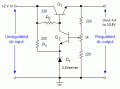
When the simple voltage regulator you're experimenting with is working, both transistors are in the active region. If you try to set the output voltage too high, Q1 will be saturated and Q2 will be barely on or off.
That's also a question of semantics. Digital is a subset of analog.
In analog circuits, we generally try to avoid saturating transistors.
To complicate things further, there's a digital logic family called ECL (Emitter Coupled Logic) that didn't saturate transistors for speed. Back in the 70's it was the fastest digital logic around, achieving clock rates of several hundred MHz and more. But it was power hungry and I burned myself more than once while using it.
I have to poke this dead horse one last time, because I simply do not understand the role of the zener in this circuit.
I could see the point if it were connected to the base of a transistor, but seeing it at the emitter throws me off. And couple that with the circuit adjusts very poorly, only a few voltages, if I go over 3V zener, the regulation span becomes very poor, about 7,8 to 10V with a 5V zener.
It is used as a voltage reference, but I dont understand in reference to what..? Who needs it as a reference? And how would I determine the size of the zener? I have access to 24V now, if need be, as compared to only 5V earlier, when I worked on this.
If you want a well-regulated output voltage then you have to compare the output voltage (0r a known fixed fraction of it) with some reference voltage and use the difference as a control signal to adjust the output voltage. In this case the emitter is at the reference voltage (relative to ground) provided by the zener diode, and the fixed fraction of the output voltage is provided by the potentiometer to the transistor base. If the base voltage tries to rise ~0.6V above the emitter voltage Q2 conducts, robs Q1 of base current and the output voltage drops back down.
A zener diode is not a perfect voltage reference, since its voltage increases slightly with the current through it.
It is used as a voltage reference, but I dont understand in reference to what..? Who needs it as a reference? And how would I determine the size of the zener? I have access to 24V now, if need be, as compared to only 5V earlier, when I worked on this.
The voltage divider on the regulator output provides feedback that controls the output voltage. You can calculate the adjust range by using the closed loop gain, but I think it would be simpler to just do it with ratios.
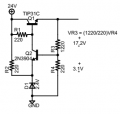
At one extreme, the wiper will be at it's lowest setting. This would give the equivalent of a 1220 ohm resistor (R3) in series with a 220 ohm resistor (R4). R4 will have 3.1V across it. Using the ratio of the two resistors (R3/R4), the voltage across R3 would be 1220/220 times that of R3; or 17.2V. Note that I changed the input voltage to 24V so the numbers work.
This is a first order approximation that ignores base current for Q2 which would affect the voltages. If you assume a beta of 100 for Q2, the difference can be neglected.
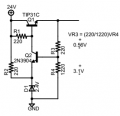
At the other extreme, you'd have this:
So, the voltage adjust range would be 3.66-20.3V.
EDIT: Just noticed that you were using a 2.5V zener; I used a 2.4v.
Hi @dl324 thanks for chiming in again. Your numbers are pretty darn close to what I got during my testing/measuring.
I just had a hard time seeing the whole point of the zener, as it narrowed the adjustment span, compared to just skipping it altogether, and then being able to adjust from 0V and up.
I just had a hard time seeing the whole point of the zener, as it narrowed the adjustment span, compared to just skipping it altogether, and then being able to adjust from 0V and up.
You could do that, which would be using the base-emitter voltage of Q2 as the voltage reference.
The disadvantage is the temperature coefficient of the Vbe voltage, which is about 2mV/°C.
This give about a 0.3%/°C change in the adjusted output voltage.
If that temperature change is of no concern in your application for the power supply, then eliminating the zener will work.
The base emitter junction has a temperature coefficient of about -2mV/C. Zener diodes above about 7 or 8V have a positive temperature coefficient that can cancel some of that, but the coefficient increases with zener voltage.
Low voltage zeners are by the zener breakdown mechanism and have a negative tempco, higher voltage zeners are by the avalanche breakdown mechanism and have a positive tempco. Some zeners are temperature compensated by putting silicon diodes in series with them.

 Facebook
 Google
 GitHub
 Linkedin