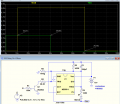
Delay On and Delay Off

Thread Starter

MrsssSu

Joined Sep 28, 2021
267
Hi all :),
The circuit on the left is a delay off circuit using NE 555 whereas The circuit on the right is delay on circuit. For hobby purpose, lets consider this scenerio. When light is off, the led will turn off after a 3 seconds delay whereas when the light is turn back on, the led will turn on after a 3 seconds delay also. I searched the web for the schematic but cant find it. So, I am deciding to combine the 2 circuit below (delay on & off) to achieve my goal? Is this how we are suppose to do it by combining both :) ? LT spice file is attached.

Thank you all for reading


1649478140812.png

1649478462844.png
1649478489519.png
 

Attachments

crutschow

Joined Mar 14, 2008
38,322
Wow sir, I have been searching the web for like 2 hours and couldn't find any. I believe your schematic is the first one to be out in the web haha . Thank you for sharing your knowledge:)
You're welcome.
As a hobby, I've generated quite a few variations of 555 circuits, and one did what you wanted, with a little tweaking to get the desired delay times.

555 circuits are relatively easy to understand, once you know the basics of the 555 operation.
 

LowQCab

Joined Nov 6, 2012
5,101
when the light is turn back on,
What is the Voltage powering the "light" ?
Is the "light" connected to the same Power-Supply as the LED ?
What is the purpose of the Delay ?
Does the Delay need to be adjustable ?, or fixed at exactly 3-seconds to "On", and 3-seconds to "Off" ?
What is the Maximum-Current-Rating of your LED ?
Does the LED need to operate at it's Maximum-Current, or lower, ( to save Battery-Power ).
What is the Forward-Voltage of your LED ?
Is your real-world Power-Supply Regulated at ~10-Volts ? or is it Battery-Powered ?
.
.
.
 

Thread Starter

MrsssSu

Joined Sep 28, 2021
267
Here's a single 555 circuit that provides both an ON and OFF delay:
Is that what you want?

View attachment 264624
Hi sir, I have decided to put the circuit to the test on breadboard. However, I do not have a big capacitor (C1) that is 62uF. I only have a 4.7uF maximum. Are there any other parameter that can be adjusted so that it does not utilize too big capactitor to produce the delay :) Thank you:)
 

crutschow

Joined Mar 14, 2008
38,322
You could try it with the 4.7µF capacitor and larger resistors for R2, R3, R4, & R5 (below), but the high resistor values could give flaky results in a real circuit.

Is it that difficult to buy a larger capacitor?

1650476193040.png
 

sghioto

Joined Dec 31, 2017
8,633
When light is off, the led will turn off after a 3 seconds delay whereas when the light is turn back on, the led will turn on after a 3 seconds delay also.
I don't understand this statement. What do you mean when the "light is OFF"? The V2 pulse, power V1 and/or V3? Is there suppose to be a photocell in the circuit?
 

johnmoz

Joined Dec 20, 2023
2
I'm trying to use this schema to delay the start and off. But I want that the turn on delay to be 10 seconds and the turn off delay 30 seconds.
With this schema it is possible to have a different on and off delay? And if so which resisters/capacitor values I need to change and how can I calculate the new values?
 

crutschow

Joined Mar 14, 2008
38,322
I'm trying to use this schema to delay the start and off. But I want that the turn on delay to be 10 seconds and the turn off delay 30 seconds.
With this schema it is possible to have a different on and off delay? And if so which resisters/capacitor values I need to change and how can I calculate the new values?
Here's the modified circuit:
R2 adjusts the delay on, and R4 adjusts the delay off.
I'm lazy so I just tweaked the values in the sim, until I got the desired delay times.

1714593960206.png
 

MisterBill2

Joined Jan 23, 2018
27,186
A simpler method, created by others, I take no credit for that, will be to use a mosfet to do the switching, and for switch on, the switch connects from the positive supply a resistor to the mosfet gate. But there is provided a capacitor between the gate and the supply negative, so that the mosfet goes into conduction slowly, and at some point the relay controlling the load switches ON, and the load is powered. To switch off, the switch connects that gate capacitor to the supply negative thru a different resistor, and the capacitor discharges until the relay releases and the load is switched off.
The benefits are zero standby current and no 555 timer needed.
 
Top