Just a quick question.
A flash camera dc to dc converter, aside from beeing non-isolated (boost converter), in the general schem of things, under what category would such converter falls in. I’m talking about converters that has no ICs.
If it’s flyback then yes its isolated (like h-bridge, half-bridge, push-pull) because of being galvanicly isolated through the use of a transformer. I thought boost and buck converters where non isolated (no transformer)
Flyback, small input voltage to large output voltage. In this case the (transformer/inductor) is a tapped inductor.
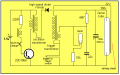
Here is an example where a transistor is a simple oscillator. The voltage on the Collector is much higher than the supply voltage. Then an inductor or transformer multiplies the voltage up to 350V in this case.
@ronsimpson
Thank you very much for the schematic.
So to answer my question, can we say that all flyback dc to dc converters works off without IC, where the transitor base (or mosfet gate) oscillates with the feedback coming off the transformer center tap?
A flyback has nothing to do with IC or no IC. Most have an IC.
An old CRT TV set has a flyback that makes the high voltage and it likely has no feedback.
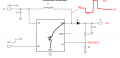
In a very simple form, hare is a flyback PWM circuit. It is taking 5 volts and boosting it to 12 volts. Inside the IC there is a power transistor or MOSFET that shorts SW to ground for a short time. This puts 5V across L1 and stores energy in the inductor. When the transistor opens the stored energy jumps up in voltage. This energy pushes through D1 and charges up C2. When the energy in the inductor is used up the voltage drops back to 5V or 0V across L1.
L1 is like a rubber band. Hold one end at 5 inches above the table and the other end at 0 inches. There is now energy in the rubber. Release the end on the table and it "fly backs" up into the air above 5 inches.

 Facebook
 Google
 GitHub
 Linkedin