DC Motor Generator HELP

MaxHeadRoom

Joined Jul 18, 2013
30,661
Finding voltage seems stupid simple. Seeing how text books don't teach or give current output on the datasheets, finding the right motor seems difficult..
The motors I use (non-Chinese origin) usually supply a data sheet showing continuous current and max peak current across the rpm range, the peak current is usually for very short term motor excursions.
Max.
 

MaxHeadRoom

Joined Jul 18, 2013
30,661
But the second I want to make a beefy or acceptable generator, I find out it's not so easy.

..
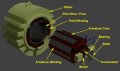
A DC motor is a surprisingly simple device.
If you have a motor say rated at 100vdc and 1000rpm. Off loaded the motor will obviously reach 1krpm when 100vdc is applied.
The armature resistance of this motor may only be a few ohms. so what prevents a high current flowing?
The answer is in if instead of applying a voltage you crank the motor externally up to 1krpm.
The output of the motor is 100v, give or take.
When used as a motor this generated voltage is also present, opposing the applied voltage, hence the low current.
The current is a product of whatever it takes to keep the armature inertia rotating at 1krpm.
The BEMF voltage can never actually reach the applied voltage, otherwise no current would flow at all.
Max.
 

Thread Starter

Guest3123

Joined Oct 28, 2014
404
Like I explained earlier, the torque required depends on the current demand on the generator.
If you crank that at 95rpm you will produce 12vdc, the torque required will depend on the degree of load (current) the motor is supplying.
Max.
So I could get that motor, and the cellphone might not even require the full X amps. So the torque will be small. Is that correct?

Kinda like he demonstrated in his video.. bigger bulb, harder to crank. Harder to crank, because of the current, which is more torque.
DC generators from ebay

No load, very easy to turn.
Big load, hard to turn.
 

Thread Starter

Guest3123

Joined Oct 28, 2014
404
The motors I use (non-Chinese origin) usually supply a data sheet showing continuous current and max peak current across the rpm range, the peak current is usually for very short term motor excursions.
Max.
Where do you buy your motors from? Mouser? Digi-Key..? Can you please tell me where you buy them from?
 

MaxHeadRoom

Joined Jul 18, 2013
30,661
Where do you buy your motors from? Mouser? Digi-Key..? Can you please tell me where you buy them from?
No, the motors I buy are specialty DC or BLDC servo motors and I buy through their distributors, these cover quite a few manufacturers, either N.A. or Japanese.
Not usually the ones sold in the internet, you can however get the same quality of such as ebay etc from a reputable seller.
Max.
 

Thread Starter

Guest3123

Joined Oct 28, 2014
404
If you have a motor say rated at 100vdc and 1000rpm. Off loaded the motor will obviously reach 1krpm when 100vdc is applied.
Easy. Understood.

he armature resistance of this motor may only be a few ohms. so what prevents a high current flowing?
The armature.. being the thing that holds the coils..?
43rtfd.jpg

I've seen videos of people measuring the resistance of a 2 pole 2 phase stepper, it was 9Ω per phase.
So if 100V was passed threw these, in parallel, 4.5Ω, 22.2 Amps..? Series, 18Ω, 5.5A..

The answer is in if instead of applying a voltage you crank the motor externally up to 1krpm.
The output of the motor is 100v, give or take.
Obviously.. But what does that say about the current with no load connected to the leads..?

When used as a motor this generated voltage is also present, opposing the applied voltage, hence the low current.
I don't know what your talking about.. I'd figure it would be something like 0 volts, because of the voltage drop. Usually at the end of a circuit, it's 0 volts at the other end.

The current is a product of whatever it takes to keep the armature inertia rotating at 1krpm.
I've seen that in videos, and such. Don't understand it much though.


The BEMF voltage can never actually reach the applied voltage, otherwise no current would flow at all.
I have no idea what BEMF means. I see EMF.. So.. B is beta..? I honestly don't know.
I don't understand.
 

BR-549

Joined Sep 22, 2013
4,931
I just noticed that you are a student. I really miss arguing with the instructors........what are you studying?

I have some "atomic" alarm clocks and several temp and humidity sensors thru out the house. All are small solar panel powered and have never seen direct sunlight. They are all over 8 years old....no failures and no battery changes.

You will need more current and so a battery. Just hang a larger panel on the wall. I'm sure you can find an off the self solution.
 

Thread Starter

Guest3123

Joined Oct 28, 2014
404
I just noticed that you are a student. I really miss arguing with the instructors........what are you studying?

I have some "atomic" alarm clocks and several temp and humidity sensors thru out the house. All are small solar panel powered and have never seen direct sunlight. They are all over 8 years old....no failures and no battery changes.

You will need more current and so a battery. Just hang a larger panel on the wall. I'm sure you can find an off the self solution.
I will get a solar panel too. Preferably from Anker.

I'm a self taught student. I like to learn about many different things. It keeps me sane, and keeps me out of trouble.

I think of it as survival knoledge. If I can be smarter than the guy next to me, I can..
1. Outsmart the other person.
2. Teach others. Which I do on my channel.
3. Understand other things, that I don't know yet.
 

Thread Starter

Guest3123

Joined Oct 28, 2014
404
I see the torque ratings on these motors.. like for instance.. This $40 motor.

680.5oz-in, which, correct me if I'm wrong, is the amount of torque it has, under full load?
Maximum torque: 680.5 oz-in. (12VDC)

Is there a way.. I can understand this torque thing? I mean, as far as comprehending how hard it would be to turn something that was 680.5 oz-in.

I understand the 680 oz part. Basically if I had a 42.5 lbs weight, and it was on a single pulley, that's how hard it would be to pull the weight up over a single inch?

So If I had a wheel, and the wheel was 2 inches in diameter, put a axle in the middle, and the motor that was turning it, had a torque of 42.5 lbs-inch.

It would stall with 42.5 lbs.. Let's say it was a pulley.

Is that correct?
 
Last edited:

BR-549

Joined Sep 22, 2013
4,931
"680.5oz-in, which, correct me if I'm wrong, is the amount of torque it has, under full load?
Maximum torque: 680.5 oz-in. (12VDC)"

I think it means that if you put a 1 in. radius pulley on the shaft......the motor was designed to lift 680.5 oz.
 

tcmtech

Joined Nov 4, 2013
2,867
But the second I want to make a beefy or acceptable generator, I find out it's not so easy.
That's the problem with working with multidisciplinary problems that cross over mechanical engineering principles with electrical engineering. You have to learn how to convert one thing into another in order to find the final solution.

In your case you need to learn the basics of what the numbers mean behind the mechanics of the motor specs and how they relate to electrical power equivalents as I did with that one motor you referenced.

(Torque in foot pounds multiplied by RPMs) divided by 5252 equals Horsepower. One horsepower is 746 watts. The rest is just doing unit conversions and the related math to find the information you need regarding the motor/generator RPM requirements and plugging that into a online search.

So as I would approach it I would start out with defining what is the maximum load you plan to power then work backwards form there while factoring in efficiency losses along the way until you reach the torque and RPM equivalents that will define the mechanical aspects of the power source.

15 watts load.
80% power/voltage control system efficiency = ~19 watts input
80% generator efficiency = ~24 watts mechanical input.
24 watts at 75 RPM = ~2.25 ft/lbs (~432 oz/in) torque.

Motor specs ~ 10 RPM per volt @ 432-oz/in minimum. ;)
 

MaxHeadRoom

Joined Jul 18, 2013
30,661
The armature.. being the thing that holds the coils..?

I've seen videos of people measuring the resistance of a 2 pole 2 phase stepper, it was 9Ω per phase.
So if 100V was passed threw these, in parallel, 4.5Ω, 22.2 Amps..? Series, 18Ω, 5.5A..


Obviously.. But what does that say about the current with no load connected to the leads..?


I don't know what your talking about.. I'd figure it would be something like 0 volts, because of the voltage drop. Usually at the end of a circuit, it's 0 volts at the other end.


I've seen that in videos, and such. Don't understand it much though.


I have no idea what BEMF means. I see EMF.. So.. B is beta..? I honestly don't know.
I don't understand.
A stepper is a different animal and it runs at the rated plate current whether stopped or running under power.

When the DC motor is generating without a load there is no current.

If you have 100v terminal voltage supply and a generated voltage of equal voltage exists, then zero current would flow.

But obviously some current has to flow to keep the armature rotating so the load is just the inertia of keeping the armature rotating . The BEMF will be slightly lower than the applied.
This assumes no other load.
BEMF = Back Electro-Motive Force.

Max.
 

MrSoftware

Joined Oct 29, 2013
2,273
The problem with mechanical power generation is, it's horribly inefficient. And when you use mechanically generated power to charge a battery, the efficiency drops even more. If you use a hand crank generator to change a phone, I would be surprised if 5% of the energy you put in is actually stored as usable energy in the battery.

That said; forget the hand crank, get your hands on one of these:

https://www.amazon.com/GravityLight-GL02-Portable-Self-Powered/dp/B01M7SM0KE


Last edited:

tcmtech

Joined Nov 4, 2013
2,867
The problem with mechanical power generation is, it's horribly inefficient. And when you use mechanically generated power to charge a battery, the efficiency drops even more. If you use a hand crank generator to change a phone, I would be surprised if 5% of the energy you put in is actually stored as usable energy in the battery.
Over the years of being online in technical forums I have seen these threads countless times and everyone who starts one thinks that human power to generate electricity is going to be some new and efficient method of powering their common devices that no one has ever researched. Yet the reality is it's as old as time itself and every instance of it has shown that most anything is more effective and efficient than us.

The reality is generating power by human source is at best a last resort tactic that is neither cheap nor reliably effective for much of anything that needs more than a few watt hours per day to operate. :(
 
Top