DC Motor Generator HELP

Thread Starter

Guest3123

Joined Oct 28, 2014
404
Cranking a Megger for a few minutes was enough for me.:(
Max.
Ok Max, I need your help.. Can I make this motor a generator with that encoder on it..?

This is the motor I've choosen to buy. ($60, 12V, 118RPM 958.2oz-in HD Premium Planetary Gearmotor w/ Encoder)
It's got a no-load current of 0.53A, 20A stall current, takes 118 revolutions per minute to generate 12V.

Torque (Stall): 958.2 oz-in, or 4.9906 ft-lbs @ 20A @ 12V @ less than 118 RPM.

5V RPM : 9.833 RPM
20A stall current / 12V = 1.66A (stall current per volt.)
5V stall current = 8.33
1V stall torque : 4.990 ft-lbs / 12 = 0.41583 ft-lbs per volt
5V stall torque : 2.0791 ft-lbs


Is that difficult to turn..? 2.0791 ft-lbs..?

I figure it's not difficult.

It's just a 2.0791 pound weight on a a piece of string on a pulley that has a diameter of
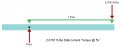
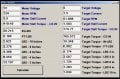
ScreenHunter_37 Feb. 25 03.34.jpg

What about this one.. $40, 12V, 165RPM 680.5oz-in Precision Planetary Gearmotor

no-load current : 0.53A
RPM @ 12V @ no-load rpm 165
stall torque : 680.5oz-in (3.544 lb-ft)
stall current : 20A @ 3.544 ft-lbs @ less than 165 rpm

That's a really good one right? 51:1 gear ration. Precision planetary gear motor..

165 RPM @ 5V = 165 / 12 = 13.75 per volt x 5V = 68.75 times a minute.
 
Last edited:

MaxHeadRoom

Joined Jul 18, 2013
30,660
If you were to use the reverse calc of 3.5ft/lbs that would be 7lb on a 6" crank operated at 165rpm, I don't think you are aware of the actual effort required in order to keep up a sustained rotation at this rpm.
Max.
 

Thread Starter

Guest3123

Joined Oct 28, 2014
404
If you were to use the reverse calc of 3.5ft/lbs that would be 7lb on a 6" crank operated at 165rpm, I don't think you are aware of the actual effort required in order to keep up a sustained rotation at this rpm.
Max.
Could you please explain to me then.. How is 3.5 ft-lb be 2x as much on a 6" crank handle.
 

MaxHeadRoom

Joined Jul 18, 2013
30,660
Theoretically a crank of 1ft length would require 3.5lbs effort in order to crank the max load, therefore reducing the length to 6" would double the effort required.
Max.
 

Thread Starter

Guest3123

Joined Oct 28, 2014
404
Theoretically a crank of 1ft length would require 3.5lbs effort in order to crank the max load, therefore reducing the length to 6" would double the effort required.
Max.
So.. 12" / 1" = 12 x 3.5 = 42 ft-lbs in 1 inch..

12" / 6" = 2 x 3.5 ft-lbs = 7 ft-lbs.

12" / 3" = 4 x 3.5 ft-lbs = 14 ft-lbs for 3 inch wheel.


So.. it doubles the current and voltage too then..
 

MaxHeadRoom

Joined Jul 18, 2013
30,660
With the motor driving the GB, the output torque is increased by the rate of reduction, the opposite is true when you back drive or drive from the output.
The higher the reduction the higher the effort to back drive.
Max.
 

tcmtech

Joined Nov 4, 2013
2,867
Is that difficult to turn..? 2.0791 ft-lbs..?
(probably talking myself here but....)

Take a 1 gallon jug of water and try and shake it around in a ~6 inch diameter circle at the speed you want to crank your generator then you tell us what you think.

2 Ft/lbs of torque at a 118 RPM will have you dead tired in a few minutes. :oops:
 

Thread Starter

Guest3123

Joined Oct 28, 2014
404
(probably talking myself here but....)

Take a 1 gallon jug of water and try and shake it around in a ~6 inch diameter circle at the speed you want to crank your generator then you tell us what you think.

2 Ft/lbs of torque at a 118 RPM will have you dead tired in a few minutes. :oops:
Alright.. So I'll use this motor as an example. (JUST AN EXAMPLE)
Voltage : 12VDC
RPM (no-load) : 165
Stall Current : 20A
Maximum Torque or Stall Torque : 680.5 oz-in (3.54 FT-LBS, 7.08 6IN-LBS, 10.63 4IN-LBS, 42.53 IN-LBS)
5V RPM (no-load) : 68.75
5V Stall Current : 8.33A

So let's see how much torque it would take for 5V @ 1A.
1A / 8.33A = 0.1200480192
680.5 OZ-IN x 0.1200480192 = 81.69267707 OZ-IN

81.692 OZ-IN @ 5V @ 1A @ 68.75 RPM
That's only 1.27 4IN-LBS, 0.85 6IN-LBS, 0.42 FT-LBS @ 68.75 RPM

Unless my math is wrong.. It's going to take 0.85 6 Inch-LBS to turn that motor at 69 revolutions per minute.

That's not very much. imho.

But like, I think, what everyone is concerned about, is doing this for 4 hours to charge a cellphone. Am I correct?

Checking my math.
What's 1 amp's relationship to 8.33 amps?
1A / 8.33A = 0.12004801920768307322929171668667
0.12004801920768307322929171668667 x 100 = 1 amp is 12.00480% of 8.33 amps

Ok, cool. Now let's see how much stall torque is required.
At 12V the stall torque or maximum torque is 680.5 oz-in
680.5 / 12 = 56.708333333333333333333333333333 oz-in per volt.
56.708333333333333333333333333333 x 5V = 283.54166666666666666666666666667

Now that's 283.541666 oz-in @ 8.33A
We want to know how much torque is for 1A of the 8.33A.
0.12004801920768307322929171668667 (1A of 8.33A) x 283.54166666666666666666666666667 oz-in =
34.038615446178471388555422168867 oz-in @ 69 RPM

34.0386154 oz-in (2.12 IN-LBS, 0.7 3IN-LBS, 0.53 4IN-LBS, 0.35 6IN-LBS, 0.17 FT-LBS)
According to my math.. Everything looks correct and proper.

Also, it's not 2 ft-lbs at 118 rpm, because it takes 118 rpm to generate 12V.
118 rpm / 12v = 9.833 rpm per volt.
9.833 x 5v = 49.16 rpm @ 5V

49.16 rpm @ 5v @ stall current of 8.33A @ 2.079 ft-lbs or 4.158 6IN-lbs

Yes, your right, it going to be tiring after a few minutes.
 
Last edited:

tcmtech

Joined Nov 4, 2013
2,867
Unless my math is wrong.. It's going to take 0.85 6 Inch-LBS to turn that motor at 69 revolutions per minute.

That's not very much. imho.

But like, I think, what everyone is concerned about, is doing this for 4 hours to charge a cellphone. Am I correct?
Your math is reasonable and yes that time constant is the #1 issue behind all human powered anything. Long slow charge cycles are tedious at minimal. It's just not how our bodies were designed to work.

We can put out several watt hours of energy in a multi hundred watt burst for a minute or so with less issue and fuss than we can sustain a low several watt continuous drain for a long period of time.

To be honest the most realistic method to charge cell phone that only takes 5 - 10 watt hours of energy to charge would be to have a exercise bike type system set up with a low duty cycle high output generator where you can get on and physically go like your nuts for a minute or so to charge up a big supercapacitor bank (600 watts for 1 minute = 10 watt hours) then let the charge you dumped into that do the actual phone charging for the next hour or two.

So,
Yes, your right, it going to be tiring after a few minutes.
:D
 

profbuxton

Joined Feb 21, 2014
421
Hand cranked torches and radios are already available commercially. Why not just try one and see how you go keeping it charged. I have a hand cranked torch(LED) and believe me that it gets tiring trying charge it fully.
By the way, in OZ we had pushbikes hooked up to generators to power outback station radios in the early days.
Also , I seem to recall that during WW2 there was a hand cranked radio used by the forces. I believe they used to call it a "Gibson Girl" from its curvy shape.
 

Thread Starter

Guest3123

Joined Oct 28, 2014
404
Your math is reasonable and yes that time constant is the #1 issue behind all human powered anything. Long slow charge cycles are tedious at minimal. It's just not how our bodies were designed to work.
Even if I made a 10:1 gear, with a 100T gear and 10T gear, that's 10:1

At 5V, that's 68.75 turns. Or.. with the gears added, 68
Hand cranked torches and radios are already available commercially. Why not just try one and see how you go keeping it charged. I have a hand cranked torch(LED) and believe me that it gets tiring trying charge it fully.
By the way, in OZ we had pushbikes hooked up to generators to power outback station radios in the early days.
Also , I seem to recall that during WW2 there was a hand cranked radio used by the forces. I believe they used to call it a "Gibson Girl" from its curvy shape.
Yeah.. I just had a reality check a couple minutes ago.. with this whole thing, including the software I wrote.
My calculations are off.

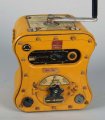
I think this is the radio your talking about.
21339827_2.jpg
 

Thread Starter

Guest3123

Joined Oct 28, 2014
404
Hand cranked torches and radios are already available commercially. Why not just try one and see how you go keeping it charged. I have a hand cranked torch(LED) and believe me that it gets tiring trying charge it fully.
By the way, in OZ we had pushbikes hooked up to generators to power outback station radios in the early days.
Also , I seem to recall that during WW2 there was a hand cranked radio used by the forces. I believe they used to call it a "Gibson Girl" from its curvy shape.
Because I want to beat the market. I don't want to spend the money, and I also want to make a hand crank generator for fun and experience.

I'm well aware of the hand crank generators available. In fact, that was the first thing I searched for. Found a really nice one to beat anything anyone probably can show me.

It's not the K-TOR anything.

I have the money to get any hand crank generator I want.
Including this one.
 

Thread Starter

Guest3123

Joined Oct 28, 2014
404
I fixed my math, and I fixed my software.. All I need to do now, if I still want to do this project, is either keep the motor I want to get, or look for another one.

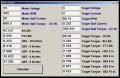
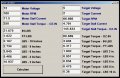
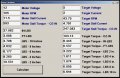
Here's a picture of the software I made.
ScreenHunter_39 Feb. 28 19.32.jpg
 

Thread Starter

Guest3123

Joined Oct 28, 2014
404
@MaxHeadRoom , @tcmtech, and others too.

These have straight cut spur gears. They should be able to be driven by hand yes..?

Ok, so I see these.. (Economy Spur Gear Motors)
All of these have straight cut spur gears. So they should be able to be turned by hand. I'm sure about 99.99%

MUCH BETTER, but much lower quality (imho, I think) than the HD Premium Planetary Gears.

I'm looking at either this one (98 RPM Econ Gear Motor)
98 Econ.jpg

This one (124 RPM Econ Gear Motor)
124 Econ.jpg

Still too high you think?
 

Thread Starter

Guest3123

Joined Oct 28, 2014
404
That's the problem with working with multidisciplinary problems that cross over mechanical engineering principles with electrical engineering. You have to learn how to convert one thing into another in order to find the final solution.

In your case you need to learn the basics of what the numbers mean behind the mechanics of the motor specs and how they relate to electrical power equivalents as I did with that one motor you referenced.

(Torque in foot pounds multiplied by RPMs) divided by 5252 equals Horsepower. One horsepower is 746 watts. The rest is just doing unit conversions and the related math to find the information you need regarding the motor/generator RPM requirements and plugging that into a online search.

So as I would approach it I would start out with defining what is the maximum load you plan to power then work backwards form there while factoring in efficiency losses along the way until you reach the torque and RPM equivalents that will define the mechanical aspects of the power source.

15 watts load.
80% power/voltage control system efficiency = ~19 watts input
80% generator efficiency = ~24 watts mechanical input.
24 watts at 75 RPM = ~2.25 ft/lbs (~432 oz/in) torque.

Motor specs ~ 10 RPM per volt @ 432-oz/in minimum. ;)
WOW !!!


98 Econ
2.73 ft-lb x 98 rpm = 267.54 / 5252 = 0.05094059405940594059405940594059 HP * 745.699872W =
37.98W (37.98W / 12V = 3.165A / 12V = 0.26375 * 5V = (1.31875A @ 5V)

124 Econ
2.184 ft-lb x 124 rpm = 270.816 / 5252 =
0.05156435643564356435643564356436 HP * 745.699872W =
38.45W (38.45W / 12V = 3.204A / 12V = 0.26701 * 5V = (1.33506A @ 5V)

NeveRest 40
1.822 ft-lb x 160 rpm = 291.52 / 5252 =
0.05550647372429550647372429550647 HP * 745.699872W =
41.39W (41.39W / 12V = 3.449A / 12V = 0.287438 * 5V = (1.437A @ 5V)

NeveRest 60
3.088 ft-lb x 105 rpm = 324.24 / 5252 =
0.06173648134044173648134044173648 HP * 745.699872W =
46.036W (46.036W / 12V = 3.836A / 12V = 0.31970 * 5V = (1.598A @ 5V)

The torque to hp to watts is spot on, as far as I know.. BUT !!

I have a question.
Let's say a 60W light bulb takes 120VAC, which according to Ohm's law, draws 0.5 Amps. (I = P/V)

Now, I have an inverter and the inverter takes an input of 12VDC. How much current will it draw from the 3S 55C 10Ah LiPo battery or 20Ah deep cycle battery?

Well.. in order to provide the 60 watts needed to light the light bulb, I'd guess it requires more current?
60W / 12.6V = 4.76A ?

If that's correct, then my math above is partially wrong.

It would look like this then.
98 Econ (37.98W, 12V, 3.165A) or (37.98W, 5V, 7.59A)
124 Econ (38.45W, 12V, 3.204A) or (38.45W, 5V, 7.69A)
NeveRest 40 (41.39W, 12V, 3.44A) or (41.39W, 5V, 8.27A)
NeveRest 60 (46.03W, 12V, 3.83A) or (46.03W, 5V, 9.206A)

Is that correct? Why would it provide less power if the motor is capable of providing the x amount of power or watts?

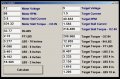
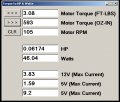
Also made a quick piece of software to do the calculations for me while I'm looking at DC motors.
ScreenHunter_39 Mar. 01 03.20.jpg
 
Last edited:
Top