DC-DC converter ideas

Thread Starter

k1ng 1337

Joined Sep 11, 2020
1,038
Hi, I'm building a hobby project based on a 2.7V supercapacitor. The vision is to 'get every drop' out of the capacitor while making something cool. I have tried a number of configurations using discrete components for stepping up the voltage necessary for the microcontroller. The ones that were successful had significant losses which I have drastically reduced making the project viable. Now, it is a matter of building an appropriate power converter which will result in a longer runtime. The project is essentially a solar powered garden light. To achieve a minimum output voltage of 2.7V at 25mA and using discrete components, I have tried:

1) Boost converter without feedback: At the expense of an unregulated output and power loss, this works best because it operates to less than 1V reliably with 2n3904 transistors. Since the source is a capacitor, I can predict the output voltage range as the capacitor discharges keeping the microcontroller in its safe operating range

2) Boost converter with feedback: Using TLC555 and LM393 ICs outside of their operating ranges, this worked down to less than 1V. Output becomes increasingly unstable as the source voltage decays

3) Voltage doubler / tripler: Cannot source more than 1mA

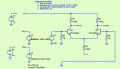
Ideas for the boost stage are appreciated. I am particularly interested in circuits built with discrete components that can be simulated in LTspice.
 

MrSalts

Joined Apr 2, 2020
2,767
Hi, I'm building a hobby project based on a 2.7V supercapacitor. The vision is to 'get every drop' out of the capacitor while making something cool. I have tried a number of configurations using discrete components for stepping up the voltage necessary for the microcontroller. The ones that were successful had significant losses which I have drastically reduced making the project viable. Now, it is a matter of building an appropriate power converter which will result in a longer runtime. The project is essentially a solar powered garden light. To achieve a minimum output voltage of 2.7V at 25mA and using discrete components, I have tried:

1) Boost converter without feedback: At the expense of an unregulated output and power loss, this works best because it operates to less than 1V reliably with 2n3904 transistors. Since the source is a capacitor, I can predict the output voltage range as the capacitor discharges keeping the microcontroller in its safe operating range

2) Boost converter with feedback: Using TLC555 and LM393 ICs outside of their operating ranges, this worked down to less than 1V. Output becomes increasingly unstable as the source voltage decays

3) Voltage doubler / tripler: Cannot source more than 1mA

Ideas for the boost stage are appreciated. I am particularly interested in circuits built with discrete components that can be simulated in LTspice.
First
How much energy is stored in your super capacitor?

Second
Assuming you can get 100% of that energy to your LED, how many hours would it run?

Third,
how much of that energy gets wasted in the conversion to your target voltage. 20% would be a reasonable guess if your input supply is stable but will be much more since you would want all the power (or a lot of the power) as the cap discharges from full to about 0.5 volts (useless power below that).

Fourth
Subtract out the losses of THREE from your ideal runtime in TWO and decide if the project is worth your time.
 

Papabravo

Joined Feb 24, 2006
22,058
Do you know how to build a differential amplifier from discrete components? If so, you can close the loop on your boost converter.
 

Thread Starter

k1ng 1337

Joined Sep 11, 2020
1,038
First
How much energy is stored in your super capacitor?

Second
Assuming you can get 100% of that energy to your LED, how many hours would it run?

Third,
how much of that energy gets wasted in the conversion to your target voltage. 20% would be a reasonable guess if your input supply is stable but will be much more since you would want all the power (or a lot of the power) as the cap discharges from full to about 0.5 volts (useless power below that).

Fourth
Subtract out the losses of THREE from your ideal runtime in TWO and decide if the project is worth your time.
Energy stored is 1800J. To my surprise, this is plenty to work with.

Do you know how to build a differential amplifier from discrete components? If so, you can close the loop on your boost converter.
I do not but I have explored the idea. Can you suggest a circuit to start with? I have a knack for finding schematics that are either too plain or too complex!
 

Hymie

Joined Mar 30, 2018
1,347
You claim that your super capacitor can store 1800J.

The formula for capacitive stored energy is given by:-

e = ½ (C.V.V)

Therefore at 2.7V, for every farad of capacitance it will be storing 3.645J.

To store 1800J you will need a capacitor of around 500 Farads.
 

MrSalts

Joined Apr 2, 2020
2,767
You claim that your super capacitor can store 1800J.

The formula for capacitive stored energy is given by:-

e = ½ (C.V.V)

Therefore at 2.7V, for every farad of capacitance it will be storing 3.645J.

To store 1800J you will need a capacitor of around 500 Farads.
Every time I look, Super Capacitors (ultra capacitors?) keep climbing in the charge they can achieve.

This one is above 13000F.
https://www.digikey.com/en/products/detail/powerresponder/PR13500F08R0-109W245L-T/13880107
 

ronsimpson

Joined Oct 7, 2019
4,649
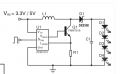
They make low voltage LED constant current drives that work with 3 and 1.5V batteries. One 6 pin IC. Generally, those ICs work down to one volt. It will be hard to make a discreet PWM that works near 1V.

Driving a LED you need your PWM to make 25mA and not 2.7V.

Here is a very old design that is common in garden lights. Works down to 0.8V. It regulates the LED current "ok" but not as well as a newer part. We were buying these 100,000 at a time. I think they are $0.60 at hobby levels and 22 cents in a real.
1670079119910.png
I have avoided super caps. I like batteries better. A 3V battery holds near 3V until most of the power is gone.
 
Last edited:

schmitt trigger

Joined Jul 12, 2010
2,032
I would suggest a Joule Thief circuit. Although it can extract power from the cap down to 0.8 volts, unfortunately the output is not regulated.
 

DickCappels

Joined Aug 21, 2008
10,661
It is difficult to make power supply circuits that operate below 0.8 or 0.7 volts. Maybe we will get back to having some germanium transistors or integrated circuits available soon.
 
Top