DC/AC welder?

Thread Starter

ConstructionK88

Joined Jul 25, 2018
282
I suspect you are using proper eye protection against the UV, but somebody should ask. Are you using proper eye protection? My son in-law has a blind spot in one eye because of a scratch on the lens of his welding mask, and it won't "heal".
I am indeed and your concern is appreciated. It's a 6x6" #10 lens. Covers most of my face. No mask but it's held close enough so there's no reflectivity.
 

Thread Starter

ConstructionK88

Joined Jul 25, 2018
282
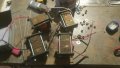
Alright friends i have fully rebult my 4 trans and they have the hummm of library whisper. Im certain these shouldnt burn out. either way i intend submerging them in mineral oil with a small pump and radiator to kill any chance of overheating. Ill work out the controls later.

Alright friend it freaking works!!! I may be 31 but still a giddy kid inside:D:DIll post pics later. I cant do so by myself.

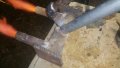
Hell of an arc. Crappy rods though. Wow. Primary coils get warm but not deleterious to operation. 34.8v open circuit. The plug wire does get overly warm, I assume because of small gauge. This is with 3016 at 1/16".

Hell of an arc. Crappy rods though. Wow. Primary coils get warm but not deleterious to operation. 34.8v open circuit. The plug wire does get overly warm, I assume because of small gauge. This is with 3016 at 1/16".
Holding/shorting Vouts through Mr weak ole flesh gives a tickle but I'm not dead.

6013s burn through 3/32" metal. good bad. has amps but to many. will try thicker rods. Arc is tricky to start but once started it will devour the rods. :confused:

It tries it butt off to use a 7018 rod but i think my clamp is to loose to give it a good start(rusty old jumper cable clamp)
 

Attachments

shortbus

Joined Sep 30, 2009
10,050
6013s burn through 3/32" metal. good bad. has amps but to many. will try thicker rods. Arc is tricky to start but once started it will devour the rods. :confused:
No disrespect meant but can tell you're not a welder. And are on a path with what your doing to end up hurting yourself. I asked before where your located with no answer, but it looks from things in your picture backrounds that you are near to a Harbor Freight store. Why not just get one of their welders? Most come as a kit with a simple hood and necessary cables and rods assortment.
 

Thread Starter

ConstructionK88

Joined Jul 25, 2018
282
:p I can weld just fine with a normal welder. This one is just tricky. I don't feel unsafe using it. The occasional spatter but not even that bad. And by devour the rods I mean to say is they burn very very fast. It's difficult to keep them going because it melts it to quick. One rod goes for about 5 seconds and it have to jam it in there just so I don't lose my arc. Devour is more like rapid and aggressive eating. And again sorry. I'm from Mississippi. My profile doesn't want to save changes.
 

DickCappels

Joined Aug 21, 2008
10,661
As they say, the proof is in the pudding, and it is there for us to see, so congratulations! I hope you understand that shortbus has your personal safety in mind. There are probably a few safety aspects of commercially available welders that we are not aware of. Please give some thought to things like electrical safety, grounding, ground fault interrupters, circuit breakers (which can probably be handled by a single GFI breaker, but things like that.

I might have missed it when it came into the discussion, but what are you using to limit the current? I believe a large choke can do that, and on more modern inverter types, probably a fast current control loop can do that too.
 

Thread Starter

ConstructionK88

Joined Jul 25, 2018
282
I had intended on building a large carbon variable resistor but I'll try a choke as well. Limiting the amperage may be moot since it's not very high to begin with. I could easily up the size of rods to accommodate. And while I appreciate the safety sake argument, I am confused. My understanding is that most commercial VAC welders operate anywhere from 20-100v and 30-500+ amps. Certainly much more hazardous than mine. I've been tickled by a commercial machine and by tickle I mean gut punched. I wouldn't think those machines have much in the way of safety except lower voltage. I'd assume with certainty they can't dicern flesh from steel.
 

Thread Starter

ConstructionK88

Joined Jul 25, 2018
282
Odd this thread hasn't been admin locked yet, But to sate yalls need for my safety....would converting to DC be possible?. I have read it's much safer in comparison and better welds to. Surely rectifying 115vac to 115dc pulse or cap smoothed would work but should that be Vin or Vout? Contrary to my profile info and nick I also do electrical work.
 

Doode

Joined Nov 15, 2019
8
Nice work.
I suspect you can convert to DC. Not sure if you've looked up the mod folks do to the cheap harbor freight AC flux core welders, converting them to DC
 

Thread Starter

ConstructionK88

Joined Jul 25, 2018
282
I appreciate that @Doode and @shortbus. On the HF welders i think i dont really want to fool with them anymore. Id prefer a lincoln. maybe a rapid 110v DC pulse with a diode bridge and no cap would still energize the transformers like a sine wave. Probably less power but a HV cap on Vout would help start the arc with 80v then collapse to 40 when working. For you safety minded guys here. Also learned that lightly swirling the rods helps immensely with the bead. And btw my original crappy welds are on purpose. Those pipes are consumable so only a dot weld is needed to hold them still while sealed with clay :mad::p
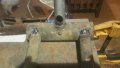
Im intrigued that it worked/penetrated on that 5/16" plate. 10% duty cycle is an estimate.
 
DC is easy. Buy a full-wave bridge rectifier and slap a choke in series with it's output.

Capacitors resist change in voltage - not ideal for welding. You'll get a huge current spike that will spot-weld your electrode in place and then nothing.

Inductors resist changes in current. No current spike -> no spot welding, more stable current flow -> more stable arc. Much more ideal for welding. Use one of the cores from your burnt-up MOTs to wind as large of an inductance in series as you can whilst still maintaining adequate 'Q' factor. With 75*C insulation: 35 amps, use 10 gauge. 50 amps, use 8 gauge. 65 amps use #6. 85, #4.

It might take multiple MOT-cores in series to give you a smooth-burning DC arc. But more wire in series = more voltage drop.

At some point it pays far more to just go out and buy a real DC welder. Used ones can be had for cheap if you know where to look. I scored my 250 amp Century 110-087 for $80 from a high school that was liquidating it's older equipment. Has quick-adjust infinite control, forced-air cooling, 100% duty rating up to 100 amps and lays a better bead than a $750 Thunderbolt.
 
Last edited:

Thread Starter

ConstructionK88

Joined Jul 25, 2018
282
very interesting! A choke i can do fairly easily. But since you mentioned a full wave rectifier then im certain i can build one. im not great at creating circuits just yet but i can certainly copy them. I have oodles of components. 10% duty cycle is with 18awg stranded plug wire and non-cooled halide transformers. Tomorrow i will upgrade to 12awg plug with trans submerged in pumped dielectric oil. all contained in one small, very heavy, unit. At least a 20-30% duty cycle im sure. though 10 has been enough. I dont need to weld much, hence building one. If itll handle 3/32" 3016 rods or similar for AC then ill be satisfied. I only think going DC since its much easier to control and a fuzz safer. Sadly, where im from, there are ridiculous amounts of weldors in my area. Not going to find a welder on the cheap cheap.
 
^Speaking of, you might want to invest in portable GFCI protection. Plug-in GFIs only cost $20-30. It will only afford protection on the primary side of your isolating transformers, but it's still cheaper than a trip to the ER if an unbonded surface happens to become energized due to overheated/nicked insulation.
 
Last edited:

Thread Starter

ConstructionK88

Joined Jul 25, 2018
282
So far, you seem to know what you are doing and are not planting dangerous ideas where others might come across them. The staff was alerted and is monitoring.
Quite the opposite. This isn't, at all, intended to instruct anyone on how to build one. This is me proving it can be done. Hence my lack of detailed information. My body is quite resistant to electrocution, so while I'll be OK with minor mishaps, I don't think anyone else would be so lucky. I want this to be more of an informitive thread.
 

Thread Starter

ConstructionK88

Joined Jul 25, 2018
282
Quite the opposite. This isn't, at all, intended to instruct anyone on how to build one. This is me proving it can be done. Hence my lack of detailed information. My body is quite resistant to electrocution, so while I'll be OK with minor mishaps, I don't think anyone else would be so lucky. I want this to be more of an informitive thread.
Yes I do have experience with HV.
 

Thread Starter

ConstructionK88

Joined Jul 25, 2018
282
^Speaking of, you might want to invest in portable GFCI protection. Plug-in GFIs only cost $20-30. It will only afford protection on the primary side of your isolating transformers, but it's still cheaper than a trip to the ER if an unbonded surface happens to become energized due to overheated/nicked insulation.
Worry not friend. The part where I said I have electrical experience? Where do you think I got 20 halide light ballasts? :cool: I have, yes legal, access to quite a bit of materials and equipment. I got me alotta gfi plugs and switches. Thick AWG wire. Wiring experience. Essentially the safety part I have covered. Not great at a lot but I'm good at some hahaha. Also adding this will all be contained in a nonconductive, dielectric cooled, sealed unit. Worse case is that I'll drop and break it (weighs about 50lbs).
 
Top