Current Mirror For Parallel LEDs

Thread Starter

Gamer91

Joined Sep 23, 2016
24
All,

I'm new to hobbyist level electrical engineering, and need some help.

I'm designing a circuit to power high power leds, instead of individual drivers and I want to power several in series/parallel.

I am using a design I found on the net, it's a current mirror, but also has protection for open circuits so that one string doesn't get
all the current if the other string opens.

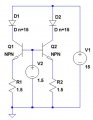
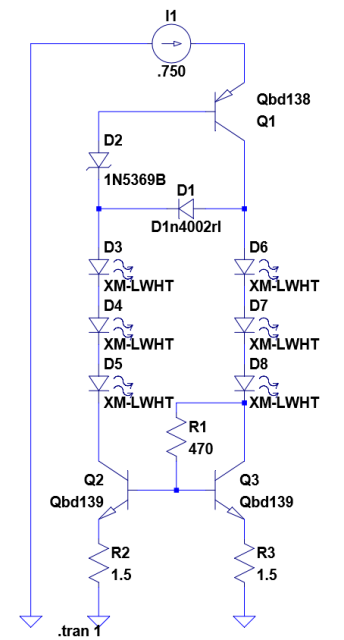
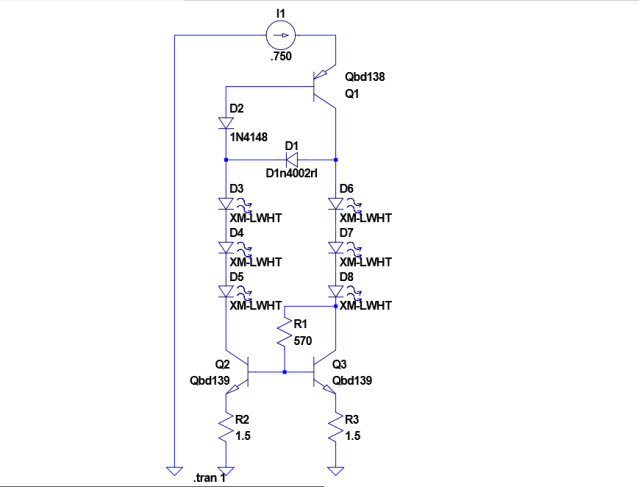
The way it's supposed to work. Pnp transistor Q1 is supposed to protect the LEDs on the right side, if an LED were to open on the left, because D1 will stop the flow of base current from pnp transistor Q1. Npn transistors Q2 and Q3 protect the LEDs on the left side, if an LED were to open on the right side, because there will be no current flow through the bases of npn transistors Q2 and Q3.

The issue I'm having is when I set this up in LTSpice, and open one side, all 750ma flows through the opposite side, not working like it's supposed to is this a problem in spice or did I do something wrong?

Thank you!
 

GopherT

Joined Nov 23, 2012
8,009
All,

I'm new to hobbyist level electrical engineering, and need some help.

I'm designing a circuit to power high power leds, instead of individual drivers and I want to power several in series/parallel.

I am using a design I found on the net, it's a current mirror, but also has protection for open circuits so that one string doesn't get
all the current if the other string opens.

The way it's supposed to work. Pnp transistor Q1 is supposed to protect the LEDs on the right side, if an LED were to open on the left, because D1 will stop the flow of base current from pnp transistor Q1. Npn transistors Q2 and Q3 protect the LEDs on the left side, if an LED were to open on the right side, because there will be no current flow through the bases of npn transistors Q2 and Q3.

The issue I'm having is when I set this up in LTSpice, and open one side, all 750ma flows through the opposite side, not working like it's supposed to is this a problem in spice or did I do something wrong?


Thank you!
When you build this, where do you plan to get a constant current source to power it? Most people use batteries or a voltage regulated supply.

With a constant 0.75a current supply, where do you expect the "other" 0.375 amps to go when you kill one string? Of course the voltage supplied to Q1 will get jacked up until 0.75 amps are forced through it no matter what happens.
 

crutschow

Joined Mar 14, 2008
38,508
As noted, the ideal current source in Spice will output 0.75A no matter what, unlike a real current source.
You need to use a current source with a reasonable voltage limit, which would be no greater than the supply voltage for a typical current source.
This can be simulated with a diode to a voltage source from the current source output.
With that, the constant current voltage can go no higher than 1 diode drop above the voltage source.
 

DickCappels

Joined Aug 21, 2008
10,661
The transistor is not connected as a current mirror, it is connected as an always-on switch.

If you put D2 from the emitter to the base with the anode connected to the emitter, it would be sort of a mirror.

Using a resistor in series with each string of LEDs is much simpler, would work very well and would not be likely to kill the LEDs as much as this discreet current source.

If you really want to drive the LEDs with a constant current, try using LM317 regulators.


I found this circuit and the description of it at http://www.bristolwatch.com/ccs/LM317.htm
 

Thread Starter

Gamer91

Joined Sep 23, 2016
24
Thanks guys!

Current source was causing the maximum voltage to go over the threshold of collector to emitter limit.

It can balance the currents because of the equal voltages developed on 1.5Ω emitter resistors R1 and R2.
 

Thread Starter

Gamer91

Joined Sep 23, 2016
24
I'll be using a constant current uC to supply the LEDs, but haven't gotten that far, ha ha.

Will be a string of 50 leds.
 

Alec_t

Joined Sep 17, 2013
15,119
Here's a simple (albeit not very accurate) way of providing each LED string with its own 'constant' current source, so that failure of one string doesn't compromise the other.
ParallelStrings.JPG
 

Thread Starter

Gamer91

Joined Sep 23, 2016
24
Don't have enough voltage for that, ha ha. Making a light bar for my truck. 50 or 40 leds, in a combination of series and parallel.
 

Thread Starter

Gamer91

Joined Sep 23, 2016
24
Thanks for the input guys, always helps to have different voices and opinions to show things I wouldn't have thought of.

But I think I've found something better, using an LT3755 because it has an option to set a over voltage limit and uses a mosfet to shut it off if it passes the limit!

I also plan to use PWM to make the bar able to dim as well.
 

#12

Joined Nov 30, 2010
18,224
I also plan to use PWM to make the bar able to dim as well.
It would have saved some time if we'd known that. The current mirror circuit doesn't have PWM. That eliminates it immediately.

I can't understand why you need an over-voltage limit. There isn't any over-voltage problem to consider with LED circuits. LEDs don't puncture from excess voltage because they are always on (never try to stop the current). The only way an over-voltage event could be imagined is if an LED burns out, at which point it stops the whole series string, and, if it shorts, the other LEDs are still forward conducting and don't care about voltage because they are current driven devices.

The LT3755 chip is a current driver. Still no over-voltage problem available.
The only over voltage situation possible is created by that chip in it's feedback loop, and then the chip shuts itself off.

There are simpler ways to create PWM, but high-tech is fashionable, so, happy soldering on your 16 pin surface mount chip.

https://www.digikey.com/product-search/en/integrated-circuits-ics/pmic-led-drivers/2556628?k=LT3755
 

Attachments

Top