Hi everyone,
I am looking for the application range or the typical current range of (BJT) current mirrors. It would be very cool if someone had a source for this or could explain it to me.
Thanks for the help.
Thank you very much for now.
Unfortunately, I don't know how to describe it exactly. I would like to consider the typical application of current mirrors, i.e. the current range in which they frequently operate (example: uA up to a few mA).
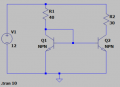
The reason for my question is that I have set up a simple current mirror with 2 BJTs in Spice and I have noticed that when I try to design this current mirror for several hundred mV, I am not able to do so successfully. My biggest problem is actually the very low load that results, as the circuit only works if the load resistor R2 is equal to or less than the input resistor R1.
My biggest problem is actually the very low load that results, as the circuit only works if the load resistor R2 is equal to or less than the input resistor R1.
Hi everyone,
I am looking for the application range or the typical current range of (BJT) current mirrors. It would be very cool if someone had a source for this or could explain it to me.
Thanks for the help.
Your question has no answer because it is to general and vague.
If I need a current mirror to operate with nanoampere-scale outputs, then I design a current mirror to operate with those scale outputs and I probably can't expect it to be able to deliver milliamperes of output. If I need a current mirror to operate with ampere-scale outputs, then I design a current mirror to operate with those scale outputs and I probably can't expect it to do well delivering microampere-scale outputs.
Thank you very much for now.
Unfortunately, I don't know how to describe it exactly. I would like to consider the typical application of current mirrors, i.e. the current range in which they frequently operate (example: uA up to a few mA).
The reason for my question is that I have set up a simple current mirror with 2 BJTs in Spice and I have noticed that when I try to design this current mirror for several hundred mV, I am not able to do so successfully. My biggest problem is actually the very low load that results, as the circuit only works if the load resistor R2 is equal to or less than the input resistor R1.
Even on paper, with ideal transistors, how do you expect this circuit to behave?
Let's assume a Vbe of 0.7 V for the transistors. That means that the reflector side of the mirror will have a current of
Io = (12 V - 0.7 V) / 40 Ω = 282.5 mA
The whole idea of the circuit is to maintain 282.5 mA in the image side of the mirror.
Let's assume that Vcesat for the transistor is 200 mV and that, again, the transistor is ideal and can maintain the programmed current right up to that point. The largest resistor that you can have for R2 is then
R2 = (12 V - 0.2 V) / 282.5 mA = 41.8 Ω
Consider another fundamental limit of your circuit: What is the largest resistance that you can get 282.5 mA through if the entire 12 V appears across it? Just 42.5 Ω.
So take a step back and clearly define what you NEED your circuit to do. Treat it like a black box and forget about what is inside. What do you need this black box to achieve? If you need 400 mA through a 100 Ω load, then that is going to require the black box to be able to place 40 V across it.
The reason for my question is that I have set up a simple current mirror with 2 BJTs in Spice and I have noticed that when I try to design this current mirror for several hundred mV, I am not able to do so successfully.
Current mirrors are usually used for low currents. It doesn't make sense to use them for several hundred mA because you'd be wasting power in the reference circuit and transistor beta will affect mirroring accuracy. A 3 transistor configuration would address beta, but then you have transistor matching and tracking issues. Adding emitter resistors isn't a realistic solution.
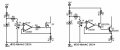
You'd be better off designing a current sink. Here's one using an opamp with a BJT or MOSFET. Originally referenced in this thread on using LM317:
The MOSFET version is better because you don't have to deal with Ie not matching Ic in transistors operating at "high" currents. It was designed for currents significantly higher than a couple hundred mA (0-4A with the component values being used).
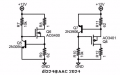
EDIT: lower component count circuits (these are ~10mA)
Making the current sense resistors (R9, R11) 6.2ohms would give ~100mA.

 Facebook
 Google
 GitHub
 Linkedin