Hi can i ask you what is the easiest way to make from 5A 200mA in my power source?
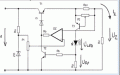
The only cruit I found is this but i dont even know how to count it.
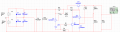
I have transformer 2x 24V; 6,6A and i want to do 1x adjustable voltage from 0V to 30V with current protection to 5A. And as second I want to make not adjustable ±15V with Imax 200m. And I have no idea what is the easiest way to make that 200mA.
For the bridge rectifier, capacitor output you have, you should derate the DC output current to no more than 3.5A to avoid overheating the transformer.
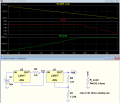
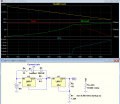
Below is a simple, near bulletproof circuit, using the ubiquitous LM317, to generate the fixed 15V with a 200mA limit:
R3 determines the current limit (ILim = 1.25V / R3), and R1 determines the output voltage (Vout = 10.3mA * R1 + 1.25V).
The yellow trace shows the output load resistance change with time.
For the negative supply, just replace the LM317's with LM337's, and use a negative voltage input.
Edit: Note that the full-load power dissipated by U1 is over 3W and the short-circuit power dissipated by U2 is over 6W, so both need to be on appropriate heat-sinks.
If they are all mounted on the same heat-sink, then all but one need thermal isolation washers.
I use the one in the post above for some of my stuff, but with LEDs on the inputs and outputs so I can see when it is on and whether it is in current limit.
If @kuji5 as the circuit he posted in post #8 he can adjust R3 to get his desired current limit.
Edit: Changed R1 to R3


 Facebook
 Google
 GitHub
 Linkedin