Current buck converter weird behavior

crutschow

Joined Mar 14, 2008
38,516
Using an inductor to increase the current is problematic, but you could readily use a transformer for that, as determined by the turns-ratio.
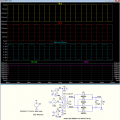
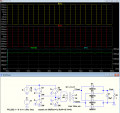
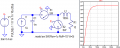
Below is the sim using an ideal 1:2 turns-ratio transformer to double the input current at the output:

The bipolar current source could be generated by switching a single current source to the transformer primary, or push-pull with a center-tapped primary, just as with a voltage converter.

Note that, as expected, doubling the output current, doubles the input voltage from the current source to the output, so the input power equals the output power.

The output is rectified by a bridge to get a unipolar output current.
Interestingly, the output current is unaffected by the diode drop, unlike the input and output voltages.
1709965274974.png
 

MrAl

Joined Jun 17, 2014
13,707
Using an inductor to increase the current is problematic, but you could readily use a transformer for that, as determined by the turns-ratio.
Below is the sim using an ideal 1:2 turns-ratio transformer to double the input current at the output:

The bipolar current source could be generated by switching a single current source to the transformer primary, or push-pull with a center-tapped primary, just as with a voltage converter.

Note that, as expected, doubling the output current, doubles the input voltage from the current source to the output, so the input power equals the output power.

The output is rectified by a bridge to get a unipolar output current.
Interestingly, the output current is unaffected by the diode drop, unlike the input and output voltages.

View attachment 317231

Hi,


The whole idea of a "current boost" circuit is problematic. Your circuit requires a somewhat complicated alteration of the original constant DC current source.

I guess the whole idea is to find the simplest way to take a current like 1 amp and convert it a current like 2 amps with a single switch, similar to how a regular boost circuit does it but with a possible different topology.

What I did was look at the theory of how inductors work and try to find a way to use that to 'boost' the current. It is known that inductors store current the same way that capacitors store voltage. It's interesting that an inductor can charge up instantaneously with a current source in the same way that a capacitor can charge up instantaneously with a voltage source.
If we introduce diodes, then use a bipolar switching current source, we can get away with just an inductor we won't need a transformer. If we had an AC sine current source, then a transformer would make sense. The output would act like a current source as well. If the turns ratio was 2:1 then an input of 1 amp AC becomes 2 amps AC on the output, and the voltage goes to whatever it needs to be in order to get that 2 amps in the same way that the voltage of any current source goes to whatever is needed to supply the current level of that constant current source. This of course is exactly how a current transformer works.
The problem here might be that the required current source appeared to be a constant DC source. We'd have to use a somewhat complex switching scheme to get that to turn into a bipolar current source.

It's also a little helpful to think of what an actual current boost would be.
If we had a current source of 1 amp and connected it to a 10 Ohm resistive load, we would get a voltage of 10 volts, the power being 10 watts. If we 'boosted' that current to 2 amps, the output voltage would go up to 20 volts. That would mean that the output power would be 40 watts, so the input voltage would have to rise to 40 volts.
If we are allowed to reduce the resistance (which would be strange however), then we could keep the output voltage at 5 volts which would then still be 10 watts. This would require a change in resistance to 2.5 Ohms (a decrease by a factor of 0.25). Thus, the converter would be taking 1 amp at 10 volts input and providing 5 volts at 2 amps output, which is the same behavior as a (ideal) buck circuit.
This again makes me question the practicality of even thinking about a current 'booster' circuit when it comes to a constant DC current source input and only one switch.
 

Thread Starter

Samantha Groves

Joined Nov 25, 2023
161
Hello again,

When I used averaging I get this:
Iout=(D*Iin)/(2*D-1)

which means for Iin=1 and D=0.75 Iout would be 1.5 amps, an increase in current of 50 percent.
However, that is the analysis for the current. For the capacitor voltage, it comes out to zero.
This may make sense, but I'll have to look at it again tomorrow I did too much of everything today.

One thing is for sure. If you input 1 amp and get 1.5 amps out, the average input voltage can not increase also or else we would end up with a greater than 100 percent efficiency device, which if course is considered not real. If somehow the voltage could be kept lower at the same time the current is increased, that may be possible.

I am thinking maybe we do not yet have the right topology to see this idea of boosting the current work correctly, if it ever works at all.

Another thing to think about having said that about the efficiency, a buck converter does just what we have been talking about. It takes a higher voltage and converts it into a lower voltage at a higher current. Thus the output current is higher than the input current, and the voltage behaves in a way that does not violate any physical laws. That means the current has been 'boosted'.
With that in mind, it is probably possible to arrange to have a current input instead of a voltage input. For example, if with a buck we had 2 amps out at 5v and 1 amp in at 10v, we could possibly just provide the input with a 1 amp current source, as long as we do not change the resistive output load. Thus we get a boost of the input current on the output.

It's also interesting that if we provide a current into an inductor and then short out the inductor, the inductor voltage goes to zero yet the current remains the same. This means if we provide 1 amp into the inductor then short it out, when we open circuit the inductor we get 2 amps out, for a time. The problem there though is I think it would take a current source with the ability to go to an infinite voltage (or very high voltage) in order to get this to work. That means it would have practical limitations although in pure theory it might work. The inductor would charge up to 1 amp instantly, then we could reverse the terminals of the inductor (with two or more switches) while still in parallel with the current source. The total current out would be 2 amps for a time depending on the value of the inductor and the load resistance. It would then ramp down to 1 amp unless we repeated the switching cycle.
The trick here is an ideal current source of X amps can force a current of X amps through an inductor of any size in zero time. With a non-ideal current source, the time to charge the inductor would depend on the compliance of the current source. If it can charge it fast enough though this may still work.
Hello how are you getting Iout = DIn/(2D)-1.Can you show me the math.I am getting a different result.
 

Thread Starter

Samantha Groves

Joined Nov 25, 2023
161
Hello again,

When I used averaging I get this:
Iout=(D*Iin)/(2*D-1)

which means for Iin=1 and D=0.75 Iout would be 1.5 amps, an increase in current of 50 percent.
However, that is the analysis for the current. For the capacitor voltage, it comes out to zero.
This may make sense, but I'll have to look at it again tomorrow I did too much of everything today.

One thing is for sure. If you input 1 amp and get 1.5 amps out, the average input voltage can not increase also or else we would end up with a greater than 100 percent efficiency device, which if course is considered not real. If somehow the voltage could be kept lower at the same time the current is increased, that may be possible.

I am thinking maybe we do not yet have the right topology to see this idea of boosting the current work correctly, if it ever works at all.

Another thing to think about having said that about the efficiency, a buck converter does just what we have been talking about. It takes a higher voltage and converts it into a lower voltage at a higher current. Thus the output current is higher than the input current, and the voltage behaves in a way that does not violate any physical laws. That means the current has been 'boosted'.
With that in mind, it is probably possible to arrange to have a current input instead of a voltage input. For example, if with a buck we had 2 amps out at 5v and 1 amp in at 10v, we could possibly just provide the input with a 1 amp current source, as long as we do not change the resistive output load. Thus we get a boost of the input current on the output.

It's also interesting that if we provide a current into an inductor and then short out the inductor, the inductor voltage goes to zero yet the current remains the same. This means if we provide 1 amp into the inductor then short it out, when we open circuit the inductor we get 2 amps out, for a time. The problem there though is I think it would take a current source with the ability to go to an infinite voltage (or very high voltage) in order to get this to work. That means it would have practical limitations although in pure theory it might work. The inductor would charge up to 1 amp instantly, then we could reverse the terminals of the inductor (with two or more switches) while still in parallel with the current source. The total current out would be 2 amps for a time depending on the value of the inductor and the load resistance. It would then ramp down to 1 amp unless we repeated the switching cycle.
The trick here is an ideal current source of X amps can force a current of X amps through an inductor of any size in zero time. With a non-ideal current source, the time to charge the inductor would depend on the compliance of the current source. If it can charge it fast enough though this may still work.
Your formula cant be correct because if the D=1 (switch is always closed), the switch shorts out the current source and the average load current is 0.
 
Last edited:

crutschow

Joined Mar 14, 2008
38,516
Your circuit requires a somewhat complicated alteration of the original constant DC current source.
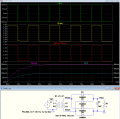
No more than used in the common transformer switching voltage supply with two switches and a center-tapped primary (current circuit below):
In this case the transformer has a 4:1 turns ratio between the center-tapped primary and the secondary for a 2:1 increase in current.

An un-tapped primary could also be driven by an H-bridge circuit if you wanted to avoid the center-tap.

(And no matter how hard you try, you can't get more average current out of an inductor than you put in.)

1710013996776.png
 
Last edited:

Thread Starter

Samantha Groves

Joined Nov 25, 2023
161
Hi,


The whole idea of a "current boost" circuit is problematic. Your circuit requires a somewhat complicated alteration of the original constant DC current source.

I guess the whole idea is to find the simplest way to take a current like 1 amp and convert it a current like 2 amps with a single switch, similar to how a regular boost circuit does it but with a possible different topology.

What I did was look at the theory of how inductors work and try to find a way to use that to 'boost' the current. It is known that inductors store current the same way that capacitors store voltage. It's interesting that an inductor can charge up instantaneously with a current source in the same way that a capacitor can charge up instantaneously with a voltage source.
If we introduce diodes, then use a bipolar switching current source, we can get away with just an inductor we won't need a transformer. If we had an AC sine current source, then a transformer would make sense. The output would act like a current source as well. If the turns ratio was 2:1 then an input of 1 amp AC becomes 2 amps AC on the output, and the voltage goes to whatever it needs to be in order to get that 2 amps in the same way that the voltage of any current source goes to whatever is needed to supply the current level of that constant current source. This of course is exactly how a current transformer works.
The problem here might be that the required current source appeared to be a constant DC source. We'd have to use a somewhat complex switching scheme to get that to turn into a bipolar current source.

It's also a little helpful to think of what an actual current boost would be.
If we had a current source of 1 amp and connected it to a 10 Ohm resistive load, we would get a voltage of 10 volts, the power being 10 watts. If we 'boosted' that current to 2 amps, the output voltage would go up to 20 volts. That would mean that the output power would be 40 watts, so the input voltage would have to rise to 40 volts.
If we are allowed to reduce the resistance (which would be strange however), then we could keep the output voltage at 5 volts which would then still be 10 watts. This would require a change in resistance to 2.5 Ohms (a decrease by a factor of 0.25). Thus, the converter would be taking 1 amp at 10 volts input and providing 5 volts at 2 amps output, which is the same behavior as a (ideal) buck circuit.
This again makes me question the practicality of even thinking about a current 'booster' circuit when it comes to a constant DC current source input and only one switch.
Io/Ii = D/2D-1 is correct if u use inverted input on the PWM signal
 

MrAl

Joined Jun 17, 2014
13,707
Your formula cant be correct because if the D=1 (switch is always closed), the switch shorts out the current source and the average load current is 0.
Hi, and thanks for that thought.

Not necessarily, although I could go over this again of course. In the case of D=1 we just have to stipulate that the formula is not valid for D=1.
That is, instead of D<=1 we just have to say D<1. That may work given the compliance of the current source, but I can look at my solution again too just to be sure I did everything right. My attention has been divided again recently between a number of tasks both online and offline.
 

MrAl

Joined Jun 17, 2014
13,707
Hello how are you getting Iout = DIn/(2D)-1.Can you show me the math.I am getting a different result.
Yes I will go over this again first. I use the general approach to calculating the average response, usually just called 'averaging'. It's where we use the ODE set to calculate the average.
 

MrAl

Joined Jun 17, 2014
13,707
No more than used in the common transformer switching voltage supply with two switches and a center-tapped primary (current circuit below):
In this case the transformer has a 4:1 turns ratio between the center-tapped primary and the secondary for a 2:1 increase in current.

An un-tapped primary could also be driven by an H-bridge circuit if you wanted to avoid the center-tap.

(And no matter how hard you try, you can't get more average current out of an inductor than you put in.)

View attachment 317280
Hi,

That circuit looks more reasonable except for the switches that short out the 1nf capacitors. One of the golden rules is never short out a capacitor with a switch or transistor the same way you never open circuit an inductor. Not sure why you added those caps anyway.

Quote:
"(And no matter how hard you try, you can't get more average current out of an inductor than you put in.)"
End Quote.

Not sure why you said this, who said anyone did or anyone could do that?
I assume you mean a single winding inductor.
 

crutschow

Joined Mar 14, 2008
38,516
Not sure why you added those caps anyway.
To kill observed spikes in my sim.
In real life you would probably use a Zener to protect the switches.
Not sure why you said this, who said anyone did or anyone could do that?
I assume you mean a single winding inductor.
I though that was how the original posted circuit was supposed to work.
Yes, a single winding inductor.
 

MrAl

Joined Jun 17, 2014
13,707
Your formula cant be correct because if the D=1 (switch is always closed), the switch shorts out the current source and the average load current is 0.
Hi,

Yes it is correct, but I am so used to calculating the duty cycle as the time when power transfers to the output that I did the inversion analysis.
This means instead of Iin*D in the numerator it would be Iin*(D-1) as you suspected. This makes it:
X1=(i*(D-1))/(2*D-1)
where
'X1' is the inductor current,
'i' is the constant input current.

We do have to be careful with averaging analysis though. I think we should approach it from another perspective next and see if the results match.
I don't want to knock it completely yet because it may depend highly on the choice of component values. We could miss the very one solution that actually works even though many fail using a simulation. This may end up in a purely theoretical solution, but that's OK with me.
 
Last edited:

MrAl

Joined Jun 17, 2014
13,707
Hello how are you getting Iout = DIn/(2D)-1.Can you show me the math.I am getting a different result.
Hello again,

I explained that in a previous post I don't think you've read yet, but I wanted to show some results doing a different kind of calculation.

This other calculation was a piecewise time domain solution. That's where we solve for the exact time domain solution for each part of the cycle 'on' and 'off'. That means we get two sets of exact time domain solutions that we use to calculate many cycles. For each half of the cycle we calculate both the current through the inductor and the voltage across the capacitor.

Doing that over 900000 cycles some patterns start to form. These are with L=1H, C=1F, and R=0.1 Ohms, but lowering the cap to 0.1F or raising it to 2F made no difference in the current, just in the cap voltage.
The first, and probably most interesting for this target application, is the current though the inductor builds up to a maximum (and may oscillate up and down a little) and then comes down and settles at some fixed value less than 1 amp. The maximum seems to be less than 2 amps always but greater than 1 amp for some duty cycles. The interesting thing is, it comes down to the same current as the duty cycle if we make the input current 1 amp. Thus, with a duty cycle of 0.1 the current settles to 0.1 amps, and with a duty cycle of 0.9 the current settles down to 0.9 amps. The duty cycle here is the time when the current source is supplying current, NOT when the switch that shorts out the current source is closed.

The question now might be, why are we both getting a different average current from the averaging equations when the average seems to be different than that.
I also used the averaged equations to calculate the average power and it turned out that the power out was greater than the power in, which says something is wrong too. You should try that calculation also.

I should point out that the resistor value made a big difference in the maximum current but not in the average current which was always less than 1 amp.
I also assumed that the resistor would always be less than 2 Ohms when L=1H and C=1F. That also keeps the response underdamped.
 
Last edited:

MrAl

Joined Jun 17, 2014
13,707
Hello again,

I tested another idea and it worked pretty well although it takes a total of five switches.

First, the single inductor pump did not work because there was no way to get the inductor in parallel to the input current source to supply power to the output because it's already in parallel to charge it up. However, using two inductors in series with an input current of 1 amp, both inductors initially have 1 amp flowing through them so when we connect them in parallel they put out twice the current. This means we go from 1 amp to 2 amps on the output.
This is the dual of the capacitor voltage doubler, where we charge two caps in parallel then switch them into a series arrangement and we get two times the output. That could mean we might be able to use an IC chip that is made for voltage doubling with capacitors to function as a current doubler. Of course depending on the duty cycle we could get less than 2 amps output if needed. This would make the circuit pretty simple for lower output current levels.

It's also a little interesting that the inductors in series driven by a current source that is highly compliant will initially get a very high voltage from the current source because the curernt source then acts as an impulse source. This can be tamed with a parallel resistor across each inductor of relatively large size so as to not lose much efficiency.
Checking the efficiency, the input power is greater than the output power by a small amount so the efficiency is high. In real life it would probably get lower because of the behavior of real inductors with ESR and core losses and all that.

I might work out the averaging equations for this too and see if they provide a better result than with the original circuit in this thread.
 

crutschow

Joined Mar 14, 2008
38,516
Congratulations, it works!
Very interesting.
By connecting the capacitor directly across the current source, it does indeed provide a current-source output, independent of the load resistance, with current determined by the duty-cycle.

I have to retract what I said about not being able to do it with one inductor. :oops:
 

crutschow

Joined Mar 14, 2008
38,516
In a real circuit, S2 can be replaced by a diode, thus requiring only the high-side switch.

Of course, this circuit is mainly of academic interest, since there are few practical constant-current power sources.
One would be a photovoltaic cell, but its voltage compliance is so low that it's generally treated as a voltage source.
 

Thread Starter

Samantha Groves

Joined Nov 25, 2023
161
In a real circuit, S2 can be replaced by a diode, thus requiring only the high-side switch.

Of course, this circuit is mainly of academic interest, since there are few practical constant-current power sources.
One would be a photovoltaic cell, but its voltage compliance is so low that it's generally treated as a voltage source.
I disagree.Photovoltaic cells are natural current sources and should be treated as current sources , not voltage sources.
 

crutschow

Joined Mar 14, 2008
38,516
Hi can you check what happens if the duty cycle is 0.5?Thanks.
His example has a 50% duty-cycle giving a 2A output for a 1A input.
I disagree.Photovoltaic cells are natural current sources and should be treated as current sources , not voltage sources.
They are current sources, but the voltage is so low that it can't be taken advantage of, such as your circuit, which increases the voltage across the current source as you increase the output current.
 
Top