LM5164 Buck Converter Fails Due to Regenerative Current in E-Rickshaw SOC Meter Application

Thread Starter

akash123kumar

Joined Aug 13, 2025
11
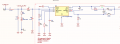
Screenshot 2025-08-13 181702.png
I'm using the LM5164-Q1 buck converter in an SOC meter circuit connected to the load side of an e-rickshaw, where the battery pack is 52V Li-ion. This DC-DC converter steps down the voltage to 5V @ 1A to power electronics.

During regenerative braking or sudden load transitions, I’ve observed that the buck IC gets damaged. I suspect this is due to regenerative current or voltage spikes feeding back into the input of the buck converter from the motor controller/load side.

Current Setup:

  • Battery: 52 V lithium-ion pack
  • Input protection: SMBJ75CA TVS diode, reverse protection diode
  • Input filter: 2.2 µH inductor + 4.7 µF and 2.2 µF ceramic capacitors
  • Buck IC: LM5164-Q1 (up to 100V input capable)
  • Load: SOC meter electronics, max 1 A @ 5 V
  • Optional test: Tried placing NTC 10D-15 in place of inductor at input to limit inrush/regenerative surge
❓ What I Need Help With:

  • How to protect the LM5164 from regenerative current or voltage spikes during braking or load switching in an EV setup?
  • Is using an NTC thermistor (NTC 10D-15) at the input useful in this case, or just for inrush current?
  • Should I add a high-power TVS diode, clamp circuit, or blocking diode to prevent damage?
  • Are there better protection techniques for automotive EV load-side converters facing regenerative conditions?
 

michael8

Joined Jan 11, 2015
472
I find it hard to believe that the input goes over 100V with a 52 volt lithium battery connected -- so I'd guess that the
battery BMS is disconnecting at some point (overvoltage?/overcurrent?). Perhaps you need a load to dump the
extra energy into if the battery won't absorb it.
 

ronsimpson

Joined Oct 7, 2019
4,646
I can't read the small schematic. What is R27 doing? What value? (10k??) I think it removes the effect of the diode just below it. D6 or D8 I can't see.
Where is the output capacitor from +5V to ground?
 

schmitt trigger

Joined Jul 12, 2010
2,027
Additionally, I worked for a company which manufactured controllers for forklifts and aerial work platforms. Regeneration has the capability to destroy your circuit, several times over. And we could see this even with the massive lead-acid batteries connected, but it is worse if a battery clamp is a little loose.

In addition to any transient suppression, your device ground should go via an independent wire directly to the battery’s negative terminal. Never, never use the same wire that powers the motor, and certainly not the chassis.
 

ronsimpson

Joined Oct 7, 2019
4,646
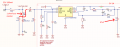
Add an output capacitor.
Change R27 from 10k to (1 to 10 ohms fuse resistor)
Move where D9 gets power to the other end of R27. Maybe move C26 as shown.
L5 + R27 will soften the blow when 150V slams into the power supply.
1755107348903.png
When i was doing automotive we had a law. We don't care if over voltage or reverse voltage pops the fuse, but it can not smoke any other components. All products must pass the 120V ac 60hz test. We plugged into the power line.
 

Thread Starter

akash123kumar

Joined Aug 13, 2025
11
I can't read the small schematic. What is R27 doing? What value? (10k??) I think it removes the effect of the diode just below it. D6 or D8 I can't see.
Where is the output capacitor from +5V to ground?
its D8 and above the D8 R27 i already removed but problem is still there buck IC burn when region comes
 

Thread Starter

akash123kumar

Joined Aug 13, 2025
11
View attachment 354167
I'm using the LM5164-Q1 buck converter in an SOC meter circuit connected to the load side of an e-rickshaw, where the battery pack is 52V Li-ion. This DC-DC converter steps down the voltage to 5V @ 1A to power electronics.

During regenerative braking or sudden load transitions, I’ve observed that the buck IC gets damaged. I suspect this is due to regenerative current or voltage spikes feeding back into the input of the buck converter from the motor controller/load side.

Current Setup:

  • Battery: 52 V lithium-ion pack
  • Input protection: SMBJ75CA TVS diode, reverse protection diode
  • Input filter: 2.2 µH inductor + 4.7 µF and 2.2 µF ceramic capacitors
  • Buck IC: LM5164-Q1 (up to 100V input capable)
  • Load: SOC meter electronics, max 1 A @ 5 V
  • Optional test: Tried placing NTC 10D-15 in place of inductor at input to limit inrush/regenerative surge
❓ What I Need Help With:

  • How to protect the LM5164 from regenerative current or voltage spikes during braking or load switching in an EV setup?
  • Is using an NTC thermistor (NTC 10D-15) at the input useful in this case, or just for inrush current?
  • Should I add a high-power TVS diode, clamp circuit, or blocking diode to prevent damage?
  • Are there better protection techniques for automotive EV load-side converters facing regenerative conditions?
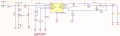
1755151507199.pngthis is my complete circuit of buck converter and i also remove the R27 and short them but problem is still here so what i have to do1755151507199.png
 

Thread Starter

akash123kumar

Joined Aug 13, 2025
11
Add an output capacitor.
Change R27 from 10k to (1 to 10 ohms fuse resistor)
Move where D9 gets power to the other end of R27. Maybe move C26 as shown.
L5 + R27 will soften the blow when 150V slams into the power supply.
View attachment 354179
When i was doing automotive we had a law. We don't care if over voltage or reverse voltage pops the fuse, but it can not smoke any other components. All products must pass the 120V ac 60hz test. We plugged into the power line.
can you explain how does this LR + C circuit work
 

ronsimpson

Joined Oct 7, 2019
4,646
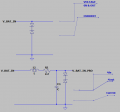
First circuit is just the SMBJ75CA. The voltage source is a very high current source. The input and out voltage will be the same. You know this. The way I read the data sheet the SMBJ75CA will barely be on at 100V. Capacitors have almost no effect. With very high current the voltage will get to, maybe, 150V at 25A.

Second circuit; shows the L and R added. The LR & C make a low pass filter. Most likely the pulse is short in time and the SMBJ75CA might not get turned on in time. With the delay from LC and the delay from RC the SMBJ75CA does not have to turn on super fast. The L limits the current at Time_0 but has no limit later. The R limits the current at all frequencies. We hope the pulse goes away before the C gets charged up and before the delay of L is done.

At Time_0 the current in the SMBJ75CA is zero because of L. The current ramps up. After time L's impedance approaches zero. Now the R limits current into the SMBJ75CA .

L is like a rubber band to limit the current. In a way R also limits the current.
1755188998638.png
The 75V diode will draw 1mA at 83 to 92 volts.
It draws 25A at 147V.
It draws 5A at 121V.
1755189310705.png

Think about choosing a lower voltage diode. Any L&R&C will slow down how hard the pulse pounds the SMBJ75CA.
Adding any R will soften the current draw form your battery, during the spike.
 

michael8

Joined Jan 11, 2015
472
Most likely the pulse is short in time

I wouldn't assume that the high voltage is of short duration. Consider going downhill with the motor generating current and
the battery management circuit (BMS) considering the resulting input to the battery being excessive and blocking it from
the battery.

How high will the voltage from the motor go? Wouldn't it last until the bottom of the hill?
 

Thread Starter

akash123kumar

Joined Aug 13, 2025
11
First circuit is just the SMBJ75CA. The voltage source is a very high current source. The input and out voltage will be the same. You know this. The way I read the data sheet the SMBJ75CA will barely be on at 100V. Capacitors have almost no effect. With very high current the voltage will get to, maybe, 150V at 25A.

Second circuit; shows the L and R added. The LR & C make a low pass filter. Most likely the pulse is short in time and the SMBJ75CA might not get turned on in time. With the delay from LC and the delay from RC the SMBJ75CA does not have to turn on super fast. The L limits the current at Time_0 but has no limit later. The R limits the current at all frequencies. We hope the pulse goes away before the C gets charged up and before the delay of L is done.

At Time_0 the current in the SMBJ75CA is zero because of L. The current ramps up. After time L's impedance approaches zero. Now the R limits current into the SMBJ75CA .

L is like a rubber band to limit the current. In a way R also limits the current.
View attachment 354216
The 75V diode will draw 1mA at 83 to 92 volts.
It draws 25A at 147V.
It draws 5A at 121V.
View attachment 354217

Think about choosing a lower voltage diode. Any L&R&C will slow down how hard the pulse pounds the SMBJ75CA.
Adding any R will soften the current draw form your battery, during the spike.
I am working on an EV-related test setup For creating a real-case EV scenario where the load is connected at the BMS side. The system operates at 100 V with up to 120 A load current. I have also connected an SOC meter to the load.

Could anyone suggest suitable L, R, and C values (or guidelines for selecting them) for this application?
 
Top