TPS563300 Buck Converter with MCP4561 Digital Potentiometer Feedback Control

Thread Starter

ubio

Joined Feb 15, 2026
2
Hello everyone,

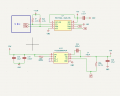
I am designing a programmable output voltage buck converter using the TPS563300, and I would like to request a schematic review to ensure my feedback implementation using a digital potentiometer is correct and stable.

Design summary:

  • Buck converter IC: TPS563300
  • Input voltage: 20 V
  • Output voltage: Target ~5 V (programmable via I²C)
  • Controller: MCU (3.3 V I²C)
  • Digital potentiometer: MCP4561-503 (50 kΩ, I²C) powered from 5 V
Feedback network:

  • Top resistor: 52.3 kΩ from VOUT to FB
  • Bottom resistor: MCP4561 used in rheostat mode
    • P0A → FB
    • P0W → FB
    • P0B → GND
This replaces the fixed bottom resistor and allows adjustment of output voltage via I²C.

I²C configuration:

  • Pull-ups: 4.7 kΩ to 3.3 V
  • MCP4561 powered from 5 V
  • Common ground between MCU and power section
Questions:

  1. Is using the MCP4561 in this configuration (P0A and P0W tied to FB, P0B to GND) correct and safe for the TPS563300 feedback loop?
  2. Are there any stability concerns when using a digital potentiometer in the feedback path?
  3. Should I add a feedforward capacitor (for example, 22–47 pF) across the upper feedback resistor?
  4. Are there any layout precautions I should follow for noise and stability?
  5. Is powering the digital pot at 5 V while using 3.3 V I²C pull-ups acceptable?
My main concern is ensuring stable regulation and avoiding oscillation or reliability issues.

I would greatly appreciate any feedback or suggested improvements.

Thank you.
 

Attachments

Rf300

Joined Apr 18, 2025
76
The problem with digital potentiometers is the big tolerance of the absolute value of their resistance, sometimes up to 20 %. This is a general fact of resistors in integrated circuits. Also the temperature coefficient differs from metal film resistors. So your solution may work if it is only one device for you that is individually adjusted and you know what step of your pot has to be selected for a dedicated otuput voltage, maybe by a look-up-table in the MCU firmware. But if you build another sample of your device, you will need a different look-up-table individually for this other device.

If your digital pot can withstand the maximum output voltage of your buck converter (read the data sheet!), it will be better to use it in potentiometer mode, where the absolute value of the resistance doesn't matter and you can benefit from the very good internal matching of the integrated resistors.
 

Rf300

Joined Apr 18, 2025
76
What I forgot to mention: Check the default wiper position after power up (datasheet). If it were at the lowest end, your buck converter would deliver the max. voltage, which could destroy the following circuit.
 

Rf300

Joined Apr 18, 2025
76
After a short glimpse at the datasheet: Your pot needs min. 0.7 * VCC at the SCL/SDA pins for detecting HIGH-level. This is 3.5 V in your case, but you have only 3.3 V pullups at your I2C-bus. You will never reach a stable HIGH-level.
 

ronsimpson

Joined Oct 7, 2019
4,663
This is 3.5 V in your case, but you have only 3.3 V pullups at your I2C-bus. You will never reach a stable HIGH-level.
Good catch.
There are many ways to make a I2C bus. If the IO pins are configured to pull up a high=3.3.
It might be possible to configure the pins as open collector (open drain) and connect the pull ups resistors to +5V. In this case high = 3.3+0.7=4.0V. The outputs will hang up on the protection diodes. ( 0.7 above the supply)
If there is no open drain option. I have made the pins "input" during that time I want the pins high.

Can the digi pot run from 3.3V supply? (yes it can) That is good.
 

ronsimpson

Joined Oct 7, 2019
4,663
digi-pot lives on 3.3V
Never let a computer have 100% control over a voltage. Things can go wrong!
FB is at 0.8V.
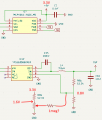
Make a voltage divider (R96 + R?) so the output voltage will close to 5V or maybe a little low.
Use 3.3V or 5V and a resistor so the digi-pot has about 1.6V on the top end. This way it can pull up or down on the FB pin. Note I added a 1meg resistor (or some value) so the computer can only adjust a little, not 100%. If the computer crashes it can only take the 5V off by 10% or 20%.
1771252929298.png
There is probably a simple way to do this, but I am not awake yet.
 

joeyd999

Joined Jun 6, 2011
6,250
digi-pot lives on 3.3V
Never let a computer have 100% control over a voltage. Things can go wrong!
FB is at 0.8V.
Make a voltage divider (R96 + R?) so the output voltage will close to 5V or maybe a little low.
Use 3.3V or 5V and a resistor so the digi-pot has about 1.6V on the top end. This way it can pull up or down on the FB pin. Note I added a 1meg resistor (or some value) so the computer can only adjust a little, not 100%. If the computer crashes it can only take the 5V off by 10% or 20%.
View attachment 363541
There is probably a simple way to do this, but I am not awake yet.
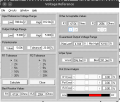
Assuming he intends to trim to exactly 5V, this is what he needs. He didn't answer the question about a output voltage range, but I can recompute if he ever does.

5v 2.png
5v.png

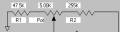
Wiper goes on the FB pin. R2 is on Out.

The EEPOT is MCP4561-502 (5K, not 50K).

Calculations made using this.
 
Top