Creating split phase 120V from 120V with transformer, safety concerns?

nsaspook

Joined Aug 27, 2009
16,344
The transformer secondary Ov C.T. referencing to earth ground in the OP drawing is shown earth connected, as it should.
However, grounding should be done right at the Transformer C.T. connection, again, per NEC/CEC.
Max.
That's a tricky one depending on how you look at the circuit. With the Separately Derived System of a transformer only one neutral-to-case bond/earth bond is allowed. The bond at the main service panel is always the preferred location if the CT from the transformer is solidly bonded to the neutral bar inside the main panel to the ground/earth/neutral connection.

https://www.ecmag.com/section/codes-standards/generator-grounding-and-bonding-essentials

If there is no switching action in the grounded (neutral) conductor through the transfer equipment, then the generator system remains grounded with the transfer switch in either position: normal or standby by the grounding electrode conductor at the service.
 

MisterBill2

Joined Jan 23, 2018
27,673
Correct, but NEC requires a earth grounded neutral, see NFPA79 DWG added.
Which is done all the time in industrial machinery enclosures.
Max.
A whole lot of production line equipment at a major auto company had all of the 120 volt controls sort of floating. Each controls cabinet with it's own step down transformer had a set of two AB 800T pilot lights in series across the 120 volt secondary, with the center of the string connected to chassis ground. The two lights would be mounted on the enclosure door. They were tagged "Ground Detect". If one side or the other of the 120 volts became grounded then one light went out and the other became bright. And all of the wires in the control system were 60 volts off ground. And I never heard anybody claiming it was unsafe.
 

MaxHeadRoom

Joined Jul 18, 2013
30,692
A whole lot of production line equipment at a major auto company had all of the 120 volt controls sort of floating. Each controls cabinet with it's own step down transformer had a set of two AB 800T pilot lights in series across the 120 volt secondary, with the center of the string connected to chassis ground. The two lights would be mounted on the enclosure door. They were tagged "Ground Detect". If one side or the other of the 120 volts became grounded then one light went out and the other became bright. And all of the wires in the control system were 60 volts off ground. And I never heard anybody claiming it was unsafe.
Well all I can say is I have built custom and retro-fit industrial CNC/PLC electrical enclosures from the 80's on and have always used the NFPA79, Electrical Standard for Industrial Machinery as a reference.
Also the Grounding 'Bible' By Eustace Soares that is published by the Industrial Association of Electrical Inspectors and is used as a guide by NEC/CEC.
Never used a floating control circuit.
I have only ever come across one old relay control panel that had 120vac floating supply.
Each to his own I guess!
Max.
PS: Still a few bad practices around.
 
Last edited:

SLK001

Joined Nov 29, 2011
1,549
With your generator only delivering 2800 watts (let's be generous and say 3000), connecting it to the entire house is folly at best. The generator can power basically one refrigerator and maybe one freezer at the same time (as long as they don't both turn on at the same time). You would be better served investing in some quality extension cords (12/3) to run what is important. You can power a small microwave oven IF you disconnect one of the other loads. Also with a SMALL air conditioner (1500 BTU, but check the starting current).

As we say down here in hurricane country, "2800 watts ain't sh... er, crap."
 

nsaspook

Joined Aug 27, 2009
16,344
Yes it is... Just don't plan on powering your entire house with it.

Only two tropical cyclones? Amateur!
I had the common sense to avoid the others by leaving if it was possible.

I went on duty station change leave early (transfer to San Diego) to miss this when I was stationed in Florida. I was riding my bike at a very high rate of speed just ahead of the storm on I-10 along the Gulf through AL.
https://www.weather.gov/mob/frederic
 

crutschow

Joined Mar 14, 2008
38,540
I must say having survived two tropical cyclones with no home power for weeks, "2800 watts is a lot better than zero".
I would also think the amount of emergency power you want to pay for is related to how often and how long you anticipate needing it.
For maybe once a year, few days use, I would think that 2800W would be okay with careful use of your appliances, limiting their use so that the power limit is not exceeded at any one time.
An inexpensive plug-in power meter, such as a Kill A Watt, can tell you the power draw of your appliances so you can gauge how many can be on at a time.
 

Reloadron

Joined Jan 15, 2015
7,892
I must say having survived two tropical cyclones with no home power for weeks, "2800 watts is a lot better than zero".
Yeah, about 2800 watts better than zero and when there is zero it can be a whole lot.

Years ago when I met my wife she was a home care giver to her mother. Her mom had brain surgery which did not go well. For all purposes she was a vegetable. In the beginning there were the huge O2 tanks replaced with a then large oxygen concentrate machine, nothing like today's units. There was also a suction machine for the trach tube and a few other electric devices. As the years passed her mom deteriorated as was expected and more and more devices came into the house including a vent machine. Anyone who has ever had to "bag" a patient to breath for them knows within 5 min your hand hurts. The manual suction machine was a nightmare and the few devices with emergency battery backup were only good for 20 min, at that point I would be ripping batteries out of the trucks in the driveway.

I went out an bought a Coleman Power Mate 4.0 KW, 5.0 KW surge, portable generator. It did have 240 VAC service so I rigged a pony station outside. I rigged a back feed in the breaker panel. OK, not exactly NEC compliant but in a real bind it worked. I was able to power all lights in the house, the 1/2 HP gas fired furnace blower motor, both a refrigerator and upright freezer plus all the medical equipment. Figure also a refrigerator and freezer only run intermittently and during a power outage you are not constantly opening and closing the doors. Likewise the furnace. Unless you are an idiot in which case you deserve to sit in the cold and dark. All of this was maybe 25 years ago. My wife's parents eventually passed on but that little generator continued to serve.

During major renovations 11 years ago I replaced the portable generator with a whole house 13 KW unit. That worked fine for 10 years and one day during a power outage it started and did the transfer but we were still in the dark. Uh Oh? I dragged that little unit out of the garage, I left the fuel tank empty on purpose, added gasoline and in two pulls that little sucker started. I did some quick bypass surgery and we were up and running. While I have no idea what the whole house load hovers around that 4.0 KW was just fine.

The 13 KW unit and 100 amp auto transfer switch is now laying in the garage replaced with another whole house 16 KW unit and new 200 amp automatic transfer switch. They are both natural gas fired. When I get the old 13 KW unit fixed I may just give it to my son or daughter who live down in Columbus, Ohio.

Anyway, while unlike Florida we don't see hurricanes we do see some bitter cold and when pipes start freezing and splitting it isn't fun. I hate sitting in the dark and cold. Yes, when you have zero watts I believe 2600 watts is quite a bit. During extended outages we have also shared our power with neighbors.

Ron
 

nsaspook

Joined Aug 27, 2009
16,344
Anyway, while unlike Florida we don't see hurricanes we do see some bitter cold and when pipes start freezing and splitting it isn't fun. I hate sitting in the dark and cold. Yes, when you have zero watts I believe 2600 watts is quite a bit. During extended outages we have also shared our power with neighbors.

Ron
That's my main requirement 'keeping the house warm'. Dark is not that bad when you're warm.

The power here is usually very reliable but things are getting old. I made a video short about the time a shorted transformer in my yard took out the sub-division. Even 6 hours seems a long time when it's cold and wet outside.

:D
 

MisterBill2

Joined Jan 23, 2018
27,673
I would also think the amount of emergency power you want to pay for is related to how often and how long you anticipate needing it.
For maybe once a year, few days use, I would think that 2800W would be okay with careful use of your appliances, limiting their use so that the power limit is not exceeded at any one time.
An inexpensive plug-in power meter, such as a Kill A Watt, can tell you the power draw of your appliances so you can gauge how many can be on at a time.
Use caution with that Kill-a-watt meter, and don't use it on systems with lots of harmonics in the power, or with dimmers. At least the earlier versions used a capcitor to limit the current to the rectifier and shunt zener regulator, and harmonics overload the zener so it fails open and then the rest of the thing burns up.
 

Reloadron

Joined Jan 15, 2015
7,892
Even 6 hours seems a long time when it's cold and wet outside.
Yeah, I was down in NC visiting friends during a major blackout which lasted a week. Generator ran all week quietly and efficiently and powered neighbors essentials all wee. My wife said it was great and neighbors couldn't thank her enough. Everyone congratulated at our house for food, booze and movies. :)

Ron
 

Thread Starter

MrSoftware

Joined Oct 29, 2013
2,273
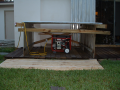
For the doubters on the power, here is our solution after a hurricane. A little makeshift house over the 4kw generator that ran our whole house for a week at a time after each of 3 hurricanes. Flip back to my prior post to see details on what was run and why I think the 3kw generator could probably get by as well. A good 3kw generator, not a big box store special, there is a difference.

upload_2019-9-8_9-4-15.png
 

SLK001

Joined Nov 29, 2011
1,549
A good 3kw generator, not a big box store special, there is a difference.
Just thinking now, but why do you have to power both sides of your house? It's not likely that anything 220V is ever going to get powered by so small of a generator. Powering only one side would be by far the safest way for you to go. Having outlets not powered is only an inconvenience and not a safety issue. Plus, adding your transformer to your transfer switch would need code and probably an engineering approval. Plus, you run the risk of your generator's capacity being exceeded by unintended demand on the circuit (lights being left on, things that come on automatically, etc). With extension cords, YOU control the load fully.
 
But an extension cord is a safety issue.

A 240 stuff can easily be turned off at the breaker.

I remember renting a generator once. the transformer providing the power to the house and 3 other houses were taken out, so we were on the low restoration priority.

One fridge upstairs, a freezer downstairs and a fridge downstairs (medications). One extension cord, and a small generator wasn't fun.
Not to mention that the fridge/freezer plugs were not easily accessible. The freezer wasn't bad.

Furthermore, my house still has fuses and no pre-wired generator feed. The only appliance that's 240 is the air-conditioner. There was a window unit air conditioner that was 240 at one time.
 

Reloadron

Joined Jan 15, 2015
7,892
There is a good chance that the portable generator has a ground-neutral bond at the generator that technically, it should not have in a whole-house application.
A real good chance. :)

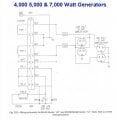
The below is what my little old 4 KW unit looks like:
Gen Ckt Basic.jpg

The Neutral and Ground are clearly bonded internal to the generator set. I think part of things is the use of the word "portable" but am not sure. The large whole house unit has 4 main wires out. Ground, Neutral, Line 1 and Line 2. So there is no internal bonding between Neutral and Ground, the bond takes place inside the house at my load center.

Ron
 

SLK001

Joined Nov 29, 2011
1,549
There is a good chance that the portable generator has a ground-neutral bond at the generator that technically, it should not have in a whole-house application.
That's where it is supposed to be. The GROUND and the NEUTRAL should be connected AT THE SOURCE. For a generator, it is the generator. For normal feed, it is at the main circuit breaker box. When you connect a generator, you HAVE to be disconnected from the main power feed.
 

MisterBill2

Joined Jan 23, 2018
27,673
The US Army defines "portable" as having carrying handles installed. Sometimes that is good for a laugh, at least until some officer asks for it to be moved. Even four STRONG MARINES are challenged trying to lift a 4000 pound generator set.
 

crutschow

Joined Mar 14, 2008
38,540
The GROUND and the NEUTRAL should be connected AT THE SOURCE. For a generator, it is the generator. For normal feed, it is at the main circuit breaker box. When you connect a generator, you HAVE to be disconnected from the main power feed.
But opening the mains breaker in the breaker box doesn't remove the GROUND-NEUTRAL connection in the box.
It only breaks the two hot leads from the main's power transformer.

I fail to see a safety issue if the generator has its internal GROUND disconnected from the NEUTRAL, with that connection maintained in the breaker box and not at the SOURCE.
 
Last edited:
Top