Question regarding creating a boost circuit, 24 to 200V for a solenoid

Thread Starter

johnvig

Joined Nov 10, 2025
10
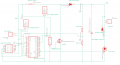
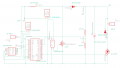
I am building a boost circuit which should boost from 24v to 200v to fire a solenoid to kick a ball. I have found the parts and put together the schematic and want to know of this would work and if there would be any parts that you would recommend to add for safety, like fuses or more capacitors and resistors, etc. I have tested in simulation and it seems to work, I have an image of the schematic here and the name of the components next to each of them. Also would like to mention that I will make a pcb out of it, so any advice on that would also be helpful, I will try to make the paths as thick as possible for the high current and close to reduce any noise and losses.

1762817176760.pngThank you in advance!
 

ronsimpson

Joined Oct 7, 2019
4,661
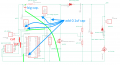
1) Q2 D is shorted to S.
2) if Q2 works right, you have some logic problems with this circuit. This needs some thinking. I think the 5V regulator will not work the way you think when Q2 is open.
3) there needs to be small caps on the power to ground pins on the Gate driver IC, and Arduino IC.
4) there needs to be small caps on the input to ground and output to ground on both voltage regulators.
5) add a large cap from Inductor pin 1 to ground.
6) D3? Are you dumping all the energy in C1 through the solenoid?
7) I have had nothing but trouble with "software PWM" code. I would think about replacing the Gate Driver IC with a real 8-pin PWM built to do this job. Then using a simple, smaller computer.
Ron S.
 

Thread Starter

johnvig

Joined Nov 10, 2025
10
1) Q2 D is shorted to S.
2) if Q2 works right, you have some logic problems with this circuit. This needs some thinking. I think the 5V regulator will not work the way you think when Q2 is open.
3) there needs to be small caps on the power to ground pins on the Gate driver IC, and Arduino IC.
4) there needs to be small caps on the input to ground and output to ground on both voltage regulators.
5) add a large cap from Inductor pin 1 to ground.
6) D3? Are you dumping all the energy in C1 through the solenoid?
7) I have had nothing but trouble with "software PWM" code. I would think about replacing the Gate Driver IC with a real 8-pin PWM built to do this job. Then using a simple, smaller computer.
Ron S.
Hi Ron, Thank you for the detailed answer, I noticed the short now, I will correct the image to avoid confusion.
2) the simulation was done on LTspice with the main components not with the microcontroller and logic mosfet and such, but do you mean it still doesn't work? I needed the microcontroller to be supplied power at all times and I wanted it to be able to turn off and on the power to the boost circuit, if it does not work, how can I implement this?
3,4,5) I will add them, thank you!
6) yes, ive seen some projects do something similar and it seems to work, its for a very short time and to fire it at high speed.
7) I can look into that, I have the microcontroller since it needs to have some communication to raspberry pi and some motors later as well.
 

Marley

Joined Apr 4, 2016
514
I might be missing something here but why are you driving the solenoid with a thyristor? How does it commutate (turn off)? Are you expecting the current to fall below the holding current when C1 discharges? Even if you switch off the boost converter, there will still be a forward current through the inductor and D2 at 24V.
Why not simply pulse a MOSFET? If you switch off the boost converter when you energise the solenoid, C1 will discharge through the solenoid (pulling it in quickly) and the voltage will reduce to 24V when fully discharged. That could be enough voltage to hold the solenoid in. The value of C1 will depend on the time required for the solenoid to pull in. Needs to be as small as possible for quick re-charging.
When you switch off the MOSFET, re-start the boost converter to re-charge C1 for the next operation.
Also the diode in parallel with the solenoid does not need to be a schottky type. It might be difficult to get a schottky diode with a reverse voltage spec of 200V+. An ordinary silicon diode (PIV >200V) will do.
 

ronsimpson

Joined Oct 7, 2019
4,661
1) IC2 pin "GND-2" What? Something wrong.
2) Input of IC1 needs a pull-down resistor. 100k or something. When a computer first powers up most I/O pins are in tristate mode. They are not low. With out a resistor the input might float high and turn on the MOSFET for a long time. This will not be good!
2.1) Many people will add a 100k pull down resistor from Gate to Source on all MOSFETs. (both)
3) Ground pin of the 5V regulator need to move to the Ground of the computer. Like the 12V regulator. What you have now, when the MOSFET is open the ground pin will go to 24V, the 5V will go to 20V and kill many parts.
4) Agree with Marley .
4.1) I do not see the need for Q2. It complicates too many things. Move Q2 to where D3 is. You can open the bottom end of J1 at this point and not at the battery.

5) at some point we need to talk about how to make a PWM work.
1762893907617.png
 
Last edited:

Marley

Joined Apr 4, 2016
514
Yes, PWM for the boost converter. Quite possible to do this with the Arduino Nano. You have your feedback resistors in place to monitor the voltage on C1. Switch off the boost converter when C1 gets to 200V. Switch on the converter when it drops below, say 195V.
To do the PWM properly with the Nano, you really need to monitor the current in the inductor L1. Difficult to do on the 24V supply voltage. Switch on Q1, wait for the inductor current to reach a maximum value (will only take a few microseconds), switch off, inductor discharges into C1 (time will depend on the voltage on C1). When the inductor current collapses to zero, repeat the cycle. The quick and dirty method could be to simply cycle at a high frequency (100kHz?) and hope for the best. Possibly some software simulation would get you some approximate timings. Or use a switchmode boost converter IC and simply enable/disable it with the Nano. This will also have the MOSFET gate driver internally.
If you replace D3 with a MOSFET it will need a proper gate driver to charge the gate capacitance quickly. If it switches slowly you risk damaging the device (see Safe Operating Area). Also the MOSFET needs to be sized to handle the peak solenoid current.
 

MisterBill2

Joined Jan 23, 2018
27,315
Questions: How often is this system supposed to kick the ball?? Or does it get triggered to kick after some time delay? Or what??
One simpler scheme will be to be driving the mosfet with a 555 timer IC to deliver some preset amount of power, and then switch the 555 off until the voltage drops some amount. The 200 volt supply accuracy will depend on what controls the charging circuit. If the control leaves the 555 charging pulse timer off after the kick then the charge can drop low enough to let the SCR drop out of conduction. You can take out the diode and let the kickback switch off the SCR. I do not see any switch or trigger to initiate a cycle of charge and kick.
It seems that quite a few details about the system operation are not given to us.
 
Last edited:

Thread Starter

johnvig

Joined Nov 10, 2025
10
I might be missing something here but why are you driving the solenoid with a thyristor? How does it commutate (turn off)? Are you expecting the current to fall below the holding current when C1 discharges? Even if you switch off the boost converter, there will still be a forward current through the inductor and D2 at 24V.
Why not simply pulse a MOSFET? If you switch off the boost converter when you energise the solenoid, C1 will discharge through the solenoid (pulling it in quickly) and the voltage will reduce to 24V when fully discharged. That could be enough voltage to hold the solenoid in. The value of C1 will depend on the time required for the solenoid to pull in. Needs to be as small as possible for quick re-charging.
When you switch off the MOSFET, re-start the boost converter to re-charge C1 for the next operation.
Also the diode in parallel with the solenoid does not need to be a schottky type. It might be difficult to get a schottky diode with a reverse voltage spec of 200V+. An ordinary silicon diode (PIV >200V) will do.
Thank you for your comment, I was looking for ways to control the transfer of power to the solenoid and saw that an thyrister is best for high voltage application and these sort of dumping of power, but I realize to turn off the current needs to be close to zero and that might not happen or take too long, so would you recommend another mosfet and gate driver like before? Also the goal is to kick a ball and return right after, so there is no need to hold, and it is for a robocup ssl competition. my idea was that I will start the charging and once the charging is complete, I will turn of the swithcing mosfet, the main supply from the battery and then fire the solenoid.
 

Thread Starter

johnvig

Joined Nov 10, 2025
10
1) IC2 pin "GND-2" What? Something wrong.
2) Input of IC1 needs a pull-down resistor. 100k or something. When a computer first powers up most I/O pins are in tristate mode. They are not low. With out a resistor the input might float high and turn on the MOSFET for a long time. This will not be good!
2.1) Many people will add a 100k pull down resistor from Gate to Source on all MOSFETs. (both)
3) Ground pin of the 5V regulator need to move to the Ground of the computer. Like the 12V regulator. What you have now, when the MOSFET is open the ground pin will go to 24V, the 5V will go to 20V and kill many parts.
4) Agree with Marley .
4.1) I do not see the need for Q2. It complicates too many things. Move Q2 to where D3 is. You can open the bottom end of J1 at this point and not at the battery.

5) at some point we need to talk about how to make a PWM work.
View attachment 358721
Thank you for the your detailed comments and markings
1) that part was incorrect, I have now fixed it.
2)2.1)makes sense I will add it.
3) the part with the logic level mosfet (Q2) was that I can turn off the power to the boost converter but still have power on the arduino, so I was looking for ways to connect directly to the battery, but if I change it to the way you mentioned, then say Q2 is conducting and if I try to turn it off, it will disconnect the path back to the battery and turn of the microcontroller right?

4) again the goal with q1 was being able to turn of the boost converter when needed, but maybe if it complicates too much, I can have a physical switch and just leave q1 off so the cap stays at 24v, there is also a bleeder resistor on the cap, so maybe there might be more power loss that way. part about moving it to D3, this mosfet wont be capable of 200v so i might then as said before find another mosfet and gate driver for it.

5) I had found this article http://uzzors2k.com/index.php?page=450vboostconverter would this solve my issues? maybe I can switch to a similar circuit. any thoughts on this?
 

Thread Starter

johnvig

Joined Nov 10, 2025
10
Yes, PWM for the boost converter. Quite possible to do this with the Arduino Nano. You have your feedback resistors in place to monitor the voltage on C1. Switch off the boost converter when C1 gets to 200V. Switch on the converter when it drops below, say 195V.
To do the PWM properly with the Nano, you really need to monitor the current in the inductor L1. Difficult to do on the 24V supply voltage. Switch on Q1, wait for the inductor current to reach a maximum value (will only take a few microseconds), switch off, inductor discharges into C1 (time will depend on the voltage on C1). When the inductor current collapses to zero, repeat the cycle. The quick and dirty method could be to simply cycle at a high frequency (100kHz?) and hope for the best. Possibly some software simulation would get you some approximate timings. Or use a switchmode boost converter IC and simply enable/disable it with the Nano. This will also have the MOSFET gate driver internally.
If you replace D3 with a MOSFET it will need a proper gate driver to charge the gate capacitance quickly. If it switches slowly you risk damaging the device (see Safe Operating Area). Also the MOSFET needs to be sized to handle the peak solenoid current.
Thank you for the points, currently my plan was to just use 100khz and when it reaches the voltage stop, I can look into monitoring the current as well.
 

Thread Starter

johnvig

Joined Nov 10, 2025
10
Questions: How often is this system supposed to kick the ball?? Or does it get triggered to kick after some time delay? Or what??
One simpler scheme will be to be driving the mosfet with a 555 timer IC to deliver some preset amount of power, and then switch the 555 off until the voltage drops some amount. The 200 volt supply accuracy will depend on what controls the charging circuit. If the control leaves the 555 charging pulse timer off after the kick then the charge can drop low enough to let the SCR drop out of conduction. You can take out the diode and let the kickback switch off the SCR. I do not see any switch or trigger to initiate a cycle of charge and kick.
It seems that quite a few details about the system operation are not given to us.
not so often, say once in 2 -3 minutes or maybe more often, the plan would be to start the charge 5 seconds or so before to be sure and kick when needed. as I wrote before I found this article http://uzzors2k.com/index.php?page=450vboostconverter maybe using this idea and having the nano turn this circuit on and off might work better
 

Papabravo

Joined Feb 24, 2006
22,065
One of the more obscure features of the plain vanilla boost technology is the difficulty of obtaining and maintaining high boost ratios. The slope of the boost ratio as a function of duty cycle goes near vertical in the neighborhood of boost ratios of 8 or 9. This makes output regulation extremely sensitive and EXTREMELY difficult to maintain. You might do well to consider a different topology.

Reference: Basso, Christophe P., Switch-Mode Power Supplies, 2nd Ed., 2014, Figure 1.53, p.48-49, and the following quote:

"We will see later that boost conversion ratios above 4 to 5 are difficult to obtain as soon as some output current is needed."
 
Last edited:

ronsimpson

Joined Oct 7, 2019
4,661
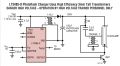
Here is a thought for you. This is a flash circuit for a camera. Remove the "flashlamp and trigger transformer and you have almost what you need. The IGBT on the bottom turns on the current to your solenoid. The drawback is the 8V max input voltage, and the current level is low. I can find the transformers for you.
1762992802995.png
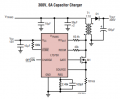
Here is a high-power version with 24V max input. We can make changes for lower power. I can change to 200V output.
1762993046176.png
If you can wait 1 minute to charge up the cap we can do a low power PWM. If you want me to try either circuit charging an 1800uF cap I might have time tomorrow.
------------------------edited-----------
1.2 seconds to charge up 1800uF to 200V using the circuit in the data sheet. LT3750
Using the photo flash LT3485-3 running from the 5V supply your micro is on, it charges from 0V to 200V in 18 seconds. It starts charging when you tell it to and signals back when done. It drives the IGBT or MOSFET when you tell it to. Very simple circuit.
 
Last edited:

MisterBill2

Joined Jan 23, 2018
27,315
How closely does the solenoid voltage need to be regulated, anyway?? The simplest and least critical power supply will be an inverter, possibly utilizing a transformer from a discarded UPS. AND it would include the ttransistors to drive the transformer. ANDan inverter is simpler to get working than a switcher supply.
 

panic mode

Joined Oct 10, 2011
4,933
IC4 cannot be 7805. arduino nano already has 5V regulator and that one going to need more than 5V to get 5V to MCU
so IC4s need to be changed to 7809 or 7810 or... just remove it and take 12V from the other regulator...

but ...

keep in mind that Arduino regulator is AMS1117 which has pretty low input range. so do not tro to connect 15V or higher to it. it need to 2-3V higher than 5V but should not go over 12V
 
Last edited:

MisterBill2

Joined Jan 23, 2018
27,315
How about a mosfet FLYBACK booster circuit, with the flyback driver controlled by the voltage sensor system. So it would charge up, switch off and wait to trigger, and then after triggering switch the trigger back on.
 

Thread Starter

johnvig

Joined Nov 10, 2025
10
Here is a thought for you. This is a flash circuit for a camera. Remove the "flashlamp and trigger transformer and you have almost what you need. The IGBT on the bottom turns on the current to your solenoid. The drawback is the 8V max input voltage, and the current level is low. I can find the transformers for you.
View attachment 358765
Here is a high-power version with 24V max input. We can make changes for lower power. I can change to 200V output.
View attachment 358766
If you can wait 1 minute to charge up the cap we can do a low power PWM. If you want me to try either circuit charging an 1800uF cap I might have time tomorrow.
------------------------edited-----------
1.2 seconds to charge up 1800uF to 200V using the circuit in the data sheet. LT3750
Using the photo flash LT3485-3 running from the 5V supply your micro is on, it charges from 0V to 200V in 18 seconds. It starts charging when you tell it to and signals back when done. It drives the IGBT or MOSFET when you tell it to. Very simple circuit.

Sorry for the late reply, thank you for all the help!!, This feels like a much better solution, I had difficulties finding transformers that fit, in mouser, but I also saw your later reply, I will try to simulate the circuit using that IC myself. and look into the datasheet of both of these circuits
 
Top