Count down timer for my soccer club

elec_mech

Joined Nov 12, 2008
1,500
At the end of the day, these laptops will be placed in a cabinet and left to re-charge overnight. This will be when they are off.
Ah, now I understand.

Hmm, that's a little of a gamble depending on the max rate of charge. My advice then would be a single dedicated 15A receptacle with nothing else on the circuit. At 500mA, you're only pulling 8A max, but if for some reason the batteries are completely drained and the charger pulls a higher current - better safe than sorry. I'm not well versed with what limits laptop manufacturers put on current draw with respect to recharging batteries. 10A would probably be okay, but 15A gives you a margin of safety. Hope that helps.
 

Wendy

Joined Mar 24, 2008
23,797
I did take a look at this before buying the LM317's (just by chance). Your article is what made be decide to go that way to regulate the voltage.

My 24V supply is a "switching" power supply. Is that classed an SMPS?
yes
Your cost for 1/4W are really cheap. I did however buy 1000 units for my digits for only $10 from rockby electronics. Reason I think is because I bought a full box.
What can I say, I'm spoiled
Back on the PWM for a minute if I can. I wired up circuit #2 with a few adjustments to POTs and got the intensity changes I was after. No heat anywhere so far. Excellent. I did however pop an electrolytic experimenting a bit - boy what a bang!

I've only hooked up 2 digits so far (so max of 1.4A) - via my temperature sensor circuit. The problem I'm seeing is that when the LEDs are "dim", then the ones that are supposed to be fully off, are "just glowing". Just as a reminder, the digits are common anode. The PWM feeds the common. The segments are fed directly via the ULN2003a's. It "feels" as if I need to use a pull up or pull down resistor somewhere. Any ideas?
Try maxing out the light level (a bright flashlight on the sensor, or simply short the LDR with a wire) and see what the voltage levels are. You should get the full power supply voltage on the other side of the MOSFET drain.
 

Thread Starter

chrischrischris

Joined Feb 18, 2012
317
Elec_mech - thanks for that.

Yea, I had the laptop fully drained with I measured it re-charging whilst off. The sparky is installing 15A power points, however it is more the "optional extras" we can buy with the cabinet. It's an "ECO power safe" unit. This unit is designed to turn on half the laptops at a time with a 1 minute interval in between. However by my calculations 1/2 of them only draw around 3A so why the ECO safe. I think the supplier is just trying to rip us off buying something we don't need. I assume most people buying these cabinets wouldn't have the know how to do the power consumption calculations, hence buy the unit.

Bill,
on full power the LEDs work well. Yes I have a small LED driven flash light. I turn the light off in the room - LEDs go dim. I then "wave" the flashlight over the LDR and they go really bright - it works a treat. The voltage at the drain is around 12V in the dark and 23.70V with the torch pointed directly at the LDR.
 

Thread Starter

chrischrischris

Joined Feb 18, 2012
317
When the LDR drops the voltage, hence the LED intensity (i.e. voltage is around 12V supply), the LED segments that are supposed to be on are correct intensity. It's the segments that are not supposed to be on that infact are on (however very dim).

For example if the number "1" is on, then segments "b" and "c" are on correctly. However segments "a", "d", "e", "f" and "g" are also on, but very, dim. They should be fully off. Any ideas why and how to fix that?
 

Wendy

Joined Mar 24, 2008
23,797
At the moment, no, but let me think on it. Is this with all the digits?

Time to review past schematics, to look at the mechanism that is turning the LEDs off.
 

Thread Starter

chrischrischris

Joined Feb 18, 2012
317
Currently I'm still only running 2 digits. I'm just trying to sort out how to run cabling on the score board via the ribbon cable. The display problem is happening on both digits.

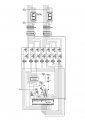
I'll attach a copy of the circuit that's feeding it.
Temperature with large digits_d.jpg
 
Last edited:

Wendy

Joined Mar 24, 2008
23,797
Does this happen at full brightness too?

If you remove the dimmer circuit (the MOSFET) does it do this?

LEDs are nonlinear on brightness, even the slightest current will cause some glow. It doesn't have to be much.

Right now I'm trying to establish whether it is part of the dimmer, or more generic.

An experiment, connect a 10KΩ to ground on one of the PNP collectors. Lets see if that makes a difference.


Attachments

Last edited:

Thread Starter

chrischrischris

Joined Feb 18, 2012
317
It's dim glow only cuts off when I reach full brightness (probably somewhere between 95 to 100% brightness (i.e. around 23.5V). So between 12V and 23.5V then dimly glow.

I did already try to pull down the collector of one of the segments via the collector via a 10K. No visible change. With a 1K resistor, it brought the dim glow to about 2/3 - still not good. I tried also to pull down the voltage at the base of the PNPs - no good.

I measure the voltage at the collector - 78mV, whereas it is 4.45V on the emitter.

I already tried without the dimmer circuit, however it only goes full brightness, so can't really test the problem. With a resistor on the supply feeding directly it does work however.

Hey, I just put a 47uF electrolytic and 0.1uF cap across the supply and the dim has dissapeared!!! I had one across the 5V, so I thought I'd try the same on the 24V. Is this ok? If yes, should the values be something else?
 

Thread Starter

chrischrischris

Joined Feb 18, 2012
317
Actually, with the electrolytic I've half fixed it at this stage.

Depending on where I place the electrolytic (either 47uF or 100uF) as well as the ceramic cap (0.1uF), I either get it working, blinking, reading the wrong temperature, etc. There seems to be no stable position.

By different point on the power rail, I mean closer to the PWM mosfet or the 24V supply or the 555 or LM393, etc.

Maybe the whole "wrong number thing" is due to lack of 0.1uF caps???
 

Thread Starter

chrischrischris

Joined Feb 18, 2012
317
It definately seems to be something to do with a lack of decoupling capacitor.

If I insert a 47uF electrolytic and 100nF ceramic across Vcc and Gnd, depending upon where I place it I get different effects. In some places on the rail it works in others it doesn't - guess work.

To add to the complication, in some positions the leds blink every say second at random as if shutting down due to overload. Also a complication, the temperature sometimes jumps from say 20 celcius to 60 something??

I'm drawing 5V off a few places across the rails and moving the decoupling to different locations has different effects. I "thought" it should be as close to the "power source" as possible. In other positions on the rails it doesn't turn off the dim leds - maybe because it is near another drain source?
 

Wendy

Joined Mar 24, 2008
23,797
OK, part of the problem is probably timing. I've seen similar with other multiplexed circuits. Problem is, that schematic does not look multiplexed.

Try a different section, we can come back to this one.
 

Thread Starter

chrischrischris

Joined Feb 18, 2012
317
Yea, no problems. I'll come back to it.
I'm now drawing up the steel frame for the board and then I'll make the looms to connect all the circuits (correct length). I'm using 14 core ribbon cable. I assume there's no problem cable tieing them to the steel channel that I make. I'm also designing it so that ventilation can go from the base through the top (but still vermin proof and water proof).

When I've made the looms, I'll test all the circuits together. Fingers crossed they all work together (except the temperature that's a little off at the moment).
 

Wendy

Joined Mar 24, 2008
23,797
Just occurred to me, try adding that PI filter we talked about about a month ago between the LEDs and PWM circuit. Can't hurt, might help.
 

elec_mech

Joined Nov 12, 2008
1,500
I've only hooked up 2 digits so far (so max of 1.4A) - via my temperature sensor circuit. The problem I'm seeing is that when the LEDs are "dim", then the ones that are supposed to be fully off, are "just glowing". Just as a reminder, the digits are common anode. The PWM feeds the common. The segments are fed directly via the ULN2003a's. It "feels" as if I need to use a pull up or pull down resistor somewhere. Any ideas?
Sorry for the delay, I've been studying the circuit in post #247 and re-reading posts to a point.

Bill asked this, but I don't think it was answered (or I missed it) - is the dimming only present when the dimming circuit is connected? In other words, if you remove the dimmer portion and wire things exactly as the schematic in post #247, do the "off" segment still appear dim or not?

I did already try to pull down the collector of one of the segments via the collector via a 10K. No visible change. With a 1K resistor, it brought the dim glow to about 2/3 - still not good. I tried also to pull down the voltage at the base of the PNPs - no good.
PNPs are off when the base voltage is high, not low. Remember, you're using these to invert the signal from your temp IC to drive the ULN2003's. Try putting a pull-up resistor, say 100kΩ, on the base of the PNP. Does that improve anything?

I measure the voltage at the collector - 78mV, whereas it is 4.45V on the emitter.
Could you elaborate on how you took these measurements just so I better understand? For example, red probe on collector and black on GND?

Hey, I just put a 47uF electrolytic and 0.1uF cap across the supply and the dim has dissapeared!!! I had one across the 5V, so I thought I'd try the same on the 24V. Is this ok? If yes, should the values be something else?
Be sure the capacitor's voltage is double or more of the working voltage to be safe. For 24VDC, use a 50VDC or higher cap if possible. Looks like you have a noise problem here.

Maybe the whole "wrong number thing" is due to lack of 0.1uF caps???
0.1uF caps should be as close to the power inputs to each and every CMOS IC. I notice there isn't one on the CD4009. I'd also put one on the temp IC too.

I "thought" it should be as close to the "power source" as possible.
Generally, you should have an electrolytic and a cermanic, for low and high frequencies (noise, power surges, etc.), respectively, at your input supply (where the power comes into your circuit). You need ceramic caps across the power inputs of any and all CMOS ICs as they are known for generating noise. 555 should have a ceramic and electrolytic if my memory serves me from what I learned from SgtWookie.

Now, that just covers the basics and assumes low frequencies and that everything is on the same board and fairly close together. Throw in high frequencies from your dimmer circuit and distances between power supplies, multiple circuits, etc. and now you need more filtering from noise.

If your power supply input is more than a few inches apart from the farthest circuit, you should add another electrolytic and ceramic cap to each circuit to compensate for noise due to long traces or wires. These can act as an antenna and pick up noise from external sources such as fluorescent lights, radio waves, etc.

You mentioned using ribbon cables. How long are these and from what point in your circuit to the next are they located? Are these carrying the PWM signal? I'd have to know more, but wires run next to each other can pick up noise from each other. A high frequency signal from one wire could be picked up and be seen as noise in another wire. I don't think you'll have to go this far, but if you determine this is contributing to your problem, you'll want to twist the wires together in pairs and perhaps put them in a shield/braid.

This is based on my very limited knowledge and understanding on the subject, so do not assume it is 100% correct.

If you could provide a complete schematic, at least entailing all the circuits, wire runs, distances apart, etc. connected to the problem, I could review it as a whole and perhaps offer further assistance.

Hope this helps some.
 

Thread Starter

chrischrischris

Joined Feb 18, 2012
317
Bill asked this, but I don't think it was answered (or I missed it) - is the dimming only present when the dimming circuit is connected? In other words, if you remove the dimmer portion and wire things exactly as the schematic in post #247, do the "off" segment still appear dim or not?
I did try to bypass the PWM circuit - noted in post 249. At full voltage, no problems. However to reduce voltage, best I could do was add a resistor on the Vcc feed - it didn't glow.

It definately has something to do with a decoupling capacitor setup, as I did find this eliminated it.

Thanks for the heads up on electrolytics rated at twice voltage - hence 47uF/50V plus the 0.1 ceramic.

I'll try the pull up with the 100kΩ on the weekend and see if that works. Got to go to work soon.

Could you elaborate on how you took these measurements just so I better understand? For example, red probe on collector and black on GND?
Sorry, the 4.45V may have infact been have been -4.45. I'll have to check again. Maybe probes back to front.

0.1uF caps across Vcc to the CD4009 and 7107 - yes I'll do that and see if it helps the "random" temperature numbers. Funny, because when I power on the temp circuit and the correct voltage appears (sasy 20c), it work perfectly. I hold the LM35 temp sensor with my fingers and it displays an increase in temperature, however when the random is random (i.e. such as 60 instead of 20), holding the temperature sensor has no effect.

The 555 I don't think is noisy, but I'll try that too - ceramic cap. No harm I suppose.

If your power supply input is more than a few inches apart from the farthest circuit...
Yes, it is, and this is what I think is a problem. To start with, I'm feeding 5V into the PWM circuit. From that I've got 2 wires about 10" long that feed the temperature circuit. I think I have to neaten my breadboard a little first, then be a little more systematic.

You mentioned using ribbon cables. How long are these...
I'm just designing the layout now. Rather than describing, I'll post the layout this weekend. The board is around 3.6m wide x 2.4m high (on poles). Sorry, 12' x 8'. The circuits are near the middle bottom. The digits are on the top right and left corners as well as bottom right and left. So lengths can be as long as 6' to 7'.

The PWM signal is going to the common of each digit. Yes, I'm wondering what it will do with the distance. Maybe it does need shielding. And I'm wondering what it will do when I tie the cables to the steel channels. I could run them on another path so they don't run with the ribbon cable.
 

Wendy

Joined Mar 24, 2008
23,797
When it is all said and done I may have to build some of this circuitry to understand the problem (I am sure I can duplicate it in general). Not my first choice, but definitely an option.
 

Thread Starter

chrischrischris

Joined Feb 18, 2012
317
Bill, don't bother with the circuits (thanks for the offer however). Let me do some more experimenting first.

I am just about finished with drawing up the framing. I'll then try cut a couple of 3m length ribbon control cables and well as a couple of power cables. I'll then test each circuit with 1 or 2 of these cables and see what happens. I hopefully will have some time Sunday or early next week. I'll let you know how it goes.
 
Top