Not on that style of meter. That is part of the reason for the two large terminal posts, because often they support the meter "movement." Not always, but often.Military meters have to withstand a lot more vibration.
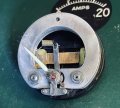
In the pictures in post #14 I think the thing that looks like a coiled spring could be the connection to the basic meter.if you unsolder the right hand end and do a resistance test between one of the terminals on the back of the meter and the right hand end end of the spring it would tell you if it is one end of the basic meter. If the reading is a few tens of ohms then it is one sise of the basic meter. If it is close to zero it goes to the shunt. I that case I think the solder tag that you unsoldered it from is one side of the basic meter. If this solder tag makes contact with the shunt where it crosses it then I think this could be moved to adjust the current calibration. (Tapping of from a different point on the shunt.)
Les.
Good point MrChips if using an analogue meter. I think a digital meter will use a low enough current not to damage the meter.
An alternative would be to pass a curreny of about 100 uA (Both polarities.) ant see if the needle moves.
Les.
Update: Just getting back to this, first, thanks for all the thoughtful responses! I wish to report that I have had success! From my old stash of Air Force parts from '68-72, I tried a small 20K pot, following MisterBil2's advice, placing series resistance on one terminal and I bypassed the other terminal (and shunt). I tried the pot at 20K, had just a hint of movement using a 9v battery.. Going down in several steps ending up at 1K, I was able to read 9v. on the meter!!! Now, to try to take the shunt out or carefully cut it somehow. I just can't see a way to get it apart any further to unsolder it.
Maybe a possibility is to cut the shunt with a sharp craft knife. It rather depends on the thickness of the shunt. It might be doable at 20A as I suspect it might be a thin sheet, but anything over a couple of hundred microns could be tough. Cut on the right side, so that the spring connection is not disturbed.
Update: To cut the shunt I tried a sharp craft knife, bigger sharp craft knife, and then utility knife. . . I found that the fine wire was wound around metal, possibly copper but it was very hard to cut. I ended up using sharp diagonal wire cutters, we called them "dikes" back in the AF days. Those worked with effort. Now, using a small 12v. car battery this time, I ended up with a 560Ω resistor in series to read close, on the meter scale. This meter needle, like another military amp meter I have, is "bouncy" at rest, and when reading voltage, so I assume that is normal and does not bother me too much. Will the resistor size I use matter? I only have 1/4w resistors in that value and somehow the nice little 2KΩ pot I had is hiding in my workshop somewhere, damned if I can find it now. Thanks in advance! Tom L.
Consider that with an internal shunt ammeter, the full current voltage drop should not be more than 0.10 volts, then the full scale meter voltage would be 0.10 volts, so
the 19.9 volts will be dropped across the series resistor. So the power will not be very much. And the unintended secondary result is that with an over-voltage, the resistor should fail instead of the meter. A cheap fuse of sorts.
I do see that and consider that at 12 volts the current will be less. At 20 volts the resistor is overheating, but since in an automotive system 20 volts means a serious problem, protecting the meter by failing open is the best plan.
@12V, P=12x12/560=144/560=0.2571W, which is about 1/4 watt.
I do see that and consider that at 12 volts the current will be less. At 20 volts the resistor is overheating, but since in an automotive system 20 volts means a serious problem, protecting the meter by failing open is the best plan.
@12V, P=12x12/560=144/560=0.2571W, which is about 1/4 watt.

 Facebook
 Google
 GitHub
 Linkedin