Conversion of DC Motor TTL Encoder Signal to Tachometer Analog Signal

Thread Starter

John Dimero

Joined Sep 18, 2024
6
Currently, in our system, we have an old configuration of DC Motor with tachometer configuration. The tacho signal is an analog signal that act as a feedback signal for speed monitoring and control. Since, we're moving our DC motor to a different design using an encoder - is there a way to convert Motor TTL Encoder Signal to analog signal just for the speed signal? Any thoughts on this? I can provide more details since we have our own custom board on this. Thanks
 

MaxHeadRoom

Joined Jul 18, 2013
30,559
If this is one of the older DC motors with a tach, they were usually used in the older voltage controlled servo amps, used in CNC/positioning etc.
The general trend was to switch over to current controlled transconductance drives which did not require the tach.
What is the controller you intend to use?
 

Thread Starter

John Dimero

Joined Sep 18, 2024
6
We have a custom board for the controls, PIC controller. The control of the DC motor speed is a typical H-bridge circuit and the tacho signal goes to a DAQ IC (with op-amp circuitry in between). The problem we're facing is how to integrate the Encoder signal of the new motor with TTL compatibility to our DAQ for feedback purposes. Or is it an option to couple 2 DC motors together and one act as a tachogenerator instead?
 

MaxHeadRoom

Joined Jul 18, 2013
30,559
I have principally converted the DC tach feedback using the type of Galil PC based controller, this is a very highly sophisticated positioning product for small scale CNC etc, they also allow the capability of slaving one axis off another, the motors or positioning device must be fitted with incremental encoders, however.
The also also very simple analogue/transconductance drives to be used.
Which makes it very easy to mix and match motors & drives.
 

Thread Starter

John Dimero

Joined Sep 18, 2024
6
1726796932525.png1726796947445.png

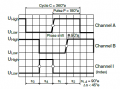
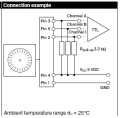
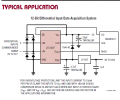
This is the encoder signal we're planning on using. Can we use 1 channel (let's say channel A - as a speed signal) as an input signal to the picture below (IC - LTC1292/LTC1297):
1726797111313.png
 

crutschow

Joined Mar 14, 2008
38,318
The LTC1297 is an A-D converter which is not what you want, if I understand correctly.
I believe you need a frequency-to-voltage converter such as the LM2917, which can be configured to give an analog voltage based on the frequency of the pulses.
That should emulate the analog tach signal from the old motor.
 

Thread Starter

John Dimero

Joined Sep 18, 2024
6
Hi crutschow, you are definitely correct. Currently, the old configuration was that we originally have an analog tach signal (analog voltage signal) --> op-amp circuit --> A-D converter for it to be interpreted in our controller. Currently, we are moving to an encoder signal - so as far as I understand, this is how it should be connected? Encoder signal --> LM2917 --> output analog tach signal --> our op-amp circuit --> A-D converter? Am i getting it correctly? Do you have a suggestion for a module for LM2917?
 

Thread Starter

John Dimero

Joined Sep 18, 2024
6
I have principally converted the DC tach feedback using the type of Galil PC based controller, this is a very highly sophisticated positioning product for small scale CNC etc, they also allow the capability of slaving one axis off another, the motors or positioning device must be fitted with incremental encoders, however.
The also also very simple analogue/transconductance drives to be used.
Which makes it very easy to mix and match motors & drives.
I've previously read some of your threads that you have an experience in coupling 2 motors together. I just want to ask the complexity of coupling them mechanically? What may be some issues that we might be seeing if we're going in this direction? So the other option is -- to couple 2 DC Maxon motors together with 1 PMDC Motor act as a tachogenerator.
 

MaxHeadRoom

Joined Jul 18, 2013
30,559
As I mentioned, The only system I have used is the Galil set up where one (or more) motors encoder is slaved off a master encoder.
The only exception was a double ended lathe that each head stock each had the identical AC motor and gear box and an identical VFD was used on each motor and worked well using the same command signal.
What is the type of machine and what application is it?
 

crutschow

Joined Mar 14, 2008
38,318
Am i getting it correctly?
Yes.
But since you have a digital signal going to the controller, could you go directly to the controller with the encoder signal and reprogram the controller to compute the speed from the pulse frequency?
One simple way it to take the reciprocal of the measured pulse interval.
Do you have a suggestion for a module for LM2917?
Google lists a bunch of frequency to voltage converter modules but I have no recommendation for a particular one.
 

MisterBill2

Joined Jan 23, 2018
27,180
Currently, in our system, we have an old configuration of DC Motor with tachometer configuration. The tacho signal is an analog signal that act as a feedback signal for speed monitoring and control. Since, we're moving our DC motor to a different design using an encoder - is there a way to convert Motor TTL Encoder Signal to analog signal just for the speed signal? Any thoughts on this? I can provide more details since we have our own custom board on this. Thanks
This is very confusing indeed!! If the motor signal is already an analog signal, why do you need to convert it to an analog signal.
OR, are you replacing the analog generator with an incremental encoder that has a TTL output, so that you lose the analog signal?? That would be my guess, which you did not state. If that is the problem, indeed, use either an LM2917 or an LM2907 tachometer IC. The difference is that the LM2917 has an internal zener diode voltage regulator, good for engine driven applications where the supply voltage varies a bit.
 

MaxHeadRoom

Joined Jul 18, 2013
30,559
I would be interested to know more details on the system being set up, much better advice could be offered with more details.
It sounds like a speed rate control system rather than any positioning involved, each requires a different approach.
 

crutschow

Joined Mar 14, 2008
38,318
are you replacing the analog generator with an incremental encoder that has a TTL output, so that you lose the analog signal?? That would be my guess, which you did not state.
Seems the statement below is reasonably clear that they are replacing the old motor with a new one that has an encoder output.
we're moving our DC motor to a different design using an encoder
 

Thread Starter

John Dimero

Joined Sep 18, 2024
6
Hi guys @MaxHeadRoom @crutschow @MisterBill2,

Thanks for your input guys! I have a clearer picture now on the possible solution for our replacement of old configuration of motor (motor + tacho signal feedback analog) and our existing board circuit that reads the analog signal for speed of the motor. So from what I understand, I can tackle this problem in:
Solution 1: DC Motor + Encoder with TTL signal --> Since its already digital signal, can be interpreted directly from the controller - just need reprogramming.
Solution 2: DC Motor + Encoder with TTL signal +LM2917/LM2907/Frequency Voltage Converter --> directly connect to controller since the input is converted to analog signal
Solution 3: DC Motor + PMDC motor (that acts as a tachogenerator) to couple mechanically to output analog signal --> directly connect to controller.

Am i interpreting it correctly? Thanks so much for your input, i apologize if I haven't made it clear in some of my statements
 

MisterBill2

Joined Jan 23, 2018
27,180
OK, so now the big question is about the driver for the motor in the intended driver for the new DC motor with the encoder and not a tachometer generator. Is the intention to use the same controller/driver?? The one that was used with the tacho GENERATOR that produced a DC output proportional to RPMs??
Do you still need a visual RPM display ??
 

MisterBill2

Joined Jan 23, 2018
27,180
If the application were for positioning then with the analog speed feedback there would also be a position feedback sensor, which has not been mentioned. Positioning using an analog speed signal is certainly very demanding of a perfect control system.
Thus a logical guess is that it is a speed control system.
 
Top