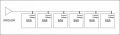
The effective resistance of the LM555 control voltage input is 3.3k so six of them in parallel would be 550Ω. As the (uncontrolled) voltage is /2 VCC, the worst case current would be pulling the control pin down to ground. That current increases as the supply voltage increases.
The permissible output current for the OPA551 decreases with increasing supply voltage - see the safe operating area of the data sheet. So whether it will work depends on the supply voltages of the two chip types.
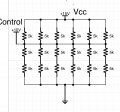
The control voltage pin is connected to a string of three 5k resistors. The string is a voltage divider between Vcc and ground. So, each is a 10k load to ground. Your op amp is only driving an equivalent of 1666 ohms. As you said, no sweat (especially since that op amp is capable of 200 mA,).
The control voltage pin is connected to a string of three 5k resistors. The string is a voltage divider between Vcc and ground. So, each is a 10k load to ground. Your op amp is only driving an equivalent of 1666 ohms. As you said, no sweat (especially since that op amp is capable of 200 mA,).
I see worst case scenario as 1666 ohms equivalence seen by the op amp in the OP's circuit if he applies Vcc to pin 5 of the 555s. If he stays within the recommended operating range of the 555 control pin, then I calculate 6111 ohms equivalent load in the op amp.
Where (how) do you get to 3.3k as the load on the op amp for 6 parallel 555 timers?
Ha, how does that account current being sourced/sunk by an EXTERNAL supply to the node? By your logic, a Wheatstone bridge would never work.
If the op amp's output is set to 10v (control voltage to pin 5), and the Vcc of the 555 timer is 15V, no current will flow in/out of the op amp (infinite resistance seen by the op amp).
If the control voltage is set to 15V, the current from Vcc stops (no flow through the top resistor to the control pin.
Also, the op amp will see 6 x 10k resistors as a load (1666 ohms) draws 9mA.
On the other extreme, which I did not consider before, is setting the control voltage to 0V. In that case, it would cause an 18mA sink into the op amp (equivalent to 833 ohms load).
I don't see it has any relevance to a wheatstone bridge. At the balance point (the only point which really matters) there is no current flowing from the (effectively) potential dividers.
I don't see it has any relevance to a wheatstone bridge. At the balance point (the only point which really matters) there is no current flowing from the (effectively) potential dividers.
Ok, you don't like my Wheatstonebridge analogy, do you agree with my load on the op amp calculations? Or do you stick with your number of 3.3k as the effective load?
Ok, you don't like my Wheatstonebridge analogy, do you agree with my load on the op amp calculations? Or do you stick with your number of 3.3k as the effective load?
With the control input at 0V, the sink current is 3mA per '555. That is for a change of voltage on the control pin of 10V. Therefore the impedance seen by the op-amp is 10V/3mA = 3.3k.
With the control input at 0V, the sink current is 3mA per '555. That is for a change of voltage on the control pin of 10V. Therefore the impedance seen by the op-amp is 10V/3mA = 3.3k.
I agree with 3mA "per op amp" when Vcc on the 555 is 15 v. However...
When Vcc on the 555 timer is 15v and the control voltage is 0V, no point in the chain will be at "10V" when the op amp pulls the control pin down to zero volts. The 3mA per 555 is calculated as 15v/5k ohms = 3mA.
(No current will flow from control pin through the other two 5k resistors in that series string).
Now, with 3mA from each control pin (6 chips) is a total of 18mA into the Op Amp
Or, equivalent load from Vcc of 833 ohms calculated as either: 15v / 0.018A = 833 ohms, or
5k ohms per timer divided by 6 timers = 833. (5k because current only flows through the top 5k resistor when op amp pulls control pin to 0V).

 Facebook
 Google
 GitHub
 Linkedin