Constant phase shifters

drjohsmith

Joined Dec 13, 2021
1,601
So your looking at a classic all pass circuit
https://en.wikipedia.org/wiki/All-pass_filter
In analog, These rely upon the capacitive element of a low / high pass frequency selective element to make the delay frequency dependent , giving a phase shift thats fairly constant over the frequency band .as seen in wiki
Phase shift is between 90 and 180 degrees
You have simulated , and these behave wonderfully
In real circuits you have patasitic and stray impedances , that makes them far from linear.
Realistic range is around 45 degrees .
Now digital , yep you can make "as near perfect" as you want all pass filteres.
But that's a much different topic
 

MisterBill2

Joined Jan 23, 2018
27,523
Now, returning to the original question:
"Would a shifter that shifts +135 deg. over a decade range in the audio frequency spectrum be possible? The angle must be +/- 135 deg., not 90 deg. that I know can be done."
What is the purpose for that amount of phase shift??
I know that 3PHASE power is usually 120 degrees, , except sometimes when a "teaser phase" has been utilized to drive a 3-phase motor.
BUT 135 degrees is a puzzle.
 

MisterBill2

Joined Jan 23, 2018
27,523
As the OP doesn't want to tell us the super-secret application, we my never know.
Perhaps it's for some "over unity" project. :rolleyes:
What the ts STATED, TO QUOTE: " That would be very complicated to answer and I don't think that it would contribute to being able to answer my question. Since you asked I would do if tor you, but it would unnecessarily make the discussion more complicated in my opinion. " So it Probably is some sort of secret project. Possibly related to the "broadcast industry" somehow. OR adding a "Secure Communications Channel" to some communications service. Like phase-shift digital data sent on top of a talk radio station. That was done with carrier FSK on some clear channel stations back in the cold war era. Secure "comm channel" on top of a broadcast station. Hidden in plain sight!!
 

Thread Starter

PeteHL

Joined Dec 17, 2014
580
At the same time?
Absolutely. Any complex signal can be resolved into sine wave components processed separately and then the output is the summation of the components. This follows from what Fourier established if I'm not mistaken. However I don't have any formal training (or very little) in electronics. It would be good if an engineer here at AAC would chime in on this.
 

Thread Starter

PeteHL

Joined Dec 17, 2014
580
As the OP doesn't want to tell us the super-secret application, we my never know.
Perhaps it's for some "over unity" project. :rolleyes:
It would take a lot of effort on my part to communicate what I'm working on and would be off topic from what I wanted to learn about. But I will give away a lot about it by saying that no, it isn't an attempt to find a source of free energy if that is what you mean.
 

MisterBill2

Joined Jan 23, 2018
27,523
I doubt that is anything that will affect us in a negative way, and thus the interest that I have is only acedemic.
 
Last edited:

BobTPH

Joined Jun 5, 2013
11,516
Absolutely. Any complex signal can be resolved into sine wave components processed separately and then the output is the summation of the components.
Please show us the analog circuit that resolves an analog waveform into its Fourier components for separate processing.
 

Thread Starter

PeteHL

Joined Dec 17, 2014
580
Please show us the analog circuit that resolves an analog waveform into its Fourier components for separate processing.
If the waveform of a complex signal at the output of an all-pass filter is identical to that of the input signal, then it follows that all of the sine wave components making up the complex signal have been equally phase- shifted by the filter. If some of the sine waves making up the complex signal were outside the operational bandwidth of the all-pass filter, then at the output of the filter the waveform would be distorted.

The frequency of a complex signal equals the frequency of its component-sine wave that is lowest in frequency. This means that if a complex signal is sent through an all-pass filter with no distortion, then all of the other components of the signal have been equally phase-shifted.
 

drjohsmith

Joined Dec 13, 2021
1,601
Thought experiment
If I had two frequencies , say 1 Khz and 2 Khz
Both in phase ,i.e the zero crossing of the 1 Khz always alignes with alternate 2 Khz peeks.
Put this through an all pass filter, assume filter is linear etc at these frequencies.
What comes out ?
Are the two waveforms still aligned at the zero crossing points ?
 

Thread Starter

PeteHL

Joined Dec 17, 2014
580
Okay.
Using two all-pass phase-shift filters do appear to give a constant shift between the two outputs within that frequency range.

But you need the phase-shift from the input to the output, right?
Or can you use the difference in the phase-shift from the two signals you generated?
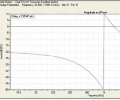
For what I'm doing, I DO need shifting referenced to phase of the input signal. So in the constant phase shifter of my post #29, the positive phase shifter I believe is causing me difficulties because it shifts less negative with increasing frequency.
 

BobTPH

Joined Jun 5, 2013
11,516
If the waveform of a complex signal at the output of an all-pass filter is identical to that of the input signal, then it follows that all of the sine wave components making up the complex signal have been equally phase- shifted by the filter. If some of the sine waves making up the complex signal were outside the operational bandwidth of the all-pass filter, then at the output of the filter the waveform would be distorted.

The frequency of a complex signal equals the frequency of its component-sine wave that is lowest in frequency. This means that if a complex signal is sent through an all-pass filter with no distortion, then all of the other components of the signal have been equally phase-shifted.
‘Fraid not. Here is the Google response:
No, an all-pass filter does not preserve the shape of the input waveform.
While it keeps the volume (amplitude) of all frequencies exactly the same, it changes the timing (phase) of those frequencies. Because a complex waveform is made of multiple frequencies stacked together, shifting their timing changes how they add up, which alters the final visual shape of the wave.
 

Attachments

Thread Starter

PeteHL

Joined Dec 17, 2014
580
‘Fraid not. Here is the Google response:
It always pays to do some thinking before you open your mouth. A constant phase shift isn't the same as a time delay of a certain constant time period. A phase delay of -90 deg. of a 1 kHz sine wave would delay the wave by 1/4 times the period at 1 kHz equal to 1 mS, that is, 0.25 mS. The same phase delay, -90 deg,, of a 2 kHz sine wave is equal to half of that of the 1 kHz sine wave or 0.125 mS. So we have two unequal time delays resulting in a different summation following the constant phase shift of -90 deg.
 

MisterBill2

Joined Jan 23, 2018
27,523
To provide a settable and repeatable phase shift of audio frequencies (20 Hz to ten KHZ), an old friend, the sine/cosine resolver, excited in both the sine and cosine phases, should provide the required shift, between zero and 90 degrees.
 

BobTPH

Joined Jun 5, 2013
11,516
It always pays to do some thinking before you open your mouth. A constant phase shift isn't the same as a time delay of a certain constant time period. A phase delay of -90 deg. of a 1 kHz sine wave would delay the wave by 1/4 times the period at 1 kHz equal to 1 mS, that is, 0.25 mS. The same phase delay, -90 deg,, of a 2 kHz sine wave is equal to half of that of the 1 kHz sine wave or 0.125 mS. So we have two unequal time delays resulting in a different summation following the constant phase shift of -90 deg.
The question was about an all-pass filter, not a constant phase shift for all frequencies, which you have not provided a circuit for. You seem to think there is such an analog circuit. If so, please show us.
 
Last edited:
Top